

Some have questioned how much thought was put into the policy, as the US confusingly continues restricting less advanced AI chips (like the A100 and H100) while green-lighting H200 sales. Trump’s Justice Department also seems to be struggling to keep up. The NYT noted that just “hours before” Trump announced the policy change, the DOJ announced “it had detained two people for selling those chips to the country.”
The chair of the Select Committee on Competition with China, Rep. John Moolenaar (R-Mich.), warned on X that the news wouldn’t be good for the US or Nvidia. First, the Chinese Communist Party “will use these highly advanced chips to strengthen its military capabilities and totalitarian surveillance,” he suggested. And second, “Nvidia should be under no illusions—China will rip off its technology, mass produce it themselves, and seek to end Nvidia as a competitor.”
“That is China’s playbook and it is using it in every critical industry,” Moolenaar said.
House Democrats on committees dealing with foreign affairs and competition with China echoed those concerns, The Hill reported, warning that “under this administration, our national security is for sale.”
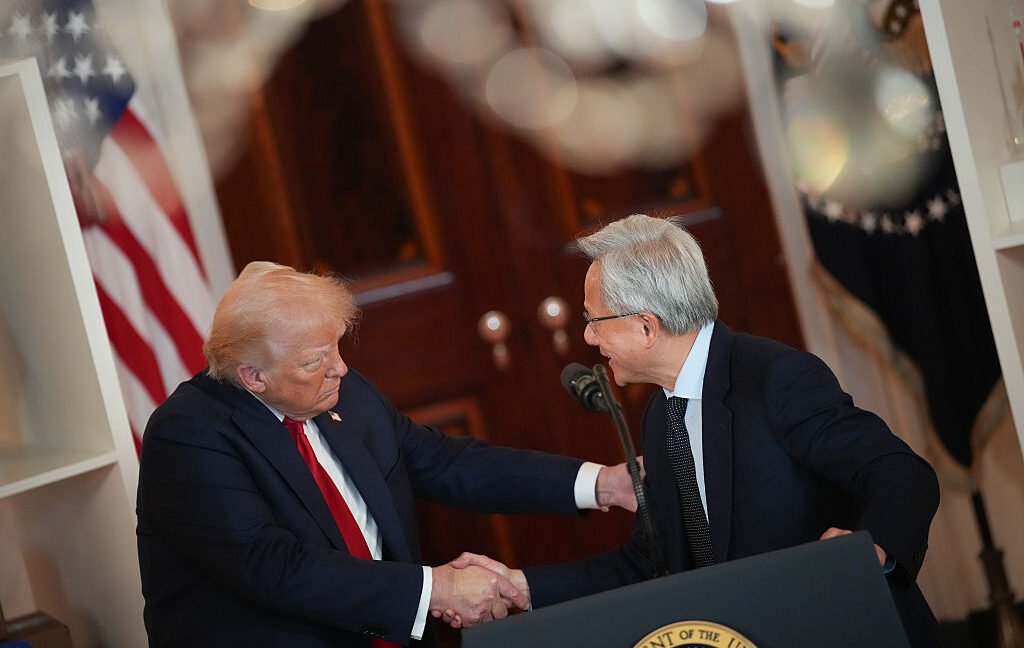
Nvidia’s Huang seems pleased with the outcome, which comes after months of reportedly pressuring the administration to lift export curbs limiting its growth in Chinese markets, the NYT reported. Last week, Trump heaped praise on Huang after one meeting, calling Huang a “smart man” and suggesting the Nvidia chief has “done an amazing job” helping Trump understand the stakes.
At an October news conference ahead of the deal’s official approval, Huang suggested that government lawyers were researching ways to get around a US law that prohibits charging companies fees for export licenses. Eventually, Trump is expected to release a policy that outlines how the US will collect those fees without conflicting with that law.
Senate Democrats appear unlikely to embrace such a policy, issuing a joint statement condemning the H200 sales as dooming the US in the AI race and threatening national security.
“Access to these chips would give China’s military transformational technology to make its weapons more lethal, carry out more effective cyberattacks against American businesses and critical infrastructure and strengthen their economic and manufacturing sector,” Senators wrote.
