

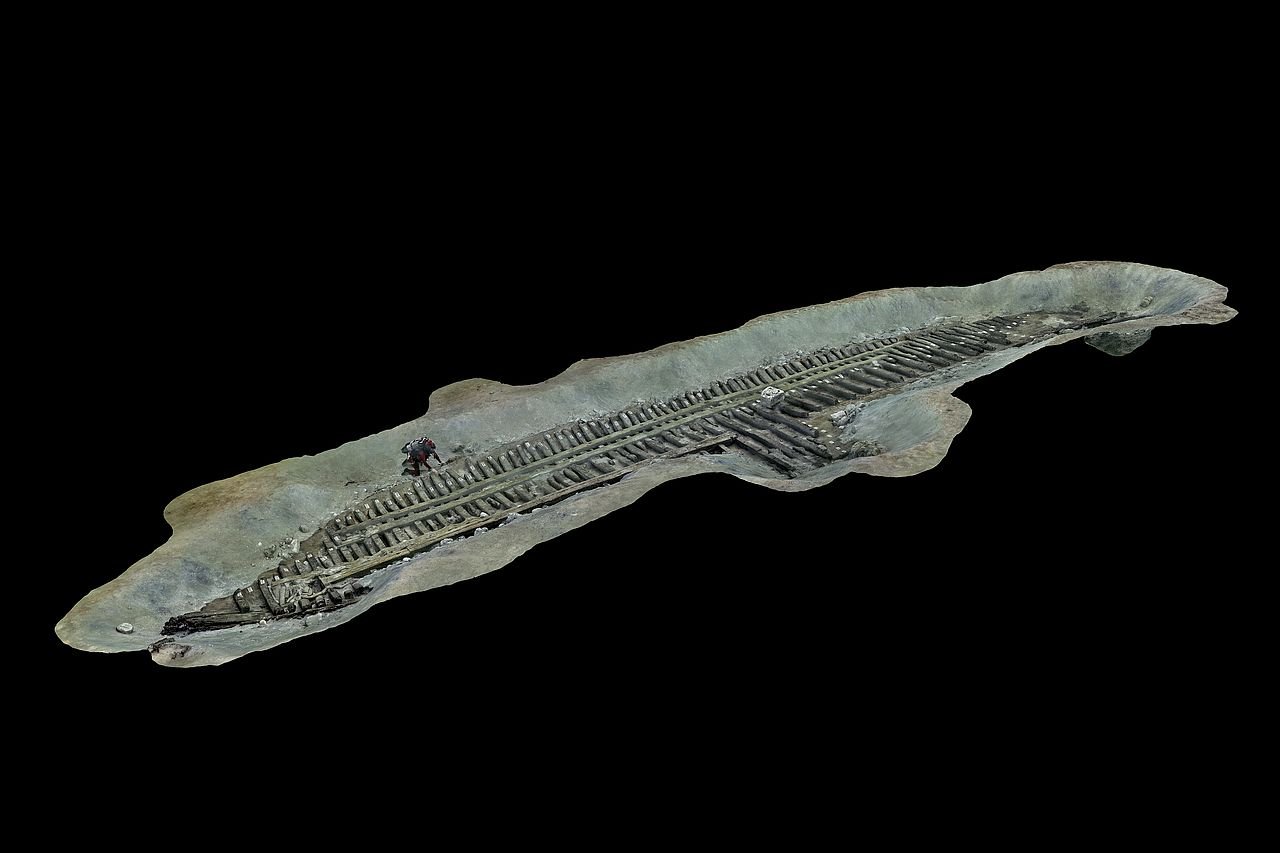
While diving off the coast of Egypt, underwater archaeologists found the 2,000-year-old remains of a boat that may have been a luxurious “pleasure barge” for the ancient elite.
The team discovered the barge in the ancient harbor of Alexandria, the capital of Egypt during the Ptolemaic period (304 to 30 B.C.) and a major city when the Roman Empire later dominated the region.
Goddio said his team discovered the remains of the vessel in October, during underwater excavations of now-sunken ruins of a Temple of Isis. The temple once sat on the island of Antirhodos, which now lies underwater, and was within the “Portus Magnus,” or Great Harbor, used at Alexandria during the Ptolemaic period. The temple there was destroyed, probably during an earthquake in about A.D. 50, and the island sank beneath the waves between the fourth and the eighth centuries.
Goddio thinks the pleasure barge would have carried a luxuriously decorated central cabin and been propelled by oars. No remains of such a vessel have ever been found, although they were described by ancient writers and portrayed in Egyptian art.

Among the lotuses
Giant pleasure barges were popular during the Ptolemaic dynasty in Egypt and were described by the first-century-B.C. Greek geographer Strabo as ferrying the wealthy between choice spots: “… they hold feasts in cabin-boats in which they enter the thick of the cyami [Egyptian lotuses that grow in fresh water] and the shade of the leaves.”
In Strabo’s time, Alexandria was under direct Roman control — an ancient regime change that began at the Battle of Actium in 31 B.C., when naval forces commanded by Roman leader Octavian (later Augustus) defeated the navy of Cleopatra VII (the last ruler of the Ptolemaic dynasty) and her lover, the Roman rebel Mark Antony.
Exactly how the newfound vessel ended up by the island of Antirhodos is unclear.
“This intriguing shipwreck could have been used along the canals in Alexandria as Strabo described,” Goddio said in the statement. But it was found near the underwater ruins of the Temple of Isis on Antirhodos and may have been caught up in the destruction there.

As a result, the researchers suggested “a ritual use for this barge,” Goddio said. It may have been part of the “navigatio iside,” a naval ceremony held in Roman-era Alexandria when a procession celebrating Isis carried a richly decorated vessel called the “Navigium” through the streets. The mock-up boat represented the solar barque that the Egyptian gods used to navigate across the heavens. (Isis was the goddess of the sea.)
That, in turn, could mean that “this vessel was performing a yearly ritual voyage of the goddess from the Portus Magnus of Alexandria to the sanctuary of Osiris at Canopus, alongside the Canopic Channel” of the Nile, Goddio said.
Early Roman Egypt
The research into the wrecked vessel is at a very early stage, but it “promises to be a fascinating journey into life, religion, luxury and pleasure on the waterways of early Roman Egypt,” Goddio said.
The vessel is a “spectacular find,” said Timmy Gambin, a maritime archaeologist at the University of Malta whose research covers ancient vessels as well as wartime wrecks. However, it has not yet been scientifically determined if the vessel is actually a thalamagos, said Gambin, who was not involved in the discovery.
“It is yet early days to determine exactly what the vessel was used for,” he told Live Science in an email.
