1. Design and Comfort
Build & Fit
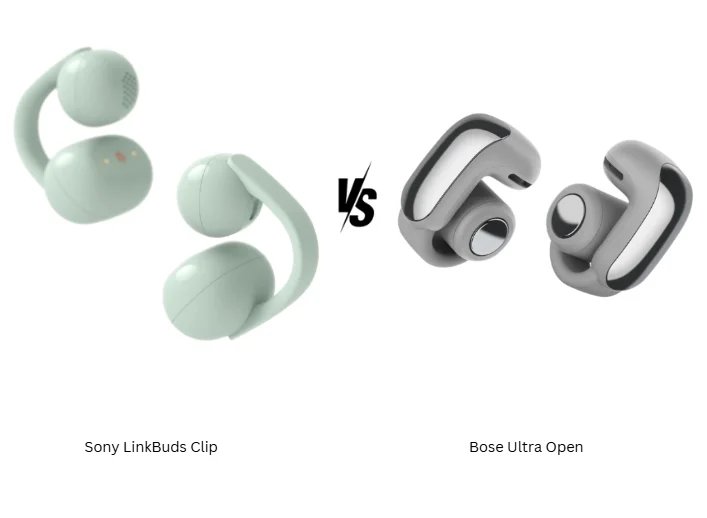
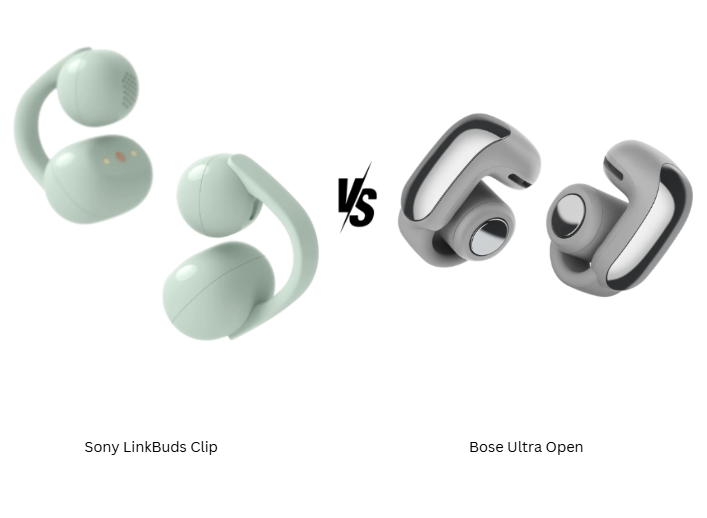
Sony LinkBuds Clip adopts a lightweight open-air clip design that hooks gently around the ear, prioritizing long-term comfort and breathability. At just 6.4 g per earbud, it feels almost weightless and works well for extended wear, especially during work or casual outdoor use. The IPX4 rating adds confidence for workouts or light rain. Bose Ultra Open Earbuds take a more premium approach with a flexible grip and sculpted open-ear frame. The materials feel more refined, and the fit is secure without creating pressure points, even during movement. Bose’s design leans more toward lifestyle and fashion, while Sony emphasizes practicality and minimalism.
Controls & Usability
Sony keeps things simple with onboard volume control, multipoint Bluetooth, and reliable touch responsiveness. Bose counters with intuitive gestures and deeper control via the Bose app, including EQ customization and immersive audio toggles. The app experience feels more polished overall.
Verdict
Sony’s feather-light build makes the LinkBuds Clip feel almost invisible over long sessions, which is exactly what open-ear users want first. Bose feels noticeably heavier and more premium, but that extra heft isn’t worth it if comfort is your priority. For most people who actually wear these earbuds all day, Sony wins decisively on comfort.
2. Sound Quality
Driver Performance, Bass, Mids, Highs
Sony’s 10 mm dynamic driver delivers clean mids and controlled highs, tuned for clarity rather than impact. Bass presence is modest, which suits spoken content, podcasts, and background music but may feel restrained for bass-heavy genres. Bose Ultra Open Earbuds sound noticeably fuller, with better low-end body and a wider soundstage. The open design still limits sub-bass depth, but Bose extracts more warmth and spatial depth from an open-ear format.
Codec Support & Audio Features
Both models support SBC and AAC, keeping codec support mainstream rather than audiophile-grade. Sony adds DSEE upscaling, subtly enhancing compressed tracks, while Bose leans heavily on Immersive Audio and spatial processing. Bose’s OpenAudio technology makes music feel more enveloping, even without isolation, giving it a more engaging presentation.
Verdict
Bose clearly takes the lead here. In an open-ear format, sound richness matters more than isolated punch, and Bose’s fuller, warmer profile delivers far more engaging audio than Sony’s thinner, balanced tuning. If music enjoyment is the main use case, Bose is the stronger choice.
3. ANC and Transparency Modes
Noise Cancellation Quality
Neither product offers traditional Active Noise Cancellation, which aligns with their open-ear philosophy. Sony LinkBuds Clip relies entirely on passive awareness, allowing environmental sounds to pass through naturally. Bose follows the same principle, choosing openness over isolation, though its acoustic shaping reduces harsh external noise slightly better in busy environments.
Ambient & Call Performance
Sony performs well for calls in quieter settings, with clear voice pickup but limited noise suppression outdoors. Bose handles calls more confidently in mixed environments, with better voice separation and consistency. Ambient awareness feels more natural on Sony, while Bose subtly balances awareness with audio focus, especially when Immersive Audio is enabled.
Verdict
Both skip traditional ANC, but Bose still manages a more refined awareness experience overall. Sony’s openness feels too raw in noisier environments, while Bose shapes environmental sound better without numbing awareness. For real-world listening around traffic or chatter, Bose feels more usable.
4. Battery and Connectivity
Battery Life & Fast Charging
Sony LinkBuds Clip delivers up to 9 hours of music playback, extending usability across a full workday without needing a recharge. Charging is straightforward, though fast-charge features are limited. Bose offers up to 7 hours of playback, dropping to around 4 hours with Immersive Audio enabled, but compensates with a strong charging case that significantly extends total usage time. Bose’s standby efficiency also stands out.
Bluetooth Stability and Multipoint
Both earbuds support Bluetooth multipoint and maintain stable connections within a 10 m range. Sony’s Bluetooth 5.3 implementation is reliable and power-efficient, while Bose’s connectivity feels equally stable but benefits from smoother device switching via its app ecosystem.
Verdict
Sony clearly beats Bose on pure battery life per charge, making it the smarter pick for long days away from a charger. Bose’s total playtime with the case closes the gap, but Sony’s efficiency and Bluetooth stability give it a practical edge that’s hard to ignore.
5. Pricing
At around $250, Sony LinkBuds Clip offers strong value for users seeking comfort, simplicity, and long battery life in an open-ear format. Bose Ultra Open Earbuds, priced closer to $300, justify the premium with superior sound immersion, app features, and design refinement. The price gap reflects experience rather than core functionality.
Sony’s price feels fair for what it delivers, comfort, simplicity, and excellent battery life. Bose feels a bit overpriced for what is essentially an open-ear experience with premium touches. If value is the priority, Sony wins; Bose is for those willing to pay extra for audio quality.
6. Conclusion
Sony stands out with ultra-light comfort, DSEE audio enhancement, and reliable all-day usability. Bose differentiates itself with Immersive Audio, richer sound tuning, and a more premium ecosystem experience. Both prioritize awareness and comfort over isolation, but approach the open-ear concept differently.
Verdict
For everyday use where comfort and long wearability matter most, Sony LinkBuds Clip feels like the smarter, more practical choice. However, if sound quality and a richer listening experience are higher priorities, Bose Ultra Open Earbuds justify their higher price. Most users who value audio engagement over comfort alone will lean towards Bose.
Read More: