

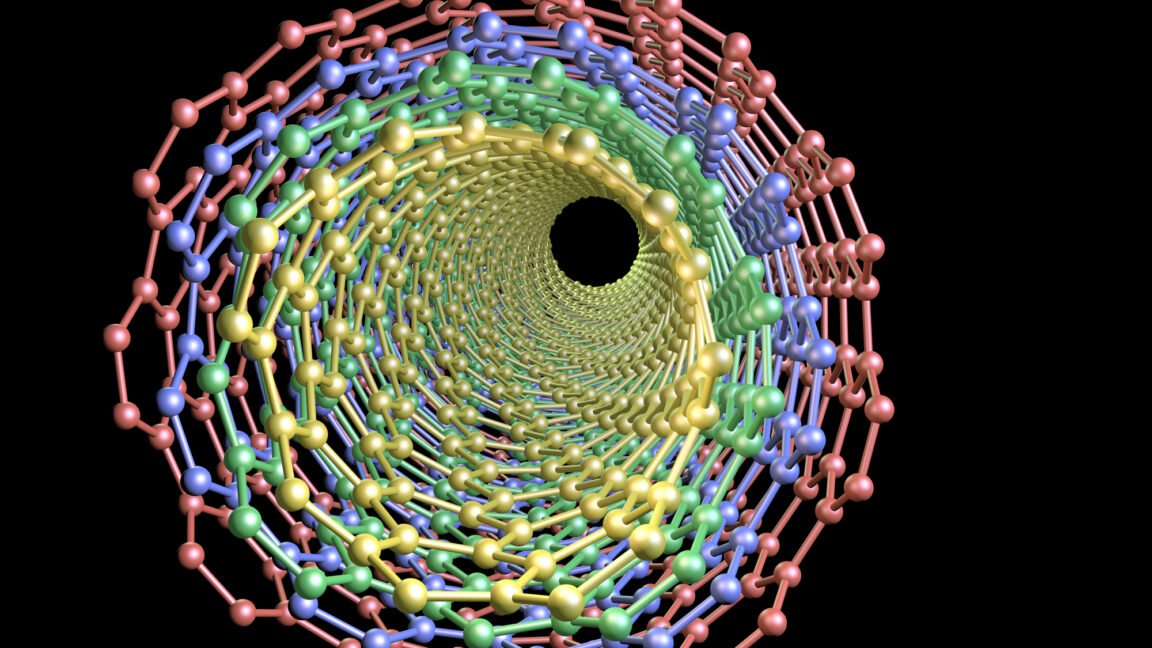
Shortly after their discovery, carbon nanotubes seemed to be a material wonder. There were metallic and semiconducting forms; they were tiny and incredibly light; and they could only be broken by tearing apart chemical bonds. The ideas for using them seemed endless.
But then the reality of working with them set in. It was hard to get a pure population of metallic or semiconducting forms. Synthesis techniques tended to produce a tangle of mostly short nanotubes; those that extended for more than a couple of centimeters remain rare. And while the metallic version offered little resistance to carrying electric current, it was hard to send many electrons down the nanotube.
Materials scientists, however, are a stubborn bunch, and they’re still trying to get them to work. Today’s issue of Science includes a paper describing the addition of a chemical to carbon nanotube bundles to boost their ability to carry current to levels closer to those of copper. While the more conductive nanotubes weren’t stable, the discovery may point the way toward something with a longer shelf life.
Doped nanotubes
Carbon nanotubes come in various forms. In the case of single-walled nanotubes, you can think of them as taking a sheet of graphene, rolling it up into a circle, and linking together the two opposite ends you just brought together. These can also be different diameters. There are also multi-walled carbon nanotubes, where a second nanotube (and maybe third, and maybe more beyond that) is wrapped around the first.
When metallic, these offer little resistance to electron flow along the nanotube. But, because most of their electrons are tied up in the chemical bonding needed to form the nanotube, there’s not a lot of them available to carry current. So, a lot of people have tried developing dopants—chemicals that can be mixed in small quantities that change the behavior of the bulk material. In this case, the goal was to find chemicals that would act as electron donors, adding to the amount of current that could potentially be sent down the nanotube.
