

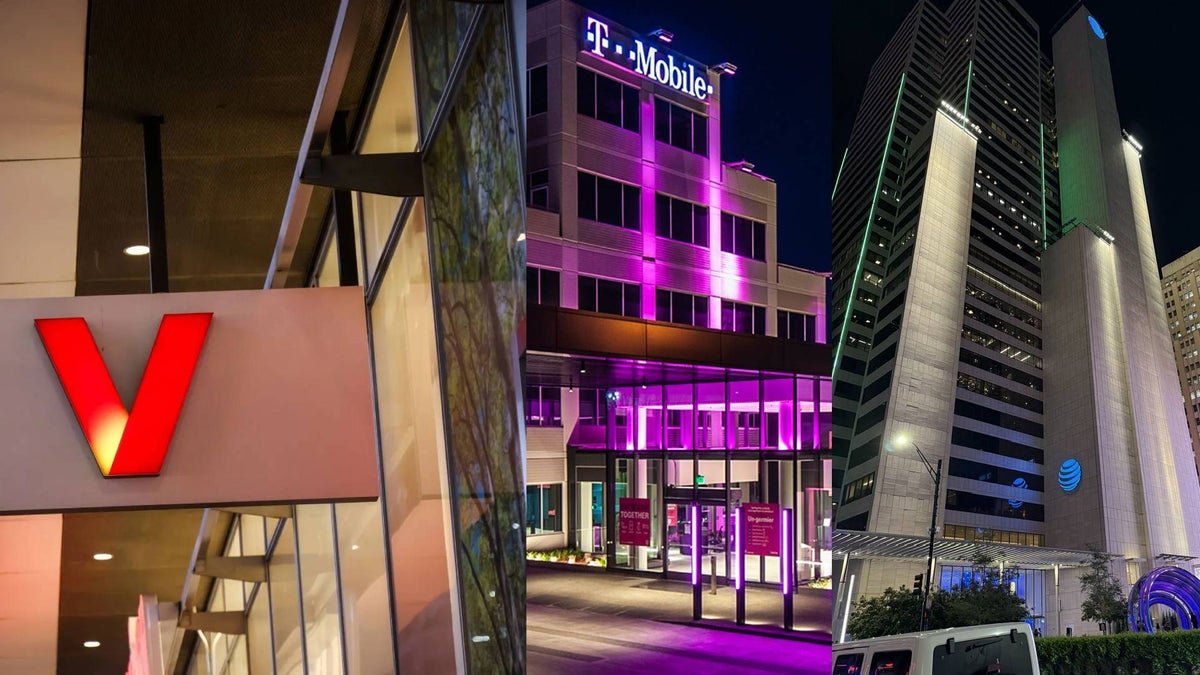
First, the particulars
The Big Three aim to launch a joint venture (JV) to kill off dead zones. They plan to do that by collaborating on a satellite connectivity initiative.
By joining with other carriers, we’re bringing our combined expertise to accelerate our customers’ access to reliable, and always-on coverage everywhere.
John Stankey, AT&T Chairman and CEO, May 2026
By pooling spectrum resources and developing unified industry specifications, the carriers hope to let customers switch seamlessly between land-based and satellite networks. The collaboration will help the carriers with faster execution and also make it easier for satellite operators to deliver direct-to-device experiences.
With the expansion of satellite constellations, soon to be supported by multiple space-based operators, this JV will use expanded capacity and improved performance to deliver the best possible service to customers.
Srini Gopalan, T-Mobile President and CEO, May 2026
For customers, it means not having to choose a specific carrier or device just to get a signal in the wilderness.
This partnership gives customers more options, continues to strengthen America’s infrastructure and increases competition for satellite providers.
Dan Schulman, Verizon CEO, May 2026
Moving beyond SpaceX
T-Mobile currently uses SpaceX’s Starlink constellation for its T-Satellite service. Verizon has partnered with Skylo, while AT&T has teamed up with AST SpaceMobile. While these existing partnerships will remain in place, the JV envisions a multiple-operator setup. The Big Three will even partner with small rural carriers to bring space-based connectivity to their customers.
The deal is in the preliminary stages.
Countering SpaceX
SpaceX recently got its hands on 65 megahertz of AWS-4, AWS-H Block, and AWS-3 spectrum, which it aims to use for the next-generation direct-to-device (D2D) network.
SpaceX can use this spectrum to provide direct-to-device services, making it a threat to the traditional carrier model.
Analysts Walter Piecyk and Joe Galone of LightShed Partners note that this announcement arrived just as SpaceX is ready to go public. It’s being viewed as a symbolic front against SpaceX.
AT&T, T-Mobile, and Verizon have also repeatedly denied having an interest in teaming up with SpaceX for an MVNO.Even if the deal goes forward, not much is expected to come of it, considering satellite companies already have access to the spectrum they need.
Maybe it matters, maybe it doesn’t
With the deal with EchoStar not expected to close until 2027, SpaceX will likely continue relying on T-Mobile for now.
T-Mobile previously reported that satellite usage hasn’t quite lived up to the hype. Terrestrial mobile networks will remain unparalleled for a high-quality experience. However, this alliance will give the three carriers significant leverage over future pricing.
The Federal Communications Commission (FCC) is determined to make D2D services a fixture of the connectivity landscape. By taking it upon themselves to control how satellite experiences are delivered, the Big Three are assuming more authority than they should, likely inviting antitrust scrutiny.
