

Getting the lead might not be the easy part, because it’s oftentimes expensive, time-consuming, and somehow always due yesterday.
But the real mess starts after that.
Someone signs up. They browse. Then, maybe they add something to their cart. Maybe they buy. Maybe they disappear into the digital void after one polite welcome email and three random promos.
That’s usually where lifecycle email marketing enters the chat, clears its throat, and asks why your entire strategy is hanging by newsletters that don’t foster customer loyalty but push promotions for conversion’s sake.
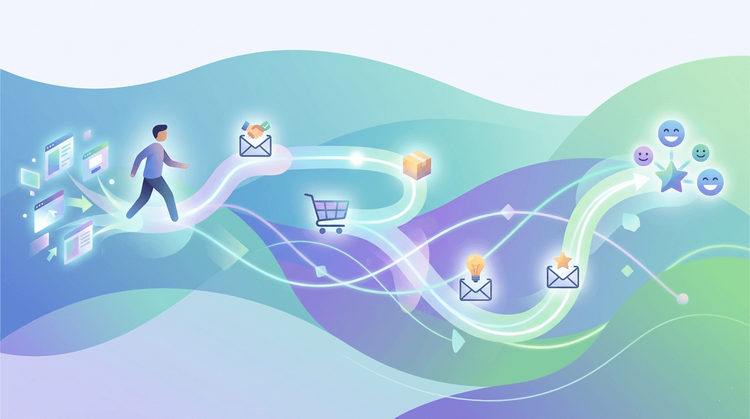
Lifecycle email marketing keeps the customer journey moving after acquisition by responding to what people actually do in relation to your brand.
Key Takeaways
- Lifecycle email marketing maps emails to customer behavior and stage (not your content calendar).
- The biggest gaps usually happen after signup and after purchase, not at acquisition.
- High-impact flows (welcome, abandoned cart, post-purchase, re-engagement) drive more value than increasing send volume.
- Each stage has a different job, so it should be measured with different metrics.
- Relevance comes from timing and context, not just personalization.
- List health is part of the lifecycle strategy.
Lifecycle Email Marketing: Definition and Why You Need It
Most email programs are built around what the brand wants to send next. Lifecycle email marketing flips that. It organizes email around what the customer did, where they are in the journey, and what would actually help them move forward.
The definition
Lifecycle email marketing is a stage-based, behavior-led approach to email. Instead of sending the same campaign to your entire list, it uses triggers like signups, product views, purchases, and inactivity to send messages that match where someone actually is in their relationship with your brand.
That shift matters because most marketers want low-cost email marketing that goes beyond the platform and right into the efficiency of your email program. Sending more campaigns to everyone might feel productive, but it increases volume without necessarily improving results.
Lifecycle email reduces wasted sends by focusing on timing and intent. You use the same platform and audience, but your emails arrive at the right moment and give recipients a reason to act. Getting more value out of every send is what makes lifecycle email a practical way to lower the cost of your email marketing efforts.
In practice, this means different emails for different moments: A welcome sequence for new subscribers, education for interested leads, abandonment emails for high-intent shoppers, post-purchase emails for new customers, and re-engagement emails for the ones who have gone suspiciously quiet.
Why you need it
You might be asking yourself: “Okay, but why can’t my regular campaigns work like lifecycle emails? Why do I need them?”
You need lifecycle email marketing because campaigns and lifecycle emails do different jobs:
- Campaigns follow your marketing calendar: Launches, promos, announcements, seasonal pushes.
- Lifecycle emails follow customer behavior: What people did, what they did not do, and what they need next.
One is schedule-led while the other is customer-led. That difference directly impacts engagement and deliverability. If your only move is “send promo to everyone,” relevance drops fast, and so does patience.
Lifecycle marketing helps you do the opposite. It assigns each email a job, reduces wasted sends, and makes your email program more efficient without getting louder. After all, a cost-efficient channel that gets more value out of the audience you already worked to acquire is precisely what email marketing is all about.
The Lifecycle, Stage by Stage
Now that you know how lifecycle marketing differs from plain email campaigns, it’s time to present and explain the different stages and actions you should take for each one.
1. Capture intent
The first job isn’t to collect as many contacts as possible, but to capture the right contact with the right expectation.
If someone signs up for a discount, they aren’t the same as someone who downloaded a guide. If someone joins through a product-specific landing page, they’ve already told you something useful. At a minimum, segmentation here should reflect acquisition source, product or category interest, engagement level, and initial intent (for example, discount vs education). Without this, lifecycle emails quickly turn into slightly delayed batch campaigns.
Treating all signups the same throws away the very context you worked to earn. Salesforce recommends mapping the customer journey around actual stages and customer needs, starting with awareness and lead acquisition rather than a vague “everyone goes into the newsletter now” approach.
What to do here:
- Match the signup source to the next message.
- Keep forms short unless you have a real reason to ask for more.
- Set a clear value exchange by being upfront about what they get, how often you’ll email, and why staying subscribed is worth it.
2. Welcome your new subscribers properly
Welcome emails signify the moment when attention is freshest, and action is most likely. So, instead of using welcome emails as prospecting tools that reveal which lead is willing to take the next step, create a purpose-driven welcome email sequence that will split the job between emails:
- Email 1 confirms the signup and delivers the promised value.
- Email 2 introduces the product, category, or core use cases.
- Email 3 adds proof with reviews, testimonials, or customer outcomes.
- Email 4 nudges toward the first conversion or preference selection.
A typical welcome sequence runs over 3–5 days, not all at once.
That sequence will vary by business model, but the core principle remains the same: each email has one clear job. If your first email is trying to introduce the brand, explain the product, ask for preferences, push a discount, tell your founder story, and secure a purchase in one go, that email needs to go on sabbatical. Quickly.
3. Nurture without acting clingy
Nurture emails exist to reduce uncertainty. They answer questions, build trust, and move people from “interesting” to “relevant.” This is an important stage in the customer journey, and also where many brands get it all wrong. They say they are nurturing, but what they really mean is sending three offers in a trench coat pretending to be education.
A useful nurture sequence is built around buying friction:
- What does this person still need to understand?
- What objections are quietly ruining your conversion rate?
- What proof would make the next step easier?
Salesforce’s email customer journey model prioritizes education and consideration before purchase, as people often need useful content, comparisons, FAQs, demos, testimonials, or category education before they are ready to act.
Good nurture content includes:
- Use-case emails
- Product education
- Comparison content
- FAQs
- Customer stories
- Recommendations based on browsing or category interest
Basically, you need every nurture email to either answer a question, remove a hesitation, or sharpen intent. If it does none of the three, it is probably just occupying inbox real estate.
4. Convert with context
Conversion-driven emails should act on intent (so, we’re leaving the guesswork out of this).
For example, someone who viewed pricing needs something different from someone who abandoned a cart. Someone who started a trial may need onboarding help. And someone who clicked the same product twice may just need targeted email marketing with content that brings reassurance, urgency, or a reason to stop overthinking and buy.
A strong conversion stage usually includes some mix of:
- Cart abandonment flows
- Browse abandonment automation
- Trial-expiry reminders
- Pricing-page follow-ups
- Demo reminders
- High-intent product recommendation emails
I can already hear you wonder whether a discount is the key to every conversion problem. Short answer: No.
Not everyone needs the same push. Some respond to urgency while others look for proof or clarity. And sometimes, a simple reminder does the job: the item is still in the cart, and the universe isn’t going to check out for them.
5. Retain after the sale
Post-purchase is where many brands suddenly develop selective amnesia. They plan lead generation religiously with the perfect landing page, then fight for the first purchase as if their lives depended on it. A receipt and a shipping email follow… and then spiritual silence. That’s how you end up over-investing in acquisition while underusing the audience you already paid to win.
Lifecycle email should keep working after the sale with the following flows and email types:
- Order confirmation and expectation-setting
- Usage tips
- Replenishment reminders where applicable
- Cross-sell and upsell recommendations
- Review requests
- VIP or loyalty communications
This stage should answer one practical question for the customer: “Okay, I bought the thing. What now?” This plays out differently depending on your product:
- If you sell software, help them get value quickly.
- If you sell physical products, help them use, restock, or expand the purchase.
- If you ask for a review, earn it first.
Loyalty in this context isn’t about repeat purchases. It shows up as shorter time between purchases, higher average order value, and engagement without relying on incentives. Lifecycle email supports this by reinforcing value after the sale rather than just pushing the next one.
Oh, and nobody wants a “How did we do?” email before the package has even stopped touring regional sorting centers.
6. Re-engage or let go
Not every subscriber wants to stay. Some just want out, respectfully, in one click.
A proper re-engagement stage tries to recover interest before a contact goes fully cold, but it also knows when to stop. That matters for performance and deliverability.
Google requires all senders to authenticate email. For bulk senders sending more than 5,000 messages per day to Gmail accounts, you also need to set up SPF, DKIM, DMARC, one-click unsubscribe, and have a spam rate below 0.30%.
Yahoo has similar requirements for bulk senders, including authentication, easy unsubscribe, honoring unsubscribe requests within 2 days, and keeping spam rates below 0.3%.
That means re-engagement is operational hygiene. A solid re-engagement sequence might include:
- A reminder of what the recipients signed up for
- A product or content recommendation based on prior interest
- A preference update request
- A tailored offer (if it makes sense)
- A final sunset email
And yes, sometimes the best lifecycle move is to stop emailing someone. Not every dormant contact is a hidden gem. Some are just dead weight, wearing an old signup date.
How to Build a Lifecycle Program (Without Creating a Monster)
Lifecycle email is a system of triggers, conditions, and priorities running at the same time. A subscriber doesn’t move cleanly from one stage of the marketing funnel to another. They might be in a nurture flow, trigger a browse abandonment, receive a campaign, and later enter a re-engagement sequence.
Start with the customer journey you already have, not the fantasy version from your strategy deck.
Map the major transitions first:
- From an anonymous visitor to a subscriber
- From subscriber to engaged lead
- From engaged lead to first-time customer
- From first-time customer to repeat customer
- From active customer to inactive customer
Then audit the elements your sequences already have, such as sending cadence, content, segments, personalization, etc. During that phase, most teams discover that one or two campaigns are doing far too much work, a welcome email is trying to carry the entire relationship on its back, and there’s a giant post-purchase gap that pretends it doesn’t exist.
If you only build four lifecycle flows (plus one that signals the end), these should be:
- Welcome series
- Abandoned cart or browse abandonment
- Post-purchase
- Re-engagement
- The final goodbye email
That sequence covers the most common gaps across acquisition, conversion, retention, and list health. From there, you can add category-specific journeys, trial nurturing, replenishment, loyalty, or win-back logic based on your business model.
Remember, lifecycle programs rely on trigger-based entry (what starts a flow), exit conditions (what stops it), and priority rules (which email is sent when multiple triggers are activated). Without these data, flows overlap, messages conflict, and the experience breaks.
What to Measure at Each Stage
The worst way to evaluate lifecycle email marketing is to judge every email by the same KPI.
A cold email isn’t a welcome email. Similarly, a welcome email isn’t an abandoned cart email, and a post-purchase sequence isn’t a re-engagement flow.
All flows and email types serve different purposes. Therefore, their success metrics should differ as well.
Let’s take a look at a clean way to measure lifecycle email KPIs:
- Capture: Signup conversion rate
- Welcome: First click, first product view, first purchase
- Nurture: Assisted conversions, product page visits, engagement depth
- Conversion: Order rate, revenue per recipient, recovery rate
- Retention: Repeat purchase rate, second-order rate, usage milestones
- Re-engagement: Reactivation rate, unsubscribe rate, complaint rate
That last one matters more than teams admit. A subscriber who doesn’t want to hear from you isn’t a pipeline opportunity. More likely, they’re a future complaint.
The Mistakes that Keep Lifecycle Programs Mediocre
The big one is treating lifecycle emails (and their fails) as a campaign problem. It isn’t. It’s a customer-journey problem.
The second is sending every contact down the same path. Source, intent, behavior, and purchase history all matter. Relevance comes from understanding what the customer needs next, not from blasting the same content harder.
The third is over-investing in acquisition while under-investing in what happens after signup and after purchase. That is how brands end up with polished lead magnets, weak onboarding, no structured nurture, and post-purchase emails that amount to “Gee, thanks for your purchase, bye now.”
And the fourth is confusing personalization with decoration. First-name tokens, cute subject lines, and product thumbnails aren’t a lifecycle strategy on their own. Useful triggers, relevant content, and stage-specific goals are.
Some Final Thoughts
Lifecycle email marketing works when each email plays a role in advancing the relationship.
That’s pretty much it.
It’s not about sending more volume, adding more noise, or chasing “quick wins” that quietly turn into inbox clutter. It’s about having a clearer system for deciding what someone needs next and sending the email that helps them get there.
