

Close Menu

    Subscribe to Updates

    Get the latest creative news from FooBar about art, design and business.

    What's Hot

    Reid Hoffman Wants Silicon Valley to ‘Stand Up’ Against the Trump Administration

    January 13, 2026

    Smartphone Camera Scores Explained: Are DxOMark Rankings Really Reliable?

    January 13, 2026

    Samsung Pushes Galaxy Watch 8 (2025) to Its Lowest Price in New Year Clearance, While Apple Watches Stay Full Price

    January 13, 2026
    Facebook X (Twitter) Instagram
    Wednesday, January 14
    Facebook X (Twitter) Instagram YouTube Mastodon Tumblr Bluesky LinkedIn Threads
    ToolcomeToolcome
    • Technology & Startups

      Reid Hoffman Wants Silicon Valley to ‘Stand Up’ Against the Trump Administration

      January 13, 2026

      Urevo SpaceWalk 5L Walking Pad Review: Compact and Affordable

      January 13, 2026

      Board Review: Tabletop Video Games With Physical Pieces

      January 13, 2026

      Atonemo Streamplayer Review: Make Old Speakers New Again

      January 13, 2026

      What to Do If ICE Invades Your Neighborhood

      January 13, 2026
    • Science & Education

      Hubble Nets Menagerie of Young Stellar Objects

      January 13, 2026

      Ötzi the Iceman mummy carried a high-risk strain of HPV, research finds

      January 13, 2026

      Can you eat too much protein?

      January 13, 2026

      NASA’s Webb Delivers Unprecedented Look Into Heart of Circinus Galaxy

      January 13, 2026

      Backcountry is blowing out hiking bags, backpacks, and luggage for up to 65% off during this clearance sale

      January 13, 2026
    • Mobile Phones

      Smartphone Camera Scores Explained: Are DxOMark Rankings Really Reliable?

      January 13, 2026

      Motorola expands Android 16 beta program to 8 more devices

      January 13, 2026

      Motorola Introduces Moto Pen Ultra for Foldables and Moto Tag 2 Item Tracker

      January 13, 2026

      OnePlus Nord CE 5 Update Adds Video Editing Tools and January Security Patch

      January 13, 2026

      Vivo rolls out OriginOS 6 (Android 16) update to Vivo V40

      January 13, 2026
    • Gadgets

      Star Wars Outlaws developer Massive Entertainment and Ubisoft Stockholm face layoffs

      January 13, 2026

      Insta360 releases AI-powered follow-up to its Link webcams

      January 13, 2026

      Proton’s Lumo AI chatbot now has an encrypted space for your projects

      January 13, 2026

      The best streaming devices for 2026

      January 13, 2026

      UK regulator Ofcom opens a formal investigation into X over CSAM scandal

      January 13, 2026
    • Gaming

      Samsung Pushes Galaxy Watch 8 (2025) to Its Lowest Price in New Year Clearance, While Apple Watches Stay Full Price

      January 13, 2026

      ASUS ROG Xbox Ally (2025 Ryzen Z2 A) Just Hit Its Lowest Price Ever With 3 Months of Game Pass Included

      January 13, 2026

      Samsung Goes All-In on Galaxy S25 Ultra Clearance at a Record Low as the New S26 Launch Approaches

      January 13, 2026

      This Great Switch 2 Handheld Controller Is On Sale For New Best Price At Amazon

      January 13, 2026

      Google Pixel 9a Drops to All-Time Low to Compete With Samsung Galaxy S25 Deals, Now the Cheapest Gemini-Powered Smartphone

      January 13, 2026
    • Cars

      Beyond Speed: A Deep Dive into the 6 Safety Features That Could Save Your Supercar in 2026

      January 13, 2026

      A Commercial Truck Caused a Hit-and-Run: Who Pays for the Damage?

      January 13, 2026

      Risk and reward: what driving teaches about smart decisions

      January 13, 2026

      How It’s Played Online on GameZone

      January 12, 2026

      How Dubai Became the Supercar Capital of the World

      January 12, 2026
    • PC Accessories

      A Kilowatt PSU Is So 2025, The Seasonic Prime PX-2200 Is The Future

      January 12, 2026

      CES 2026: The Good, Bad And Ugly

      January 12, 2026

      Hands-On With Samsung Galaxy Z TriFold: An Impressive New Take On Foldables

      January 11, 2026

      Edifier’s Funky Portable ES300 Wireless Speaker

      January 9, 2026

      Testing All The Features of AMD’s FSR Redstone

      January 9, 2026
    ToolcomeToolcome
    Home»Science & Education»Controversial startup’s plan to ‘sell sunlight’ using giant mirrors in space would be ‘catastrophic’ and ‘horrifying,’ astronomers warn
    Science & Education

    Controversial startup’s plan to ‘sell sunlight’ using giant mirrors in space would be ‘catastrophic’ and ‘horrifying,’ astronomers warn

    October 31, 2025No Comments8 Mins Read2 Views
    Facebook Twitter Pinterest LinkedIn Telegram Tumblr Email
    Share
    Facebook Twitter LinkedIn Pinterest Email


    A California-based startup’s controversial plan to put 4,000 tennis-court-sized mirrors in orbit around Earth is “catastrophic” and “horrifying,” astronomers warn.

    Reflect Orbital, which was founded in 2021, has recently taken the first step in a scheme to sell sunlight at night by bouncing solar rays off giant “reflectors” that can redirect the vital resource almost anywhere on our planet. By doing this, the company aims to extend daylight hours in specific locations, thus allowing paying customers to generate solar power, grow crops and replace urban lighting.

    But experts say it is a wildly impractical plan that should never get off the ground. What’s more, the resulting light pollution could devastate ground-based astronomy, distract aircraft pilots and even blind stargazers.


    You may like

    As its first step, Reflect Orbital recently submitted an application to the U.S. Federal Communications Commission (FCC) to launch its first test satellite, EARENDIL-1, in early 2026. If this application is granted and the initial tests are successful, the startup envisions launching as many as 4,000 similar satellites by 2030, company representatives recently told Live Science’s sister site Space.com.

    Once in low Earth orbit (LEO), EARENDIL-1 would unfurl a square reflector up to 59 feet (18 meters) across, giving it a surface area of around 3,500 square feet (325 square meters). This would allow the mirror to illuminate a single patch of Earth’s surface up to 3 miles (5 kilometers) across at a time. From the ground, the light within one of these patches would be up to four times brighter than the full moon, the company representatives said.

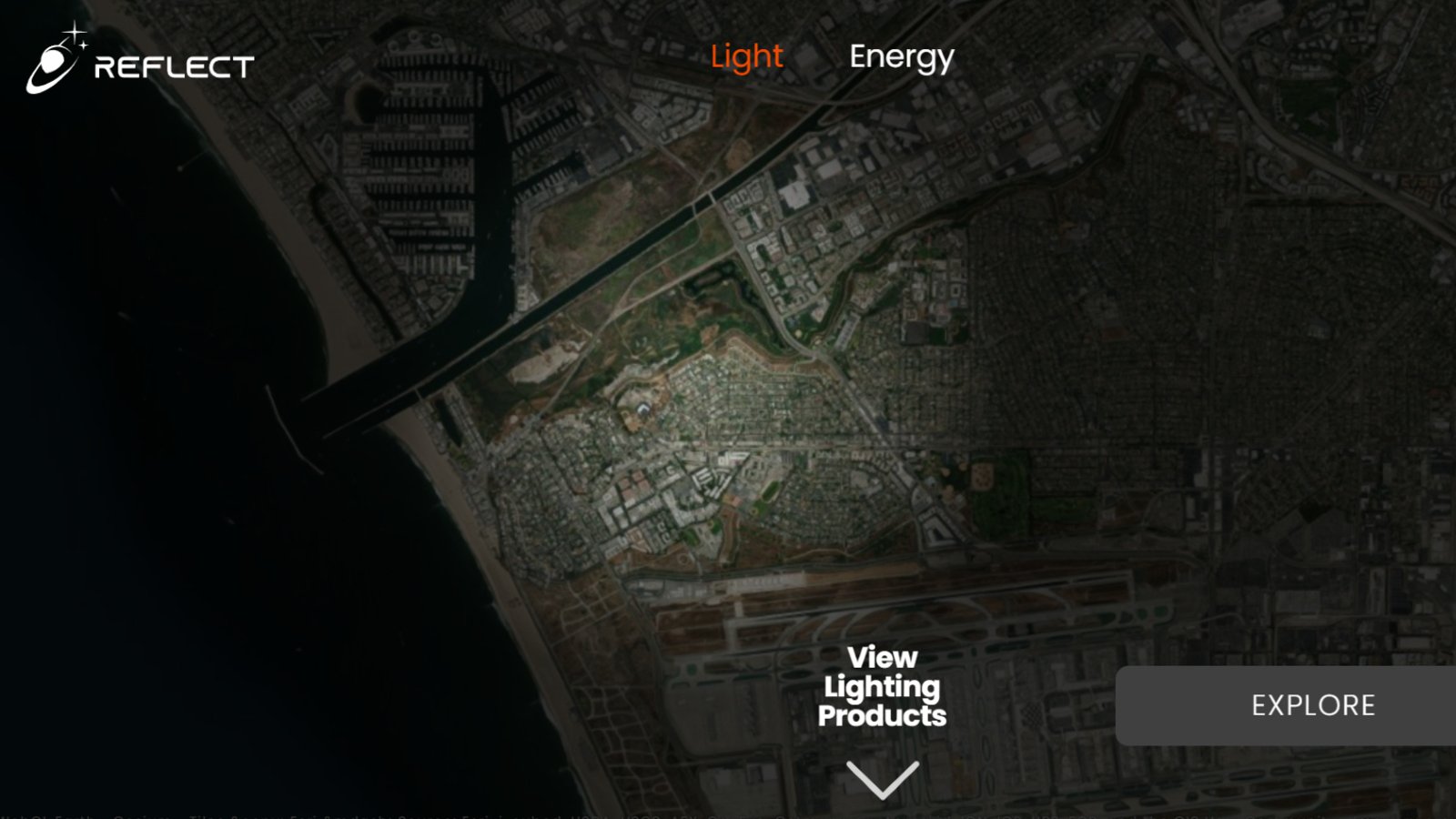
    Website screenshot showing what a bright spot might look like from space

    The proposed mirrors will create 3-mile-wide “bright spots” on Earth’s surface. This screenshot, taken using an interactive map on the Reflect Orbital website, shows what one of these spots would look like over part of Los Angeles. (Image credit: Screenshot from reflectorbital.com taken by Harry Baker)

    However, future reflectors in the planned constellation could have mirrors up to 177 feet (54 m) across, which would likely create larger and more intense bright spots.

    Reflect Orbital said it can minimize the effects of its light pollution by rotating the mirrors away from Earth when they’re not in use. “Our service is highly localized,” company representatives told Space.com. “Each reflection covers a defined area for a finite period of time rather than providing continuous or widespread illumination.”

    Get the world’s most fascinating discoveries delivered straight to your inbox.

    However, these reassurances have done little to put scientists at ease.

    “A terrible idea”

    The reflectors would orbit Earth in a sun-synchronous orbit, which would cause them to circle Earth from pole to pole, perpendicular to the planet’s spin. They would be positioned to constantly align over the day-night divide on our planet, essentially allowing the mirrors to bounce sun’s rays from the daylight side onto locations that are dark. In theory, this would illuminate areas just after sunset or before dawn.

    But while the basic physics behind this idea is solid, experts say it is much easier said than done — and they are skeptical that the company could pull it off.


    You may like

    A photo of one of Russia's Znamya reflectors in orbit around Earth in 1993.

    Russia previously tested the idea of reflecting sunlight to Earth’s surface with its Znamya satellites. This mirror was unfurled in 1993 and burned up in Earth’s atmosphere after several hours. (Image credit: ROSCOSMOS/Wikimedia)

    Their plan “is flawed from the outset, technically speaking,” Fionagh Thomson, a researcher at Durham University in England who specializes in space ethics, told Live Science in an email. “It is highly unlikely to come to fruition due to the complexity of the engineering involved, and trying to operate through busy orbits such as LEO.”

    In fact, this idea has been tried — and subsequently abandoned — before. In 1993 and 1999, Russia attempted to launch two similar reflectors, dubbed the Znamya satellites, but canceled the program after struggling to control the satellites, which both quickly burned up in the atmosphere. (No other reflectors have been launched since.)

    Researchers writing in The Conversation and Big Think have also questioned whether the mirrors are capable of delivering one of the company’s future flagship services: generating solar power.

    In theory, the mirrors could be used to shine light on giant solar farms on the planet’s surface, thereby extending the amount of time they can create electricity. However, the resulting light would be thousands of times weaker than the midday sun, meaning the illuminated panels would generate a tiny fraction of their normal energy. Moreover, a single mirror could focus light onto the same spot for a maximum of only four minutes at a time, the researchers predict.

    An aerial photo of a giant farm of solar panels in Australia

    Reflect Orbital plans to illuminate giant solar farms with their reflected bright spots, allowing them to generate more energy than normal. But researchers are highly skeptical of this idea. (Image credit: Andrew Merry via Getty Images)

    Even if the mirrors could collectively generate enough energy, it would be “eye-wateringly expensive” compared with other forms of renewable energy, Thomson said.

    All in all, “this is a terrible idea,” Samantha Lawler, an astronomer at the University of Regina in Canada, told Live Science in an email. However, there is still a decent chance that the EARENDIL-1 mission will be approved by the FCC, she speculated.

    Blinded by the light

    A single mirror is unlikely to have a major impact on the night sky. But if Reflect Orbital’s proposed constellation is realized, astronomers say it will be increasingly hard to study the stars beyond the glare of thousands of “new stars” zooming across the night sky.

    Robert Massey, deputy executive director at the U.K.’s Royal Astronomical Society, told Space.com that the astronomical community was “seriously concerned about the development, its impact and the precedent it sets.”

    Photo of the night sky with zig-zagging streaks left by satellites

    Light pollution from the rising number of private satellites in LEO is already causing problems for astronomers. This time-lapse photo was captured during a 30-minute period in May 2023. (Image credit: Alan Dyer/Stocktrek Images via Getty Images)

    While other spacecraft, such as SpaceX’s Starlink satellites, accidentally reflect light toward Earth’s surface, astronomers are particularly worried by the deliberate generation of light pollution proposed by Reflect Orbital.

    “The central goal of this project is to light up the sky and extend daylight, and obviously, from an astronomical perspective, that’s pretty catastrophic,” Massey said.

    For unlucky stargazers who ended up in one of the mirrors’ bright spots, it would also be almost impossible to see any other stars in the night sky, Lawler said. Past research into this concept has also shown that staring directly at the reflectors through a telescope or binoculars could cause eye damage, she added.

    Given that a mirror could be suddenly rotated or repositioned at any location on Earth without warning, there is no guaranteed way of avoiding this. And sudden flashing from a reflector’s movement could also distract aircraft pilots during takeoff or landing, with potentially disastrous consequences, several experts have said.

    Photo of a group of stargazers next to a telescope in mountians

    Experts warn that if stargazers are flashed by a rotating mirror, they could sustain significant eye damage. (Image credit: Roberto Moiola/Sysaworld via Getty Images)

    Past research on light pollution has also shown that it can alter the behavior of a wide array of animals and plant species, as well as disrupt human sleep cycles.

    “One tiny company in California can, with a few million dollars and the approval of a single U.S. federal agency, change the night sky for everyone in the world,” Lawler said. “It’s horrifying.”

    Additional issues

    While astronomers are mostly concerned about the light pollution and the invisible radio pollution these mirrors will likely create, the planned swarm could prove dangerous in other ways.

    For example, the mirrors’ large size makes them more likely to be hit by micrometeorites or the rapidly multiplying bits of space junk that encircle our planet, Lawler said. This could leave the reflectors “riddled with holes,” which would make them harder to control, she added.

    A timelapse photo of a rocket launch showing the streak of light as it takes off

    If approved by the FCC, Reflect Orbital’s first satellite EARENDIL-1 could launch in early 2026. (Image credit: Yue Wu/500px via Getty Images)

    If operators lost control of a mirror, it could end up spinning out, similar to NASA’s Advanced Composite Solar Sail System, which began tumbling end over end after being deployed in August 2024. If this happened, the mirrors would uncontrollably flash across the night sky.

    Additionally, the number of planned satellites across the globe is already higher than the number of spacecraft that experts predict can safely operate in LEO. And the new reflectors would eventually fall back to Earth at the end of their operational lifespan, which could lead to issues such as atmospheric metal pollution.

    As for the potential wildlife impacts of the project, Reflect Orbital has committed to carrying out an environmental risk assessment, but only after EARENDIL-1 is launched, according to Space.com.

    Share. Facebook Twitter Pinterest LinkedIn Tumblr Email
    mehedihasan9992
    • Website

    Related Posts

    Hubble Nets Menagerie of Young Stellar Objects

    January 13, 2026

    Ötzi the Iceman mummy carried a high-risk strain of HPV, research finds

    January 13, 2026

    Can you eat too much protein?

    January 13, 2026

    NASA’s Webb Delivers Unprecedented Look Into Heart of Circinus Galaxy

    January 13, 2026

    Backcountry is blowing out hiking bags, backpacks, and luggage for up to 65% off during this clearance sale

    January 13, 2026

    Ethereal ice structures swirl alongside Chicago during extreme cold snap fueled by polar vortex — Earth from space

    January 13, 2026
    Leave A Reply Cancel Reply

    Top Posts

    Steam and Valve’s online games are down

    December 24, 2025129 Views

    773,000-year-old fossils found in Casablanca may be earliest common ancestor of modern humans and Neanderthals

    January 8, 202695 Views

    Get three months of Apple Music for only $1 right now

    December 5, 202542 Views
    Don't Miss

    Reid Hoffman Wants Silicon Valley to ‘Stand Up’ Against the Trump Administration

    January 13, 2026

    Reid Hoffman doesn’t do much in half measures. He cofounded LinkedIn, of course, and helped…

    Smartphone Camera Scores Explained: Are DxOMark Rankings Really Reliable?

    January 13, 2026

    Samsung Pushes Galaxy Watch 8 (2025) to Its Lowest Price in New Year Clearance, While Apple Watches Stay Full Price

    January 13, 2026

    Hubble Nets Menagerie of Young Stellar Objects

    January 13, 2026
    Stay In Touch
    • Facebook
    • YouTube
    • TikTok
    • WhatsApp
    • Twitter
    • Instagram
    Latest Reviews
    8.9

    Review: Dell’s New Tablet PC Can Survive -20f And Drops

    January 15, 2021

    Review: Kia EV6 2022 The Best Electric Vehicle Ever?

    January 14, 2021
    72

    Review: Animation Software Business Share, Market Size and Growth

    January 14, 2021
    Most Popular

    Steam and Valve’s online games are down

    December 24, 2025129 Views

    773,000-year-old fossils found in Casablanca may be earliest common ancestor of modern humans and Neanderthals

    January 8, 202695 Views

    Get three months of Apple Music for only $1 right now

    December 5, 202542 Views
    Our Picks

    Reid Hoffman Wants Silicon Valley to ‘Stand Up’ Against the Trump Administration

    January 13, 2026

    Smartphone Camera Scores Explained: Are DxOMark Rankings Really Reliable?

    January 13, 2026

    Samsung Pushes Galaxy Watch 8 (2025) to Its Lowest Price in New Year Clearance, While Apple Watches Stay Full Price

    January 13, 2026

    Subscribe to Updates

    Get the latest creative news from FooBar about art, design and business.

    Toolcome
    Facebook X (Twitter) Instagram YouTube Mastodon Bluesky
    • Home
    • Technology
    • Gaming
    • Mobile Phones
    • Cars
    • PC Accessories
    © 2026 Tolcome.

    Type above and press Enter to search. Press Esc to cancel.