

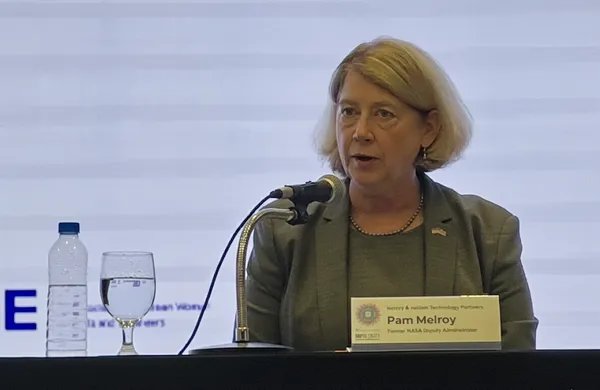
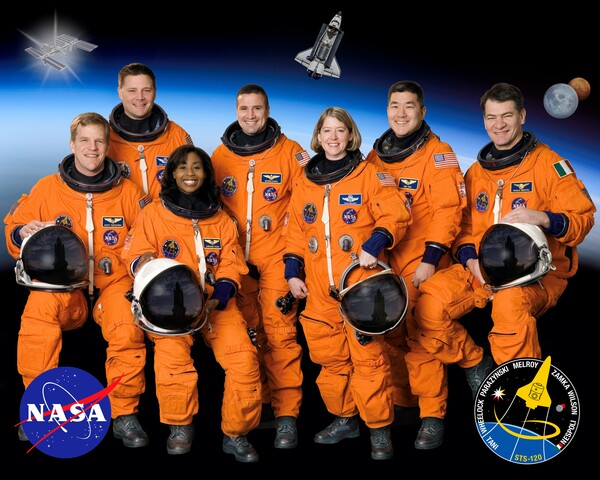
Pamela Ann Melroy’s life has been defined by challenges that continually pushed the boundaries of what was possible. She is a veteran astronaut who flew on three Space Shuttle missions and played a leading role in building the International Space Station. She later served as the Deputy Administrator of NASA.
That lifelong pursuit of exploration began early. Growing up watching the TV series Star Trek, Melroy dreamed of venturing beyond Earth.
At a time when few women could become pilots, she joined the U.S. Air Force and showed that skill mattered more than gender. Her determination eventually led her to join NASA and take a leading role in building the International Space Station through international collaboration.
Those experiences left her with a defining philosophy: true progress comes when people from different backgrounds work together toward a shared goal instead of standing in opposition. That belief was reinforced when she looked down from space and saw Earth—one blue planet without borders.
As she once put it, “The Earth is our spaceship, and we are all its crew.”
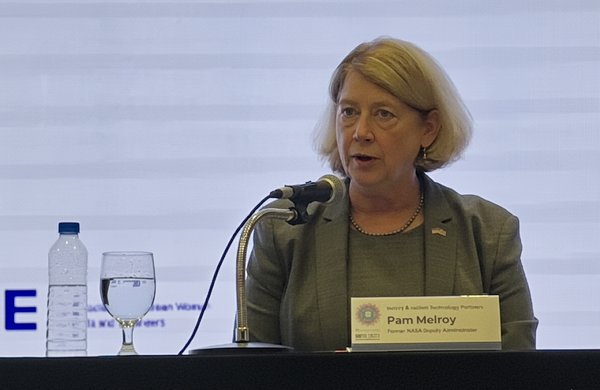
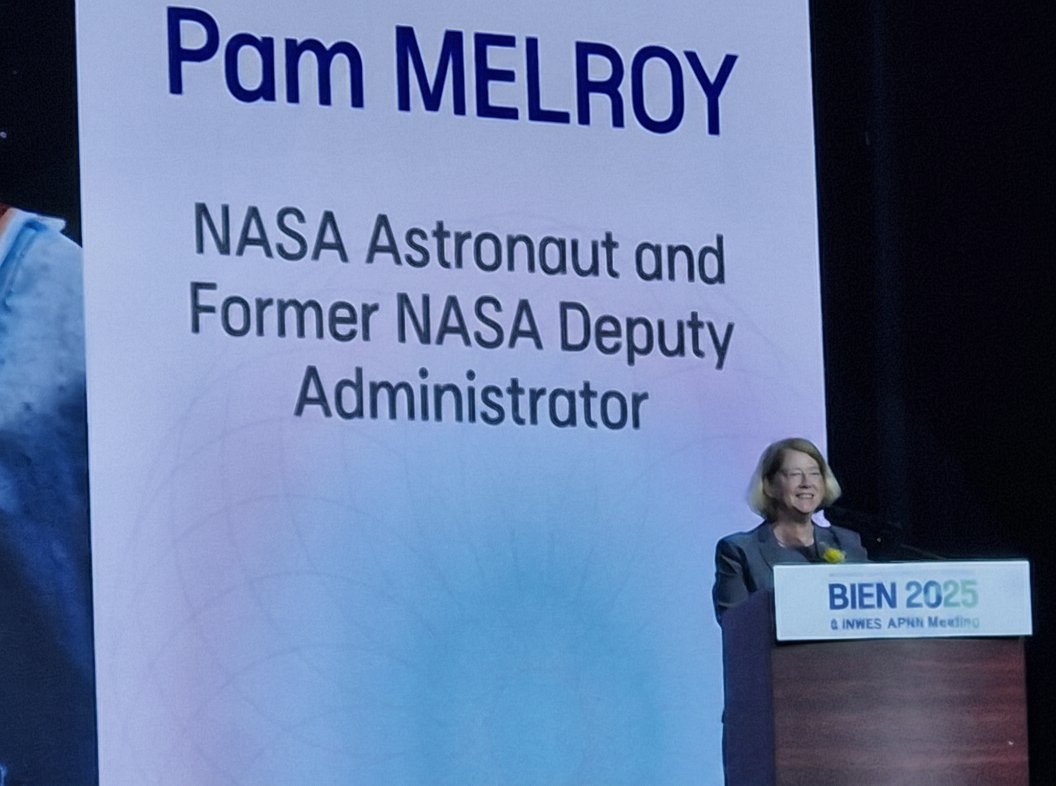
She reiterated that message during her visit to Korea for ‘The 6th International Conference for Women in Science and Technology (BIEN 2025)’ and her lecture at the National Science Museum. Melroy shared her leadership experiences from guiding NASA missions and reminded audiences that true exploration begins when humanity transcends its own boundaries.
From a Star Trek fan to a NASA astronaut
Pam Melroy spoke about how she first dreamed of becoming an astronaut during her visit to Korea. As a child she watched the TV series Star Trek with her family and imagined herself on the bridge like Captain Kirk leading a crew of her own. When Apollo landed on the Moon she realized that what once seemed like fiction had become reality.
The world Melroy grew up in offered little room for her dreams. Gender at the time still largely determined a person’s career path. A career as an astronaut required experience as an Air Force pilot. This career path presented a challenge for women, as flying opportunities within the service were exceptionally rare. Melroy seized the opportunity to apply when social attitudes began to shift and the Air Force started admitting female pilots.
Looking back, Melroy says that timing and steady encouragement helped guide her career through these barriers. “Growing up in the 1960s there were not many women pilots but I was very fortunate. When I was in high school the opportunities opened up in front of me,” she said.
She stressed the importance of her parents’ encouragement in giving her the confidence to seize those opportunities. “My parents always told me that I could do anything that I wanted,” she recalled. “They did not tell me that I could not do that. Instead they kept saying ‘we believe you can do anything that you want to do’ and I believed them.”
Melroy herself tells a story that illustrates just how rare that kind of foundational support was at the time. She recounted an introduction once given by a former classmate. Melroy explained that the friend’s speech began with a childhood memory of being told by her parents that girls could not be astronauts.
“And then she came to university and met me,” Melroy continued, “and I was telling everyone I wanted to be an astronaut.” The classmate admitted to feeling a quiet sadness for Melroy back then, believing her to be naive because no one had warned her that her dream was impossible.
Melroy then delivered the story’s conclusion. “She paused, looked down, and then looked up at the audience and said, ‘Please meet my friend, astronaut Pam Melroy.’”
But even after breaking through social barriers with this support, Melroy faced distinct physical challenges. She barely met the minimum height requirement to become a pilot. “I had to use my head to overcome the physical challenges,” Melroy stated. “In some cases, someone big and strong just does things. I had to use my head to think through how I can leverage myself.”
She later realized that the very traits once seen as limitations had become her strengths. “In many cases, being small has been very important during repairs in operations in very tight situations,” she recounted. “Many times, I was the one with a hand that was small enough to do the job.”
Melroy’s NASA lesson on success
After serving as an Air Force pilot, Pam Melroy joined NASA as an astronaut. Melroy said the NASA she knew was built on a culture that valued every voice in the room. She explained that NASA’s breakthroughs often come from non-specialists.
“When you are working on very difficult science and technology problems, when you are exploring, there are many examples where one person who was not the expert provided the key insights to allow things to go forward,” she said. “So encouraging all voices is a part of the mission of NASA.”
At NASA, inclusion is not only key to innovation but also vital to safety.
Melroy also linked the importance of open communication directly to the agency’s safety record. A spacecraft is a place where even the smallest error can have catastrophic consequences. Constant cross-checking among diverse perspectives is what keeps a crew alive.
“NASA has learned bitter lessons from major human space mishaps that it is important to hear all voices,” she stated. “And so it is critical to promote the safety culture inside NASA to encourage all voices to speak up and to be listened to.”
She also reminded the audience that in space no one survives alone. In microgravity even simple tasks demand teamwork and precision. Melroy once described spaceflight as “the most fascinating camping trip imaginable,” yet one that demanded constant vigilance and precise teamwork to stay alive. A small item could clog an air filter and cause the onboard systems to overheat. Every action was guided by a single rule that put the team’s safety before individual comfort.
Melroy said that in space even the smallest problem can’t be solved alone. She recalled moments when the crew had to reroute power systems or repair a damaged solar panel, each demanding cooperation to keep the mission going.
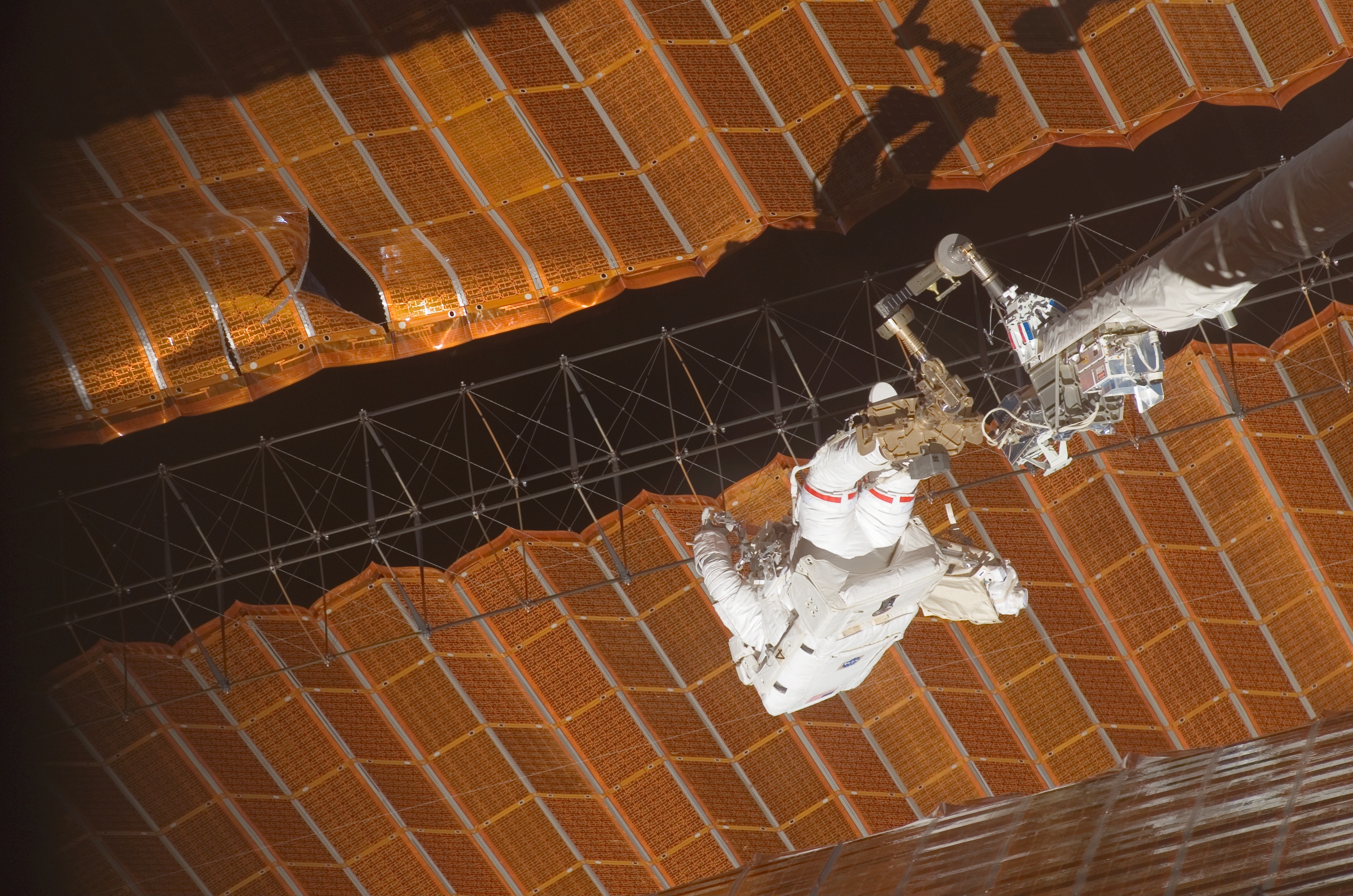
A major electrical failure during Melroy’s first flight demanded an immediate response from the crew. As the pilot in charge of in-flight maintenance, it was her job to perform the complex repair in real time. Guided by checklists and working with her team, she rewired a critical component under immense time pressure.
The crew’s response was a model of efficiency and professionalism. There was no room for ego or discussion of alternative plans. They simply received the procedure from NASA’s ground control, confirmed their understanding, and executed it as quickly as possible.
She recalled, “Working together well is everything, because it really slows you down if you are not working well together and we did not have time for that.”
Such strong teamwork doesn’t come naturally. It’s built through rigorous training. Her team of pilots, engineers, and scientists from various disciplines spent several weeks in Alaska conducting field trials designed to prepare them for the mission’s extreme conditions.
“It’s very difficult to go on a trip like this,” she began. “We found out who gets cranky when they’re cold, who is difficult when they’re tired, who gets very upset if she’s not fed three times a day.”
Melroy stressed that her primary focus in command was on the team not the technology. “As a commander I needed to know about everybody because the most important system I operated on the space station was the crew,” she said. “It was not switches, it was not systems. It was the crew.”
That lesson extends far beyond her own missions. Toward the end of her lecture at the National Science Museum, Melroy spoke about what lies ahead for lunar and Martian exploration. She told the students that future missions will become more complex than ever, demanding unprecedented international cooperation.
When a student asked what qualities future astronauts should develop Melroy gave a simple but memorable answer. “One thing that won’t change is the human aspect of working together,” she said. “Learning how to work well with other people is the most important thing in space. It is and always will be.”
The spirit of cooperation beyond borders
The spirit of cooperation that NASA pursues extends beyond individuals and reaches across nations. Melroy reminded her audience at the BIEN 2025 that space is a unique realm where collaboration beyond politics and ideology becomes possible.
Melroy described the profound shift in perspective experienced from space, a phenomenon known as the ‘Overview Effect’.
“Every astronaut experiences what’s known as the Overview Effect,” she said. “Imagining that what we do in one country does not affect anyone else, you can see from space that that is not true. You can see how interconnected we are.”
This realization leads to a clear mandate for cooperation. She argued “We recognize that we must partner together, we must share ideas, we must honor and respect each other’s culture and each other’s contributions.”
Melroy recalled the 1975 Apollo–Soyuz Test Project as an example of that spirit. During the Cold War, the United States and the Soviet Union were divided by ideology, yet their astronauts met in orbit and docked their spacecraft in a symbolic act of cooperation that came to represent peace beyond Earth. It was NASA’s first international partnership.
Melroy credited the spacefarers themselves as the driving force behind the Apollo-Soyuz mission. “The influence behind this first effort was the astronauts and the cosmonauts,” she said. “Because of our perspective from space, we understood that space has a unique way of unifying people and bringing peace.”
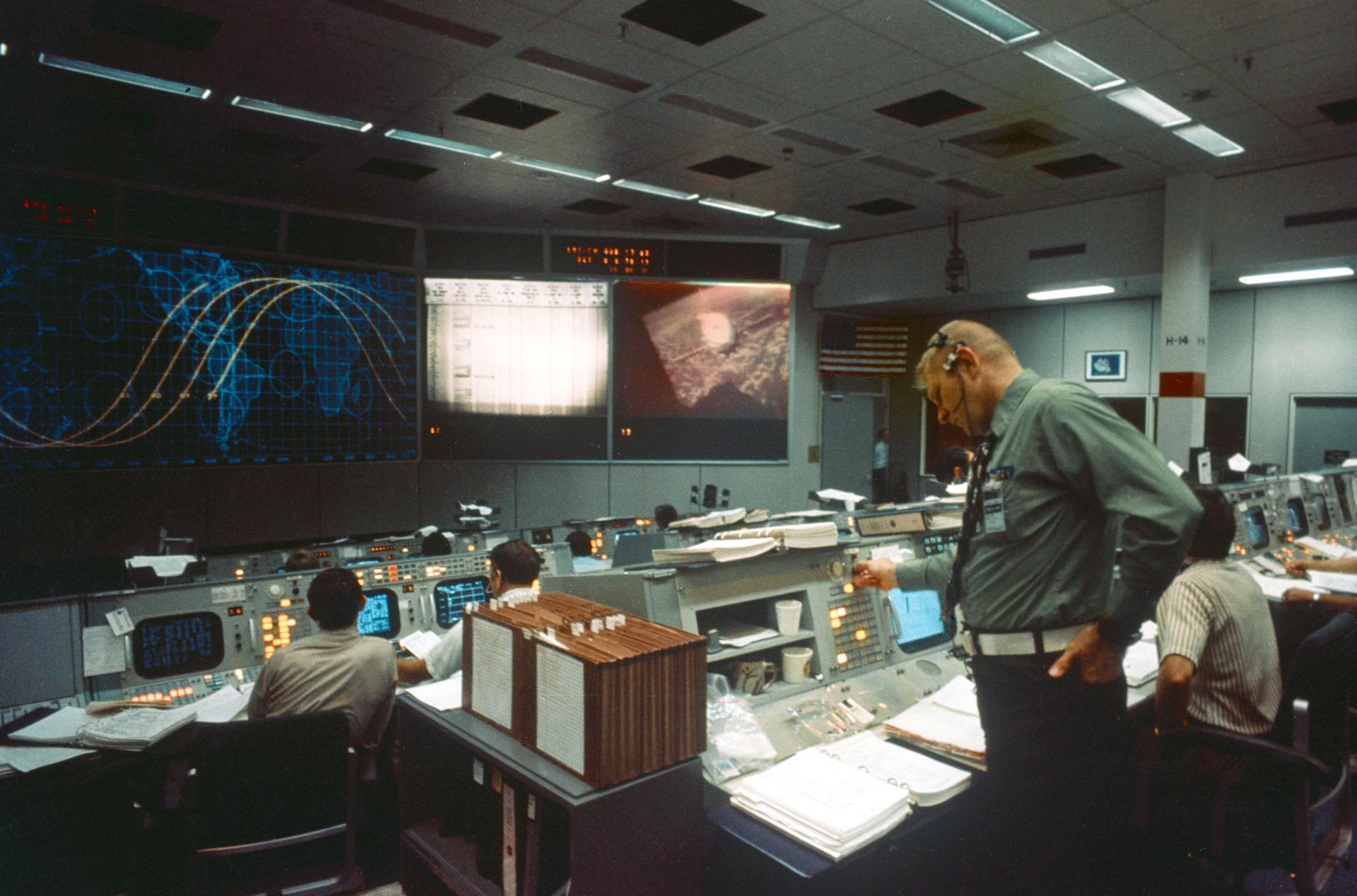
She emphasized the partnership’s remarkable durability despite political tensions. “We’ve had many ups and downs with our partner, first the Soviet Union, now Russia, and yet this is an unbroken cooperation from 1975,” Melroy stated.
The collaboration that began with Apollo–Soyuz laid the foundation for deeper partnerships in the decades that followed. That legacy continues in the International Space Station (ISS) which brings together five space agencies and twenty-three nations in a single effort to work in orbit. Melroy played a leading role in assembling the station. She spoke about the challenges of bridging differences in language and engineering philosophy as well as in how teams approach spare parts and system redundancy. What once appeared to be obstacles became strengths under a shared mission. Since November 2000 the International Space Station has been continuously inhabited, serving for nearly twenty-five years as humanity’s outpost in space and a lasting symbol of international partnership.
The multinational experience of building the International Space Station helped shape a new spirit of cooperation in space exploration. That same spirit now defines the Artemis Program and humanity’s renewed effort to return to the Moon. Nations including Canada, Japan, and the United Arab Emirates, together with members of the European Space Agency, are working with the United States to build the Lunar Gateway. The outpost will orbit the Moon and serve as a hub for future exploration beyond it. The Artemis Accords form a set of international agreements that establish peaceful norms for lunar exploration. To date, 56 countries have signed the accords. Reflecting on this growing network of cooperation, Melroy noted in a recent press briefing that the future of space exploration must remain rooted in the same spirit.
During a press briefing she emphasized that the future of space exploration should continue to be built on cooperation. When asked about the growing U.S.–China rivalry in space she offered a measured and thoughtful response.
“As someone who has flown in space as an explorer, I believe that the more people that fly in space and the more that we explore space the greater the benefits for humanity,” she said. “But those benefits require transparency, collaboration and sharing of information.”
She added that the way humanity ventures into space is just as important as the technology that makes those journeys possible. “As humanity goes into the solar system, how we go and bringing the best of humanity and all of us together matters as much as the technology.”
This article was produced as part of the NASA Impact Series by Popular Science Korea.

2025 Home of the Future Awards
