

What your votes told us
Not long ago, we ran a poll asking whether Verizon’s promos and offers could make up for the price hikes. And honestly, the results didn’t shock me. As of the moment I’m writing this, roughly 63% of you said promos absolutely do not make up for higher bills. Only around 6% thought they do, and a bit over 30% took the “maybe – but only if the perks are truly worth it” stance.
That tells us something pretty straightforward: if Verizon plans to win you over by sprinkling in streaming services like Apple TV+, HBO Max, Netflix, or whatever else it can bundle in, that’s probably not going to cut it.
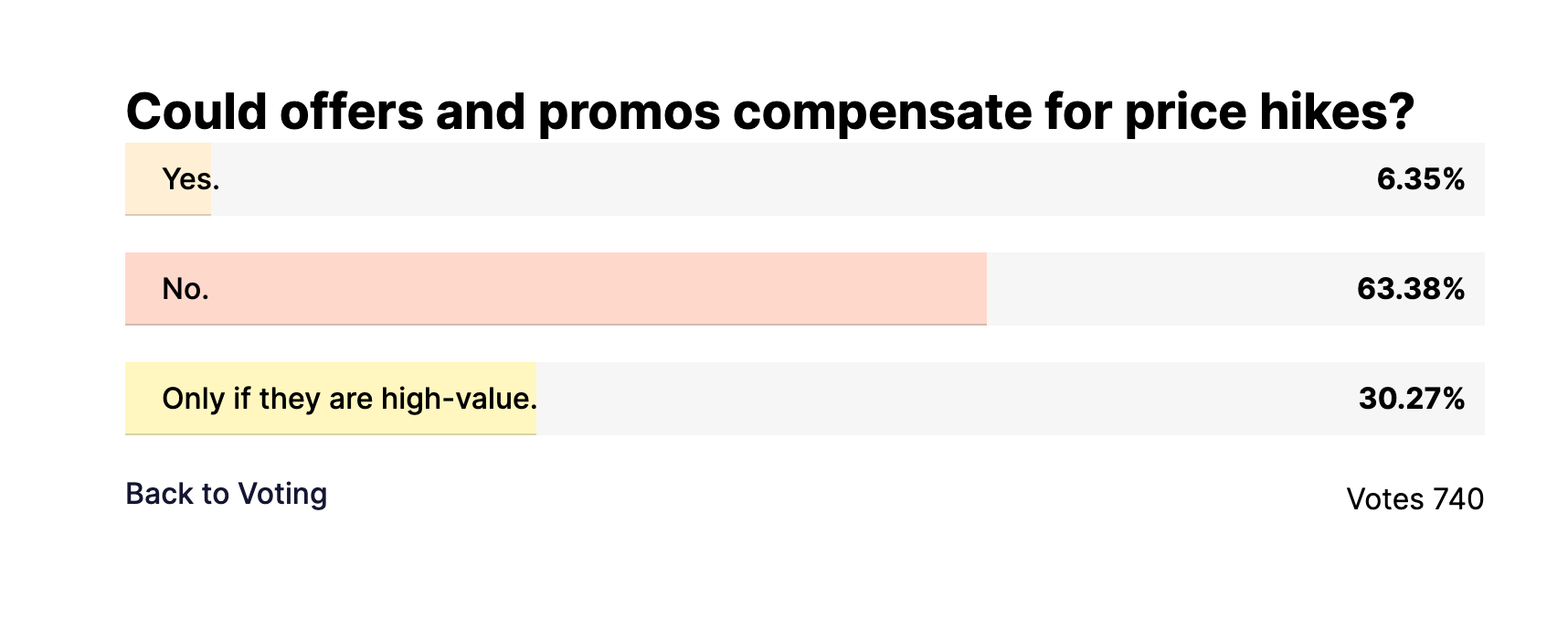
Most of you said promos do not make up for price hikes. | Screenshot by PhoneArena
Something like offering free phones on its top-tier plans – the kind of thing we’re seeing in the holiday promos for the iPhone 17, Galaxy S25, and Pixel 10 – might count as high-value to some. But even then, a higher price is still a higher price.
And I’m completely with the majority of you: no promo is enough to justify price hikes when nothing meaningful has improved. If Verizon was rapidly expanding 5G coverage nationwide, okay, that would make more sense. But paying more to still end up on LTE in most places outside big cities? That just feels wrong in 2025.
We’re literally talking about 6G already being on the horizon, yet some areas can’t even get solid 5G, while prices keep climbing. So, yeah, I get why so many of you voted the way you did.
And while this is happening, T-Mobile is sitting there with cheaper plans, better 5G coverage, and perks already baked into the price. With Verizon, you’re still expected to pay extra for add-ons most of the time.
So nope – promos and short-term offers aren’t what fix a price hike. Better service, stronger 5G reliability, and actually improving the customer experience would go much further.
But why did we ask this in the first place?
The whole reason this poll happened is that Verizon has been steadily losing market share, and Schulman – the new CEO – is trying to stop the bleeding. But he’s not interested in cutting prices, so he’s looking at other ways to create value.
But here’s the issue: Verizon charges the most out of the big three right now. That worked back when it clearly outperformed its rivals, but now that advantage has faded. You can’t keep charging premium prices when the premium experience isn’t as consistent anymore.
Verizon also seemed convinced that its “high-value customers” – the ones who either have money to spare or don’t care much about price shifts – would balance out the customers it lost. But three quarters of consecutive losses made it clear that this approach just doesn’t work.
And it’s not only battling AT&T and T-Mobile anymore. Prepaid carriers like Google Fi, US Mobile, and Mint Mobile are getting stronger and stronger, and more people prefer to go with them, instead of having to deal with the big three.
Schulman might fully understand where Verizon went wrong, but if he keeps holding back on lowering prices, he might push even more customers toward those cheaper alternatives.
