


It’s been a good year for metal detectorists. From a giant Iron Age hoard to tens of thousands of ancient coins and a 19th century shipwreck, it’s a wonder everyone isn’t having a go at the treasure-hunting trade. And now there’s yet another discovery to add to the list.
Archaeologists in Norway have excavated a Viking Age grave of an individual bedecked in costume and jewelry, as reported by Norwegian SciTech News, an outlet that publishes research news from the Norwegian University of Science and Technology and the Scandinavian research group SINTEF.
The team began their work after metal detectorist Roy Søreng discovered an oval brooch in Trøndelag County and reached out to researchers. They have since been excavating in secret to preserve the area and its archaeological riches.
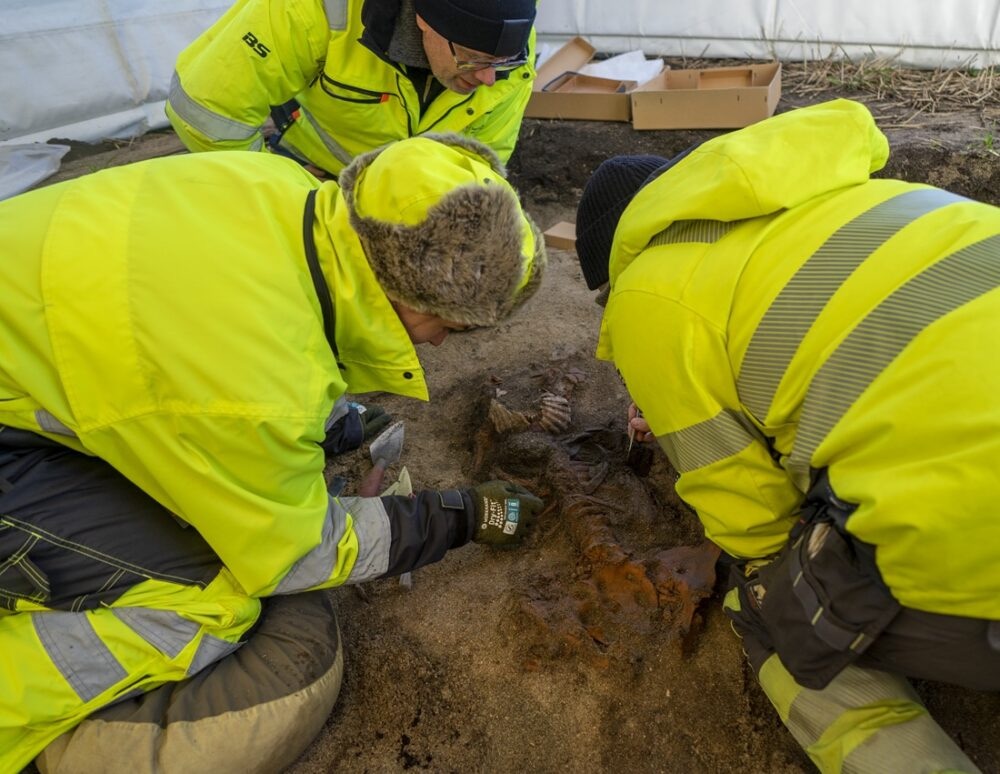
“The Viking Age grave contains what we believe to be a woman, buried with a typical Viking Age costume and jewelery set from the 800s,” Raymond Sauvage, head engineer at the NTNU Museum’s Department of Archaeology and Cultural History, told the outlet. “This indicates that she was a free and probably married woman, perhaps the mistress of the farm.” Sauvage also works as the archaeological surveys’ project manager.
The grave includes skeletal remains, two oval brooches (including the one Søreng found) that attach to a suspender dress’s straps, and a ring buckle used to close a petticoat’s neck opening. The most notable feature, however, is two scallop shells that partly covered the deceased’s mouth. While scallop shells were a Christian symbol related to the cult of St. James during the Middle Ages, they are exceedingly rare in pre-Christian graves.
“This is a practice that is not previously known from pre-Christian graves in Norway. We don’t yet know what the symbolism means,” Sauvage explained. He and his team also identified bird bones, likely wing bones, along the grave. According to Norwegian SciTech News, the shells and bird bones were probably meant to communicate symbolic meaning to the people who observed the burial.
The excavation follows the previous discovery of a pristine skeleton, recorded this same year at the same field. According to Hanne Bryn, field supervisor also from the Department of Archaeology and Cultural History, the recently discovered individual is likely one to three generations younger.
“During the inspection, we quickly realized that we were facing a new skeletal grave that was in acute danger of being damaged during the next ploughing,” Bryn explained. Thankfully, landowner Arve Innstrand let the excavation continue.
Next comes the analysis. “We will examine the skeleton, preserve the objects and take samples for dating and DNA analysis. The goal is to learn more about the person and about possible kinship to the previous find from the same place,” Sauvage said. Researchers will also investigate body height, gender-defining traits, and potential traces of disease.

2025 PopSci Outdoor Gift Guide
