

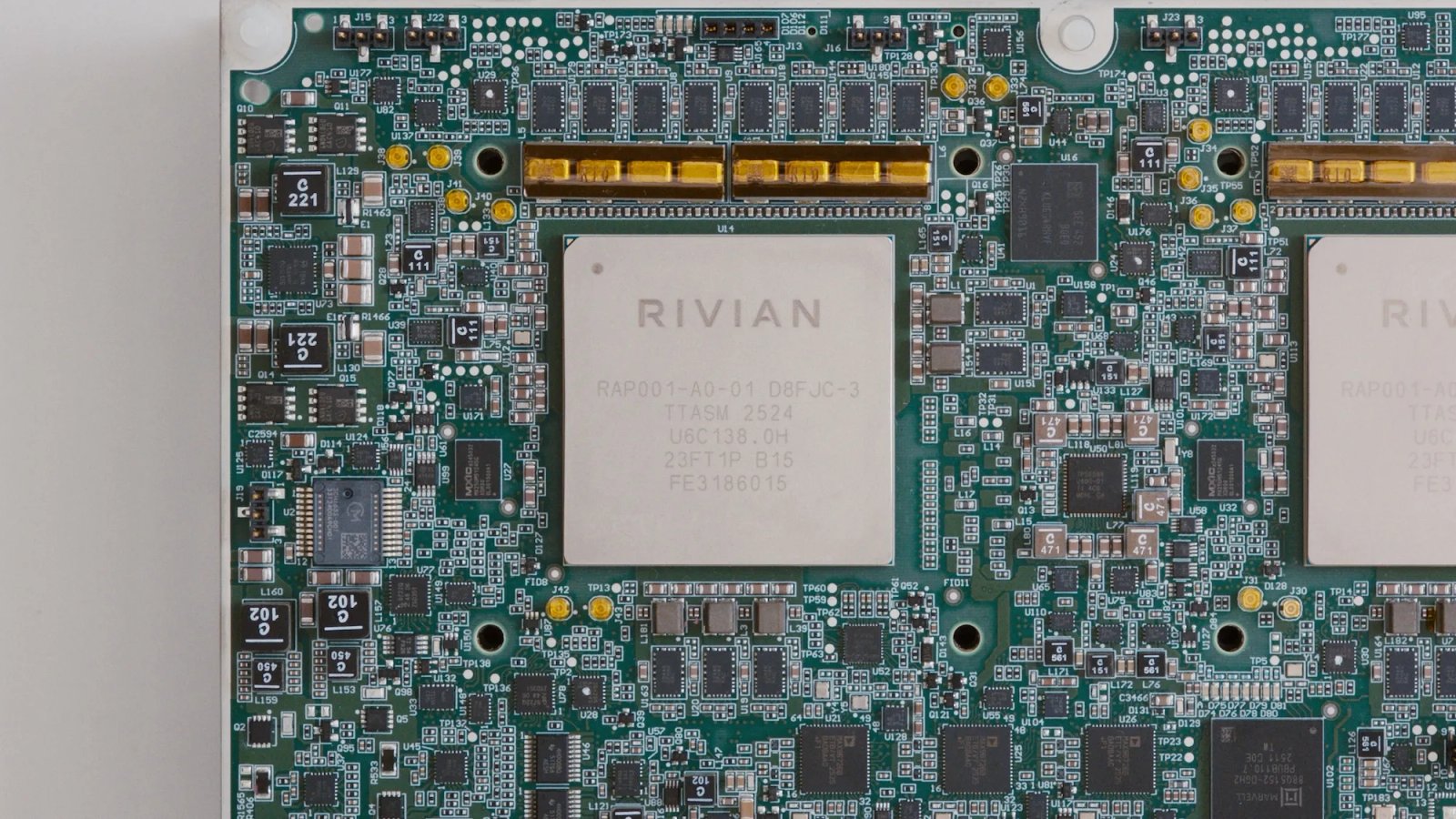
Rivian founder and CEO RJ Scaringe hosted the EV manufacturer’s first Autonomy and AI Day this week, announcing a slew of big advancements from his no-longer-fledgling company. Appropriately, from Rivian’s headquarters in Silicon Valley, the automaker revealed a project it has been keeping under wraps: a silicon chip of its own design.
The chip is a processor that powers the next version of Rivian’s on-board computer. Dubbed Autonomy Compute Module 3, it’s capable of 1600 sparse INT8 (8-bit integer) TOPS (trillion operations per second) and 5 billion pixels per second of processing power. Without getting too deep into the bits and bytes, these numbers are indicative of bar-setting performance.
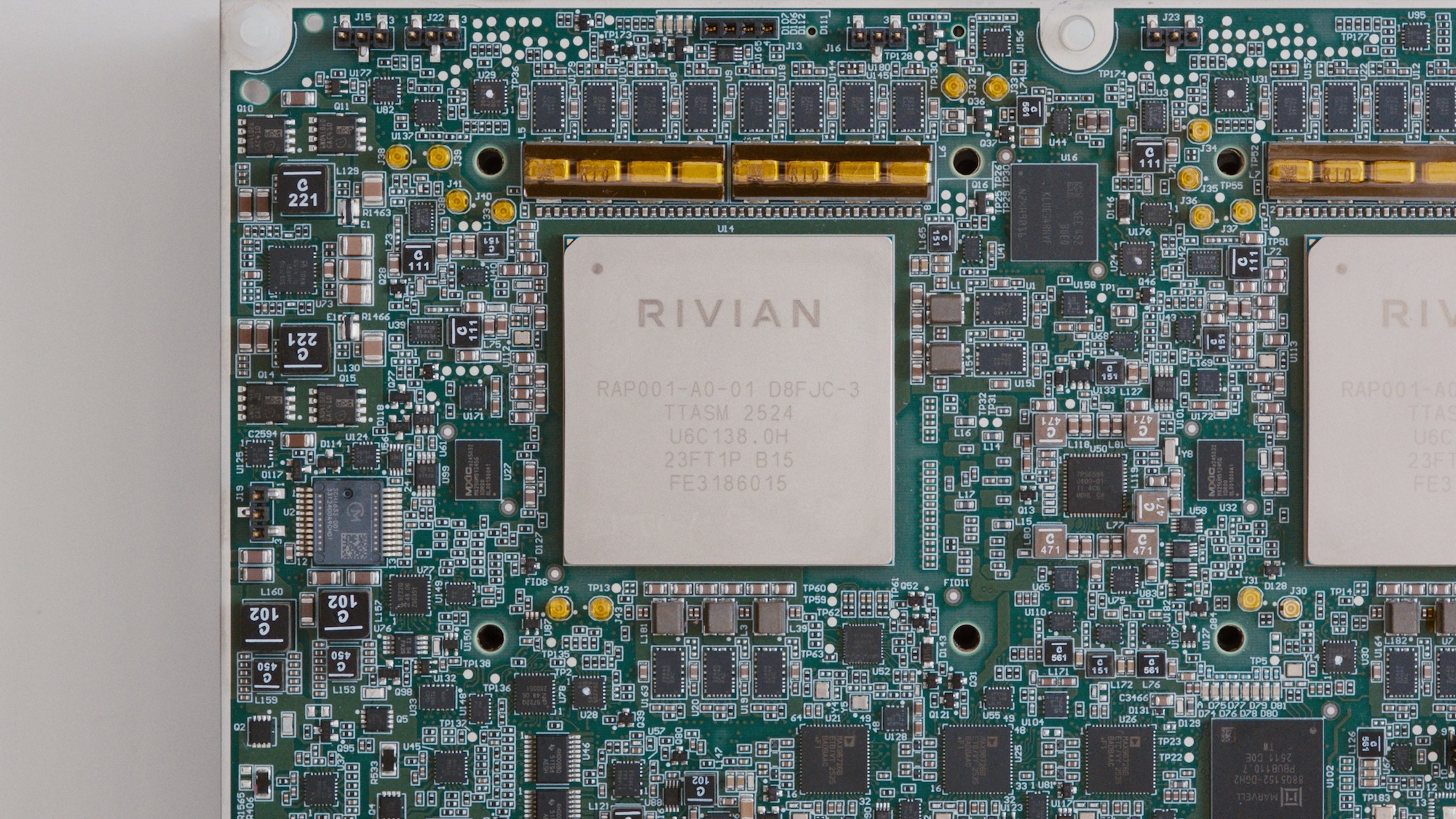
Rivian is talking about data with numbers that boggle the mind. For scale, Rivian says this new setup will quadruple the capabilities of the Nvidia-chip-centered system it’s currently using.
Rivian focuses on the neural engine and a new middleware stack
Semiconductors are the brains that run just about everything digital in our lives now, from smartphones to cars. Chip manufacturing generally requires a multi-billion dollar facility with cleanrooms and an incredibly complex process that results in tiny silicon-based wafers. That’s not what Rivian is doing; the automaker sources the chip itself, but the design and housing are all done in-house by Rivian. Designing an in-house chip was just a dream a couple of years ago, but it’s a massive advantage.
“We’re cognizant of the fact that we are a car company, not a full time chip company,” says Vidya Rajagopalan, Rivian’s senior vice president of electrical hardware. Rajagopalan worked on the Model 3 at Tesla and for several silicon and systems companies before joining Rivian in 2020, and she knows what she’s talking about. Rivian works with ARM and uses the company’s microprocessor while Rivian designed the core, which is the neural engine. That’s the most important part of the chip, Rajagopalan says, and that’s where Rivian adds the most value.
“Building a chip is time consuming and requires a world class team,” Rajagopalan says. “But the benefits are velocity, performance, and cost. This means we’re able to get to market sooner with a cutting-edge AI product and we can optimize our silicon for our use cases with room for models of the future. We don’t carry the overhead with a design that was designated for another purpose.”
In other words, designing the chip allows Rivian to customize the system along the way instead of receiving a universal chip and figure out how to make it fit. Customizing its use of AI is a major tenet of the company’s game plan, underpinning its software, autonomy research and mapping, and Rivian Assistant, its new voice command setup. Wake it up with “Hey Rivian” and the system can handle complicated, multi-part requests, interruptions, and a texting interface that circumvents the need for Apple CarPlay and Android Auto.
Another aspect of the equation is Rivian’s new middleware stack, also developed in-house. Middleware is the glue that ties the pieces together, acting as a bridge to connect different applications, databases, and services. It maximizes flexibility and speeds up testing and development, scaling across various platforms and computing hardware.
Rivian forges ahead with a plan for ubiquitous artificial intelligence
Rivian also unveiled its next-generation autonomy platform, which will be run by its new chips. The proprietary, purpose-built silicon was designed to “achieve dramatic progress in self-driving,” Scaringe says, as part of his road map to reshape the future of the industry with artificial intelligence.
“AI is enabling us to create technology and customer experiences at a rate that is completely different from what we’ve seen in the past,” Scaringe says. “If we look three or four years into the future, the rate of change is an order of magnitude greater than all the experience from the last three or four years.”
As the market debates a potential “AI bubble” that could crash like the dot-com bubble of the late 1990s, technologists, politicians, and ecological specialists have expressed their concerns. AI, for all of its potential, also represents threats to the environment due to its vast energy requirements and job loss.
“The integration and adoption of AI in real-world settings can be complex and create unwanted outcomes as we pave our way forward,” says Ali Shojaei, a professor at Virginia Tech. “For example, the environmental impact and energy consumption of AI cannot be overlooked. Data privacy and security are also valid concerns with the increased use of AI and automation of sensitive information.”
Scaringe insists we’re in the middle of a technology inflection point.
“The way that we approach AI in the physical world has shifted dramatically, and the idea of not having fully capable artificial intelligence across every domain of our lives will be almost impossible to even imagine,” the CEO predicted in a video released this week.
Up until about five years ago, Scaringe says approach was centered on a rules-based environment with a set of perception sensors to identify and classify objects. A few years ago, it became clear that the approach needed to shift to a neural net-like understanding of how to drive.
All this will come to fruition on the upcoming R2 model with Rivian Autonomy Processor 1 chips and a new LiDAR sensor, combined with cameras and radar technology. Waymo’s driverless rideshare vehicles, for example, use LiDAR sensors all around the vehicle, sending laser pulses in all directions to detect objects. Rivian’s main lidar sensor is built into the car above the windshield instead of the Waymo-style dome that screams “taxi.”
Scaringe’s updated vision for self-driving Rivians kicks off in 2026, when the automaker will roll out point-to-point navigation in the R2 and via over-the-air updates for its second generation vehicles. Rivian is clearly aiming for self driving that doesn’t require the driver to keep their eyes on the road without the need to be engaged in the operation of the vehicle. And after that, the CEO says, is level 4 autonomy, which means the car could drop the kids off at swim practice for you.
Rivian engineers admit its autonomy is a work in progress, and every R2 vehicle will be eligible to provide crowd-sourcing training for the system via AI. When asked about the multiple instances of Waymo vehicles illegally passing school buses, director of product and programs of autonomy Nick Nguyen pointed out that the driver is still responsible in level 2 autonomy situations. This is not yet at level 4.
“We will not be able to handle every single situation the car can encounter, but if the person is looking at the road [which is required at this level], in that situation the driver should take over,” Nguyen emphasizes.
The company will start charging for its Autonomy+ software platform next year; customers can either pay $2,500 up front or a $49.99 monthly subscription. That’s less than Tesla’s FSD system, which requires either $8,000 in a lump sum or $99 per month.

2025 PopSci Outdoor Gift Guide
