


T-Mobile beats Verizon with a final score of 8-1
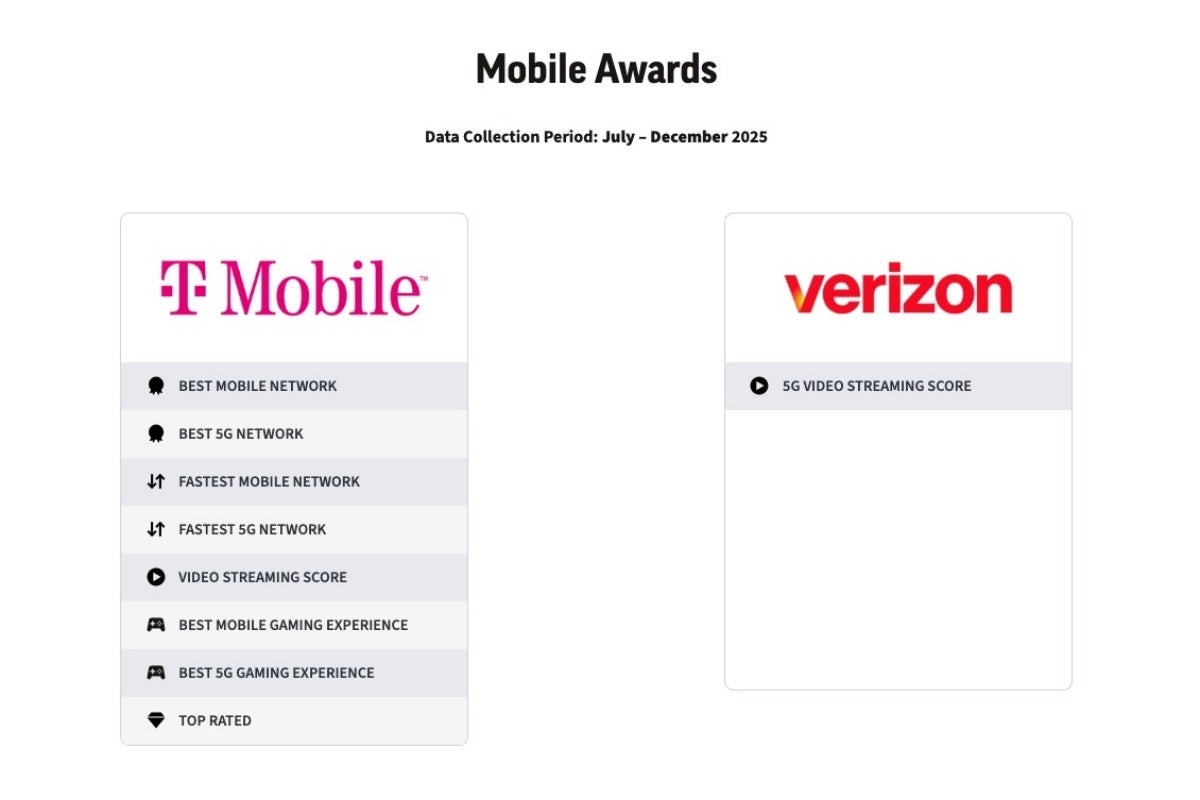
That’s A LOT of awards for T-Mobile and a single consolation trophy for Verizon. | Image Credit — Ookla
What’s weird is that Ookla is the (parent) company behind both these studies, although the explanation for the radically different results is pretty simple. On one hand, RootMetrics bases its research on network speed, performance, reliability, and responsiveness tests conducted by its own employees while driving more than 246,000 miles and visiting over 6,800 indoor locations in every single US state.
On the other, the Speedtest Connectivity Report relies on consumer-initiated tests, which might be more representative of the daily experience of the average user on T-Mobile, Verizon, and AT&T without carrying the same statistical or scientific weight.
If you choose to give this type of research more value and trust, then T-Mobile should definitely be your go-to mobile network operator going forward, as it offers not just the best overall service but also the best 5G signal, the greatest speeds (with or without 5G factored in), top gaming experience, video streaming experience, and the best user ratings as well.
T-Mobile has officially broken the 300 Mbps 5G speed barrier
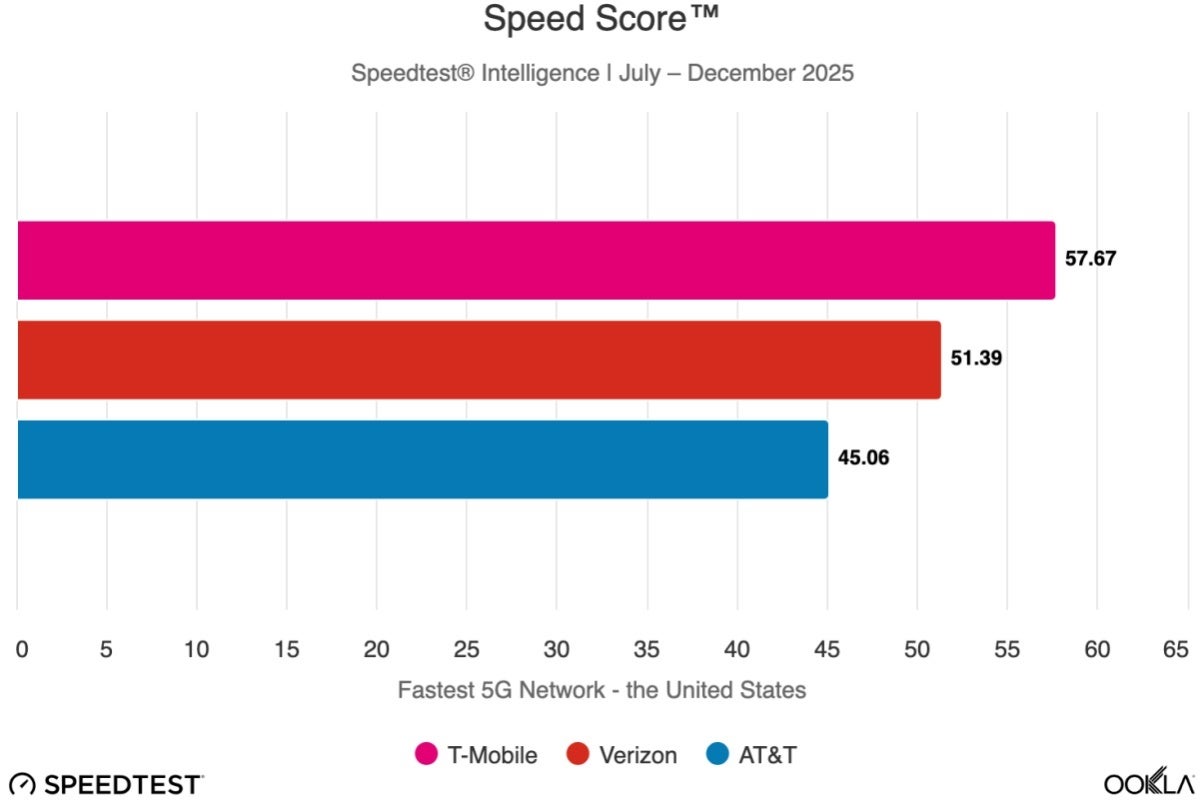
T-Mobile’s advantage over Verizon in 5G speeds may not look huge in this graph, but it’s definitely pretty significant.
Of course, AT&T‘s results are even more disappointing (pretty much across all categories), while Verizon can find a little solace in edging out the 5G video streaming battle… if we ignore that T-Mobile actually holds the advantage now in overall video streaming performance after losing that trophy in H1.
Interestingly, Verizon came out on top in H2 2025 in terms of mobile coverage, but for some reason, Ookla didn’t add that win to the final “mobile awards” tally. The same is true for T-Mobile‘s relatively easy 5G availability victory over AT&T, which was evidently deemed a less significant aspect of the overall network performance than the very subjective “consumer sentiment” factor.
Perhaps unsurprisingly, the mighty “Un-carrier” reigned supreme in terms of Speedtest user ratings with an average score of 3.73 (out of five stars). What’s worth mentioning here is that T-Mobile, Verizon, and AT&T all saw their scores drop between H1 and H2 2025, which is clearly not good news for the three carriers and the US wireless industry on the whole.
Should you care about these latest tests?
Like I said, it’s totally up to you if you pay more attention to Ookla’s RootMetrics studies or Ookla’s Speedtest reports. What you probably shouldn’t do is ignore all these network performance evaluations and think you (or your friends and family) know better.
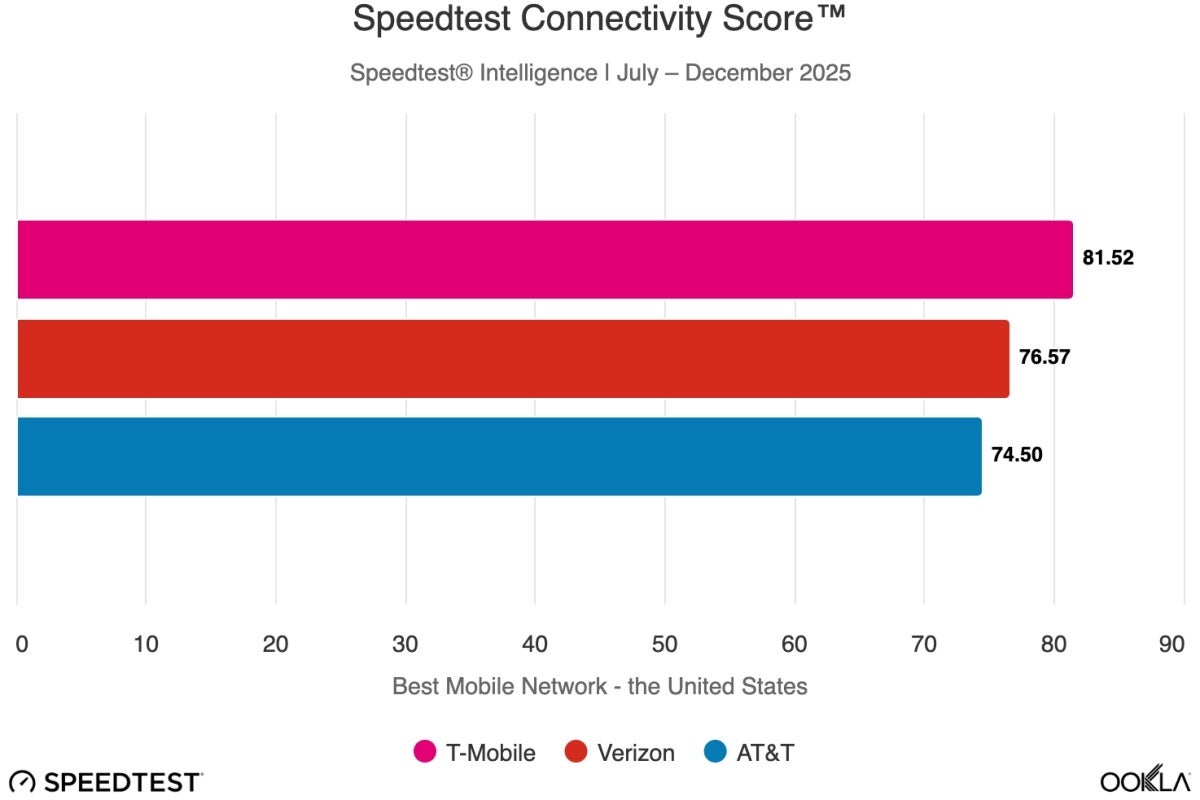
T-Mobile seems to have a pretty comfortable lead in the overall mobile network category, while Verizon and AT&T are duking it out for second place.
Yes, your personal experience is the one that counts the most when deciding to stick with a carrier or switch to a new one, but if millions and millions of tests across the nation show that a network is worse than the other two (cough, AT&T, cough), you’ll undoubtedly feel that in your day-to-day use sooner or later.
