

We may earn revenue from the products available on this page and participate in affiliate programs. Learn more ›
I started riding an electric commuter bike out of necessity. Living in the suburbs of D.C. means our Metro lines sometimes shut down for weeks (or even months) for repairs, and driving into the city can easily run $20 or more each way once you add tolls, hot lanes, and parking. When I crunched the numbers, an e-bike—in my case, my first Specialized Turbo Vado—started to look downright economical. What I didn’t expect was how this one piece of outdoor gear would transform my commute into the best part of my day: a chance to decompress after stressful work hours, sneak in a workout, and actually enjoy the ride.
The beauty of e-bikes is that pedal-assist power helps close the gap between your fitness level and the distance between home and office. They make long commutes feel shorter, tough hills less intimidating, and everyday riding way more doable. And the latest generation of commuter e-bikes is smarter than ever: think longer battery life, improved torque and cadence sensors (plus the ability to switch between them), integrated security features, and more throttles for when you need a cheat code.
The goal? A bike—like our best overall, the Priority Current Plus—that keeps your bum happy, makes commuting easier, and during a great promotion doesn’t cost so much you’ll be working extra shifts to pay it off. We’ve updated our list of the best electric commuter bikes to do exactly that.
How we selected the best electric commuter bikes
As a long-time bike commuter, I know how riding the same roads—smacking into the same roots, rattling over the same cracks, and climbing the nemesis hill—can really do a number on your backside. That’s why I test these bikes in the wild, not on some cushy closed course. Think city streets with sketchy bike lanes, suburban roads where drivers forget bikes exist, and trails that are smooth one minute and out to sabotage you the next.
To test the battery’s range, I take each e-bike on a 16-mile loop with about 1,300 feet of elevation changes. The route is part obstacle course, part endurance test: stoplights, crosswalks, runners with earbuds, stroller-pushing parents, and plenty of other cyclists jockeying for space. I set the pedal-assist to max, turn on the lights, and ride until the battery taps out to figure out the low end of the range. But don’t picture me rocketing along at 28 mph like some Tour de France hopeful. Between the traffic stops and trail chaos, my average speed is a much more mortal 12 to 15 mph. The point is to see how far you can get without being drenched in sweat—exactly what you’d want going back and forth on work days.
The best electric commuter bikes: Reviews & Recommendations
Sure, any e-bike can technically get you from A to B. But a great commuter bike makes the ride something you’ll actually look forward to, even when the weather is meh and traffic is worse. Here’s what matters most:
- Lights: Not optional, though you may want supplemental lights. They help you see and make sure cars, buses, and daydreaming drivers see you.
- Fenders: Say no to the dreaded stripe of road filth up your backside. (It’s as gross as it sounds.)
- Racks: Let the bike carry your stuff. Backpacks are great, but they mean showing up to work sweaty in warmer temps. Instead, check out our tips for how to carry stuff on your bike.
- Comfort: The real secret sauce. If the bike feels good, you’ll ride it even when it’s humid, chilly, or drizzly.
Bonus tip: Part of the fun is finding the bits and bobs that make your bike yours. Take your pick, grab some of the best electric bike accessories, and off you go. A helmet isn’t an accessory; it’s a necessity. Get the best one you can, especially when your e-bike tops out at 20 to 28 mph.
I recommend checking out the options below to find what matches your use case, reading our guide on what to expect on your first ebike ride, and going from there.
All prices may fluctuate based on tariffs and other factors.
Best overall e-bike for long commutes: Priority Bicycles Current Plus
See It
Pros
- Mid-step frame offers easy on-and-off for riders of all sizes
- Grippy 650b x 50mm Goodyear touring tires deliver confident handling and comfort
- Choice of fast-changing 5-speed Shimano hub or smooth Enviolo trekking hub
- Hydraulic disc brakes with motor cut-off
- Low-maintenance, whisper-quiet carbon belt drive system
- Impressive torque for quick acceleration and hill starts
- Thumb throttle for instant power boost on demand
- Practical commuter setup with half front and full rear fenders, integrated 600-lumen front light, and rear fender light
Cons
- Enviolo hub shifting requires a short learning curve to perfect timing
- Bike weight is manageable but could challenge smaller riders when lifting
- Need to retighten fenders from time to time to prevent rattle
Specs
-
Motor:
500W mid-drive motor w/ 140Nm torque -
Battery:
720Wh capacity -
Removable battery:
Yes, with lock -
Compliance:
UL 2849 and UL 2271 -
Riding range:
20 to 75 miles (in Class 2 mode) -
Class:
Ships as Class 2, can be unlocked to Class 3 -
Throttle:
Yes -
Top speed:
28 mph -
Bike weight:
55 pounds -
Frame sizes:
S, M, and L fit riders from 5’ to 6’3”
At first glance, the Priority Bicycles Current Plus may look like many typical e-bikes, but on first ride, you realize it’s a feature-packed powerhouse. The 2025 Current 2.0 takes everything riders loved about the original belt-drive model and turns it up a notch. It’s smoother, stronger, and smarter, packed with refinements born from real-world feedback. Riders begged for a convenient thumb throttle for effortless riding, and this one hauls.
The Current Plus packs the power of some moped-styled e-bikes with battery capacity bumped up to an eye-popping 720Wh (up from 500Wh), supporting longer rides for the 500w mid-drive motor and hill-flattening 140Nm of torque. The Current Plus hits Class 3 speeds of 28 miles per hour with five selectable assist modes to align with your pedaling, so riders can quickly accelerate to keep up with cars on shared roads, easily maintain consistent speeds, and confidently stop with upgraded hydraulic brakes and an electric cut-off. I felt like I had killer quads and unflappable fitness, which is sadly not true. There’s no suspension, but 650b x 50mm tires smoothed out bumpier stretches of my boosted personal best.
The drivetrain still couples a low-maintenance Gates Carbon Belt (less grease, less grief) with either an internal 5-speed Shimano hub or a stepless Enviolo trekking hub for $3,299 or $3,499, respectively. I’ve been testing the Enviolo with a continuously variable transmission, aka no set gears. To shift, you twist the right handle to make a rider’s figure either steepen up a hill or flatten out. It took a bit of practice to get the timing right for when you need to ease off pedaling and adjust. Once I got a feel for how to avoid shifting under load, riding the Current Plus felt more like I had superpowers, not a motor helping me out.
The Current Plus enhances the original’s strengths while adding subtle but practical improvements to geometry and ergonomics for more stability on rough roads, like redesigned handlebars that sweep back slightly. The upright stance keeps creases out of work outfits and visibility enhanced. The motor controls remain well-positioned by the left thumb, now including the new throttle feature—simply press the button down and easily catch up. The backlit display, meanwhile, stays centered to keep your eyes on the road. The 600-lumen bike-powered front light casts wide and is shockingly bright—it actually illuminates dark bike lanes/trails—and the rear tail light adds to safety.
Touchpoints like the ergonomic grips and wide, gel-cushioned saddle are better than average, too. The frame is multi-height friendly with what the company calls a “mid-step frame” that’s lower than a traditional triangle but higher than most low-step or step-thru options (another contributor to keeping clothes crisp). The removable battery features a lock and a button-release that prevents it from falling out before you’re ready during removal (though on-bike charging is also an option). For the price point, I might like cleaner, more internal cable management around the handlebars, but it’s a small quibble.
Priority is a direct-to-consumer brand, and its analog bikes aren’t hard to finish yourself, even if you’re not a regular wrencher. But the company encourages you to have your local bike shop assemble e-bikes, which will be an additional fee (shoutout to Alexandria, VA’s Strictly eBikes for preparing my Current Plus). The bike—available in charcoal and white—also ships as a Class 2 e-bike with a top speed of 20 miles per hour, so if you’re wondering why you’re not getting the output I’ve described, it’s because you need to unlock Class 3 in the settings. However, check local laws before you do.
I’ve used the Priority Current Plus to haul packages and my pet, and just haul at high speed to get to appointments, and it’s proven to be the perfect bike for rush hour or just to get a rush while cruising bike trails without worrying about hills or headwinds.
Really want to max out your performance and smooth out your ride? The $3,999 Skyline SMART.SHIFT E-Bike ups the motor to 750w and adds a suspension fork plus a Pinion Smart.Shift C1.12i gearbox for seamless shifting.
Best value commuter e-bike for most people: Ride1Up Roadster v3
See It
Pros
- Fast-rolling 700 × 45c Schwalbe G-One RS gravel tires that grip confidently on pavement or smooth dirt
- Strong hydraulic disc brakes that stop smoothly and predictably
- Handy throttle for effortless launches or quick boosts through traffic
- Intui-Drive torque sensor delivers responsive, natural-feeling pedal assist
- Bright 120-lux front light and integrated rear fender light for nighttime visibility
- Chainguard stay helps protect pants and drivetrain
- Optional PIN to unlock motor
Cons
- Shorter riders should check the standover height carefully when choosing between low-step and medium frames
- Very stiff, non-suspension frame can transmit road vibration on rough pavement
- Rear-rack mounts work best with Ride1Up’s proprietary rack
Specs
-
Motor:
500w angled gear MIVICE hub motor w/ 50Nm torque -
Battery:
10Ah Samsung 50GB -
Removable battery:
Yes, lockable -
Compliance:
UL 2849 and UL 2271 -
Riding range:
25 mph (belt drive) or 28 mph (chain) -
Class:
1-3 -
Throttle:
Yes -
Top speed:
25 mph (belt drive) or 28 mph (chain) -
Bike weight:
40 pounds -
Frame sizes:
Low-step, M and L fit riders from 5’2” to 6’4”
The Ride1Up Roadster v3 packs a surprising amount of premium features into an extremely reasonable price tag of $1,395. It’s not the -est in most categories, but all the practical, souped-up features turn this lightweight e-bike into an appealing match for most riders—and potentially leaves some room in the budget for some smart upgrades.
Ride1Up also has one of the better direct-to-consumer experiences. The Roadster v3 arrived mostly assembled, with a thoughtful toolkit—a hex key set, seat post paste, and a torque wrench—and clear instructions that link to helpful YouTube videos. It was my second time tightening a Ride1Up bike to spec, and both builds were quick and frustration-free.
At around 40 pounds, its lightweight build remains one of its most compelling features. I can carry it upstairs solo and easily lift it onto my car rack or the higher racks in my building’s bike storage room. The frame is slim like a non-electric bike, making it easy to lock to racks with U-locks (which you can’t say about all ebikes).
From the first few miles, I was smitten with the nearly silent ride of the v3: the carbon belt and motor are whisper-quiet, and the fenders rarely rattle. The v3 has since worked its way into my regular rotation, and I’m approaching 500 miles on this model. I’ve been consistently impressed with the 500w hub motor that easily takes me up even my most formidable hills, the smooth, responsive pedaling enabled by the Intui-Drive torque sensor, and the bright-enough front light. This bike is for someone who plans to pedal most of the time, but occasionally wants to tap the throttle for a break or to power through a series of errands.
I happen to like the moderate riding position and the agility of a stiff frame, but eventually, I opted for some comfort upgrades. I swapped out the saddle for something with cutouts and added a Redshift ShockStop suspension post—both were huge improvements that let me ride longer in plain clothes rather than wearing padded bike shorts. I also added Ride1Up’s compatible rear rack, and came to appreciate a few features I initially overlooked, such as the optional PIN required to start the motor. Without it, a potential thief has to pedal the bike without any motor assistance, which, while possible, is a pain.
The battery life is still impressive. Just for funsies, I did a ride on Boost (the highest setting) with the lights on just to see how long it would last. On my test loop, it did 25.5 miles despite headwinds for several miles. That’s a solid performance. I usually ride around on the Eco, the lowest assist level, which sips at the battery, and I’ve gotten into the 40s. While going from 100% to 90% takes forever, anything under 30% seems to fly by. While that could be anxiety, the display blinks as a warning, and the bike becomes noticeably harder to pedal around 10%. As someone who gets lazy about chain maintenance, I happen to love the single-speed carbon belt drive. However, riders in hillier areas may want to consider the 9-speed Microshift Advent drivetrain v3 version with a traditional chain (with or without a suspension fork).
Need to haul stuff but don’t want a standard cargo bike? You can also consider the $1,595 Ride1Up Vorsa, the company’s “SUV of e-bikes.”
Best compact e-bike for last-mile commuters: JackRabbit OG2
See It
Pros
- The lightest, most compact e-bike I’ve tested
- Swappable batteries extend range
- Handlebars fold flat for easy transport
- 20-inch all-terrain tires
- Black and white digital display
- Foldable foot pegs
- Comfortable saddle
- Tons of accessories available for additional purchase
- Available in black, white, blue, or yellow
Cons
- No alternative to the throttle
- Lights and fenders are sold separately
- Would prefer hydraulic disc brakes for the speed that this can go
- Steep hills can seriously slow you down, or in some cases, stop you
Specs
-
Motor:
300W rear hub brushless electric motor -
Battery:
151.2Wh battery -
Removable battery:
Yes, but locks are an additional purchase -
Compliance:
UL2271 and 2272 -
Riding range:
Up to 10 miles -
Class:
2 -
Throttle:
Yes -
Top speed:
20 mph -
Bike weight:
25 pounds -
Frame size:
One size that fits 4’9” to 6’2”
When you live in a city, thinking about transportation can take up a surprising amount of energy in a day. You wanna go somewhere, but are you walking, taking a bus or train, calling a ride-share or taxi, or driving yourself? Is there even parking if you drive, or will you end up essentially back where you started to find a spot? When you’re taking a train, how long are you walking on each side of the ride? How many transfers? Even owning a bike isn’t that simple. Where can you store it? Does your building have an outdoor bike rack or a storage room? Or are you carrying it up a multistory walk-up and hosting it in your living room?
Enter the JackRabbit OG2, a mold-breaking micro e-bike that only weighs 25 pounds and sells for $1,250. This small package is one of the most fun and somehow practical “bikes” I’ve ever taken on a commute. Instead of pedaling, the OG2 relies entirely on the 300W rear hub motor and the throttle, which can go a surprisingly fast 20 mph for a range of about 10 miles.
Despite the small size (even smaller than the typical e-scooter, as you can see above), the OG2 accommodates riders as short as 4’9” and up to 6’2”, which I admit I was skeptical about. However, this has quickly become a favorite of my 6-foot-tall son for one very simple reason: It hauls. The OG2 is an e-bike in looks but not in operation. It’s more like a scooter you can sit on but with more stable steering and larger, more forgiving wheels. Instead of standing up super straight, you’re low to the ground for better balance. Picture a tall dude on a BMX, and you’re in the right ballpark. But with stationary pegs instead of pumping pedals, your legs don’t feel cramped. You might feel silly at first, but for me, this quickly morphed into what I think Toad feels like passing other drivers in “Mario Kart.”
The OG2’s diminutive size is the main appeal. It’s less than 49 inches long, and the handlebars and front wheel can “fold flat” to save a little more space if you need to walk it through a busy subway station, carry it onto a bus, or pack it into a car or RV. They even sell a bag to help you carry it (or ship it if you’re flying somewhere).
I’ve found I use it most for short errands near my house—like going up to the CVS about a mile away—or to tackle the last few miles left after riding public transportation. I’m lucky the Metro and the various bus lines cover as much as they do, but I still often have a few miles to go to get to my destination. The OG2 easily closes this gap, and when batteries start to fade, I can easily swap them out for backups roughly the size and shape of VHS tape (and, because of their compact size and capacity, you can pack them in your carry-on if flying).
If batteries die, though, I’m out of luck and walking unless I happen to be on top of a hill. And hills can be a problem. A long, steep hill can slow the OG2 to just a few miles per hour, even when the throttle is pressed all the way down. I haven’t had to walk yet, but I’ve come close.
For hilly areas, the OG2 Pro and its 500W / 17A / 50NM motor adds some extra pep. But you really want to upgrade to the more powerful and slightly larger JackRabbit XG with nearly twice the motor power, battery capacity, and range (and the XG Pro brings even a little more). These microbikes (or seated electric scooters, if you will) are hella fun. While many JackRabbit fans love personalizing their rides with the many accessories offered (as well as stock third-party components that fit the custom frame), it should be noted that adding racks and packs compromises their portability. I like the grab-and-go nature of them—and if I need to carry something, I put it in my backpack.
Best Dutch-style electric commuter bike: Trek Verve+ 1 LowStep LT
See It
Pros
- Step-thru frame makes for easy on and off
- 27.5-inch x 2-inch wheels
- 8-speed drivetrain
- Hydraulic brakes
- Wide and cushiony enough saddle
- Comes commuter-ready with integrated front and rear lights, and half fender in front and full rear fender
- MIK-compatible rear rack
- Two sets of bosses on frame for water bottle cages, etc.
- Multiple colors available
Cons
- Wide but slightly squirrely handlebars
- Integrated battery means plugging in the whole bike to charge
- Can be hard to tell when the charger is properly plugged in due to deep charging port
- Sluggish first pedal assist level
- Step-thru frame can be harder to lift and carry than a standard triangle
Specs
-
Motor:
250w mid-drive motor w/ 40Nm torque -
Battery:
250Wh capacity -
Removable battery:
No -
Compliance:
UL 2849 -
Riding range:
Not listed -
Class:
1 -
Throttle:
No -
Top speed:
20 mph -
Bike weight:
42 pounds -
Frame sizes:
S, M and L fit riders from 5’1” to 6’1”
I’ve owned several Trek models over the years, and the Verve+ 1 Lowstep LT e-bike reminded me of what this American bicycle maker does best. Trek is all about better-than-average components that make the $2,300 price tag feel like a steal, like cables that tuck in to the frame, commuter accessories including a chainguard, and Bontrager touchpoints like ergonomic handle grips and a wide, squishy-enough saddle that lets you skip padded cycling shorts. It was also perfectly tuned thanks to assembly by the pros at Trek Bicycles in Clarendon, VA.
The 8-speed Verve+ channels some Dutch commuter bike vibes, with an extremely upright riding position. I’m a shorty who usually opts for more aggressive postures, but I appreciated the improved road visibility from this taller vantage point. Even though I was sitting up higher than normal, the step-thru frame is an excellent option for shorter riders or anyone who doesn’t want to swing a leg over a saddle anymore. I particularly like it for the frequent stops and starts of city riding, and at 44 pounds, it’s a lighter-weight option, and easier to control and handle.
The simple control skips the screen and opts for red and green LEDs to indicate battery life and assist level. This e-bike isn’t about metrics: It’s for casual riders and commuters who want to hop on and confidently get to their destination. That said, I found the first assist level a little low; I had to put some work in to get going and get up hills, but the second level had considerably more oomph, and the third was practically a sweat-free ride even though I was still pedaling.
And by the way, the hydraulic brakes work. In an unexpected real-world test, an SUV turned into my bike lane and came to a dead stop. I’m pleased to say I didn’t crash into the side door, nor did I skid. I may have had a mild heart attack, but that’s not on the bike.
Best lightweight commuter e-bike: Tenways CGO600 Pro
See It
Pros
- Very lightweight
- Moderate riding position
- Nimble handling
- CST puncture-proof 700 x 45C tires
- Half-size fender in front and full fender in rear
- Included bell
- Adjustable stem
- Minimal, monochrome controls
- Integrated front light
- Carbon belt drive
- TEKTRO Hydraulic Disc Brakes
- Optional Tenways app
- Optional PIN to start motor
- Extremely quiet ride
- Multiple colors
Cons
- No built-in tail light, though it does come with a battery-operated one
- No bosses for water cages or other accessories
- Uncomfortable saddle
- Handles are grippy but could use more cushion
- No suspension features to soften road chatter
- Some unproductive pedaling as assist kicks in
Specs
-
Motor:
Mivice M080 350W rear hub motor w/ 45 Nm torque -
Battery:
360Wh capacity -
Removable battery:
Yes, lockable -
Compliance:
EN 15194:2017 + A1:2023 -
Riding range:
Up to 53 miles -
Class:
1 -
Throttle:
No -
Top speed:
20 mph -
Bike weight:
37 pounds -
Carrying capacity:
Not listed. -
Frame sizes:
M, L, and XL fit riders from 5’7” to 6’5”. -
Connectivity:
Tenways app
The Tenways CGO600 Pro converted me from a single-speed skeptic to a full-fledged fan. For me, it takes me back to simpler childhood bikes instead of thinking when the right moment is to downshift before a big hill. If I want to go faster, it’s up to my legs or increasing the assist level. At only 37 pounds, it feels a lot like a nimble, non-electric fitness bike rather than the tanks many e-bikes are. The aluminum frame is incredibly responsive, while the single-speed carbon belt drive version replaces the clackety-clackety-clackety of a chain coasting with a near-silent ride. No gears or derailleur also means far less maintenance and less tangling on bike racks (though there is now a Shimano 8-speed Chain Drive version, if you’re so inclined, particularly for inclines).
Within easy reach of my left thumb is a minimal LED screen that controls three pedal-assist levels powered by a sufficiently strong 350W rear hub motor. While changing levels is intuitive, more advanced functions like turning on the headlights or setting security passwords require reading the manual.
I thought this thing would choke on some of the larger hills and twisty corkscrew turns I encountered, but the 45Nm of torque was plenty. But in fairness, these are East Coast hills that the CS600 Pro handled. Tenways’ site lists the bike’s climbing range as up to 15 degrees, so keep that in mind if you live in proper mountains.
The bike’s range is listed as up to 53 miles, and for plenty of rides, I’ve gotten into the 40s on a single charge. On a particularly blustery day, strong headwinds cut my range down to about 20 before I needed to remove and recharge the 360Wh locking battery. This model does equally well with longer commutes as it does with shorter city rides that need to dodge pedestrians and cars, or lift onto a bus bike rack. Tenways also sells a power bank separately, which adds 180Wh, if you want to ride longer.
There are trade-offs for CS600 Pro’s lightweight build. The bike’s stiff aluminum frame is easy to maneuver on and off the saddle, but there’s also no suspension to absorb any of the bumps and cracks in the road. What you hit, you feel. The touchpoints weren’t great, either. After about a week of riding, I upgraded the rock-hard saddle to a softer gel version and the OK handlebar grips to ergonomic ones. The regular price is $1,899, though I’ve seen multiple end-of-season deals that knock up to $400 off. For that price, I don’t mind spending on a few upgrades.
Tenways can be found in local bike shops or sent directly to consumers. I built my mostly assembled CGO600 Pro in less than an hour, but that’s really best for people who are confident in their bike part knowledge and have a torque wrench to secure bolts and screws properly.
Best gravel-style bikepacking e-bike: Salsa Confluence Drop-Bar GRX 6000 2x
See It
Pros
- Comfortable geometry despite the aggressive position
- Drop bars have a nice flare
- Internal cable routing prevents tangles
- Compatible with internal dropper post routing but not included
- High-quality components from well-known cycling brands like WTB saddle, Shimano, etc
- Range extender battery available from MAHLE for total capability of 458Wh
- 700c x 42mm tires, which will fit fenders or tires up to 700c x50mm for something cushier
- Compatible with racks and fenders
- Tons of extra mounts for accessories
- Optional MAHLE MySmartBike app connects via Bluetooth to allow customizations, metrics, mapping, etc. Also supports Ant+ connectivity for other devices.
Cons
- No lights or fenders built-in
- Battery is only removable for service, which means charging the whole bike between rides
- No kickstand included but that is standard for gravel bikes
- Somewhat of a learning curve for position and color-coding of ebike controller, plus orange and red can be hard to tell apart
Specs
-
Motor:
MAHLE X35+ rear hub-drive system w/ 40 Nm torque -
Battery:
250Wh capacity -
Removable battery:
No -
Compliance:
UL 2849 and UL 2271 -
Riding range:
Up to 40 miles -
Class:
1 -
Throttle:
No -
Top speed:
20 mph -
Bike weight:
About 33 pounds -
Frame sizes:
49, 51, 53, 55, 57, 60 cm.
With its comfortable but far from cruiser geometry and only Class 1/40Nm of assist torque, Salsa’s Confluence isn’t necessarily designed for traditional commuting, unless your commute is regularly along the road less taken. But this option from the brand’s electric gravel lines appeals to my need to get to and from the office quickly and my weekend warrior side that wants to log in some time bikepacking. It’s an e-bike for people who love spending time in the saddle, customizing components to their exact liking, and still getting a workout in. The Confluence is for riders who want to go faster and farther, not just get from point A to B.
Based on the brand’s tried-and-true Journeyer gravel bike line, the Confluence is peppered with plenty of mounts on the frame and the forks for fenders, racks, and pretty much any cargo accessory you can imagine to attach, so you can easily transport a change of clothes for when you get to (or back from) the office. The Confluence’s frame is only slightly thicker than its analog counterpart, though the MAHLE X35+ hub-drive system in the rear wheel is the giveaway that you’re getting assistance.
Most e-bikes have handlebars cluttered with wires, screens, and assist controls. Not the Confluence. Internal cable routing keeps things clean, as does the screen-free interface. An iWOC One Controller sits on the top tube, which is a single button that does everything from powering up the bike to changing assist levels. This interface isn’t intuitive—you have to memorize what the colors mean, for example—but you can also connect your phone through the MySmartBike app or Ant+-supported third-party devices for a more traditional display. Still, there’s something liberating about not having stats and metrics in your face, especially during something as routine as commuting.
At only 33 pounds, the Confluence flies on roads and paths thanks to three levels of assistance. While the 40Nm of torque is plenty to boost speed, you’ll still need enough legs and cardio to get up hills using 11 gears and nominal help from the motor. As the sun sets earlier, you’ll also need to add some lights for visibility. We tried the top-of-the-line version with a price tag of $3,699, but Confluence options are available for less with two flat-bar options and two drop-bar options.
Best for fitness buffs who secretly love a shortcut: Trek FX+ 7S
See It
Pros
- Built-in Quad Lock wireless phone charger
- Bontrager Verse Comp split saddle
- Lightweight frame that’s easy to carry upstairs
- Integrated fenders and MIK rear rack and integrated rear light
- 700c x 40mm Bontrager H2 Hard Case Lite tires
- Optional 160Wh Range Extender
- Compatible with Trek Central app
Cons
- 250W motor might feel underpowered
- Stock headlight could be brighter for extra-dark commutes
- Requires a Quad Lock case to use the phone charger mount
Specs
-
Motor:
250W TQ HPR50 mid-drive motor w/ 50Nm of torque -
Battery:
360Wh internal battery -
Removable battery:
No -
Compliance:
UL 2849 -
Riding range:
Not published -
Class
1-3 -
Throttle
No -
Top speed
28 mph -
Bike weight
About 40 lbs. -
Frame sizes
S, M, L, XL fits riders from 5’1” to 6’6”
The Trek FX+ 7S feels like the electrified version of your favorite do-it-all fitness bike—and it rides like one, too. It’s not twitchy like a race-hungry road bike, and it’s definitely not a heavy trail bruiser either. Instead, it nails the sweet spot: nimble enough for your morning commute, chill enough for a weekend park loop.
Trek loaded this model with tech borrowed from their top-tier machines, including the whisper-quiet TQ HPR50 mid-drive motor with harmonic pin ring transmission. Translation: smooth, silent, and subtly powerful. It’s an ebike that enhances your ride, not one that takes over and turns you into a passenger.
Sure, the motor’s 250 watts and 50Nm of torque are modest by today’s throttle-heavy ebike standards. But that’s the point: You’re still pedaling, still feeling the effort, just with a delicious, wind-at-your-back boost. If you’re expecting a lazy no-sweat rocket ship, look elsewhere.
Where the FX+ 7S really shines is in the thoughtful details. Integrated front and rear lights? Standard. A Quad Lock mount on the stem that doubles as a wireless phone charger? Genius. (You’ll need a Quad Lock case—but there are options for iPhone, Samsung, Google, and even universal fits.) A sleek top tube display keeps your speed and battery life in check without cluttering your handlebars. Shifting is silky smooth thanks to Shimano’s CUES Linkglide system, and the lightweight frame keeps the ride lively whether you’re climbing hills or threading through traffic.
And bless Trek for the rattle-free fenders and MIK rear rack—cargo-ready without sounding like a busted shopping cart.
Of course, no bike’s perfect. The motor’s mellow output won’t make you king of the steep grocery-haul hill, and while the front light is pretty bright, it’s not going to light your way down a pitch-black backroad. A backup light wouldn’t hurt. The carrying handle is a good idea that needs to be easier to grip in the next version.
Bottom line: The FX+ 7S is for riders who want versatility without overkill. Light commuters, casual city cruisers, weekend adventurers—this is your jam. Trek clearly obsessed over the little things—cockpit cleanliness, rider comfort, everyday usability—and it shows. But like a finely tailored suit, these details come at a higher price tag (about $4,400).
Best premium electric commuter bike: Specialized Turbo Vado 4.0 Step-Through
See It
Pros
- Integrated front headlight and rear lights
- Internal cable management
- Front suspension fork
- Front and rear fenders
- Built-in rear rack holds up to 59 pounds
- Hydraulic disc brakes
- 11-speed drivetrain
- App offers additional controls
- Anti-theft local built-in to motor that unlocks with PIN or connected phone
- Multiple colors offered
Cons
- Magnetic battery charger can be difficult to connect
- Battery is removable but can be hard to get in and out
- Specialized’s apps come and go
- Long wheelbase can be hard to move when walking the bike
Specs
-
Motor:
250w Hyena hub drive motor -
Battery:
250Wh capacity -
Removable battery:
Yes, lockable -
Compliance:
UL 2849 and UL 2271 -
Riding range:
Up to 90 miles -
Class:
3 -
Throttle:
No -
Top speed:
28 mph -
Bike weight:
58 pounds -
Frame sizes:
S, M, L, and XL to fit riders from 5’1” to 6’4” -
Connectivity:
Specialized app
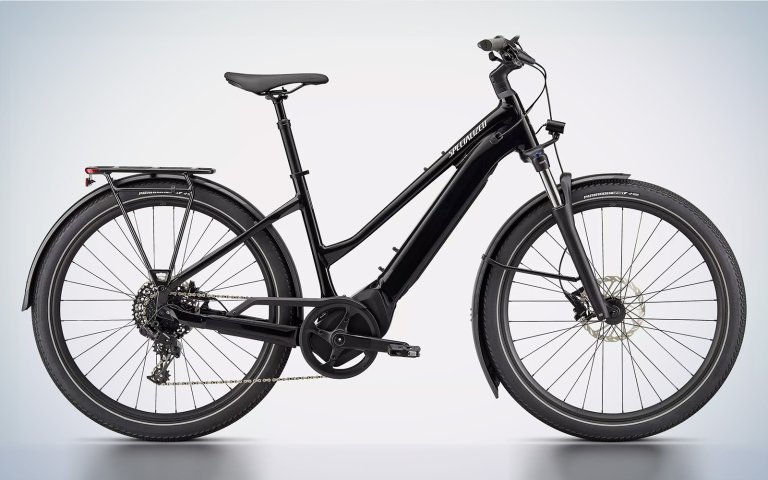
Specialized is an American company that has been making bicycles since 1974 and has launched several e-bike models under the Vado name. For a while, the company marketed the e-bike line with the phrase, “It’s you, but better,” which captures how riding the Specialized Turbo Vado 4.0 Step-Through feels. The latest iteration of the Turbo Vado features an upright riding position on high-volume 650b tires, which helps smooth out road unpleasantries when coupled with the front suspension fork. The battery is discreetly tucked into the downtube, and the powerful 250w mid-drive motor is housed between the pedals, which helps keep the weight in the center of the bike for agile handling. This Class 3 bike relies on a Brose motor tuned to proprietary Specialized standards that get the rider up to top speed in a snap without requiring much effort. The bike has three levels of pedal assist—eco, sport, and turbo—and an 11-speed drivetrain. There’s no throttle, but you don’t need one.
The Turbo Vado isn’t cheap at the usual retail price of $4,000. However, the extra dollars go to higher-quality grips, saddle, a very sturdy kickstand with a foot, and technology. The motor includes an anti-theft device that only allows power when unlocked by a PIN or an authorized phone. The Bluetooth connectivity allows the bike to be updated over the air and connected with my Garmin watch to track my rides, though I’m not sure which device initiated the connection. Though a rider can rely exclusively on the very bright handlebar display to control the Turbo Vado, Specialized apps unlock additional features like the ability to input your route and automatically budget battery power so it lasts the whole ride. As far as range, the website says up to 90 miles, but the farthest I’ve gotten on one charge is 50-ish miles using mostly eco mode. Still, that’s on the longer side of ranges.
This brings me to some downsides. You can charge the bike with the battery in or out, but either way, it can be awkward to get the magnetic charger to align with the little pins. The battery can be removed, but it requires unlocking with a key, releasing a lever, and unhooking it from a bar you can never see. That’s not even as awkward as reinstalling it.
The full-size Turbo Vado weighs about 58 pounds—depending on which of the four frames fits you—and has a long wheelbase. Those specs create confident handling during rides, but for a smaller rider like me, the bike is hard to get in and out of elevators and subway cars. If you’re looking for something lighter weight, Specialized also offers a Turbo Vado SL 4.0 Step-Through that only weighs 36 pounds. The tradeoff is skinnier wheels, no front suspension, and a smaller battery capacity. Don’t mind the weight, but want even fancier components? Then add another $1K and look no further than the Turbo Vado 5.0 Step-Through.
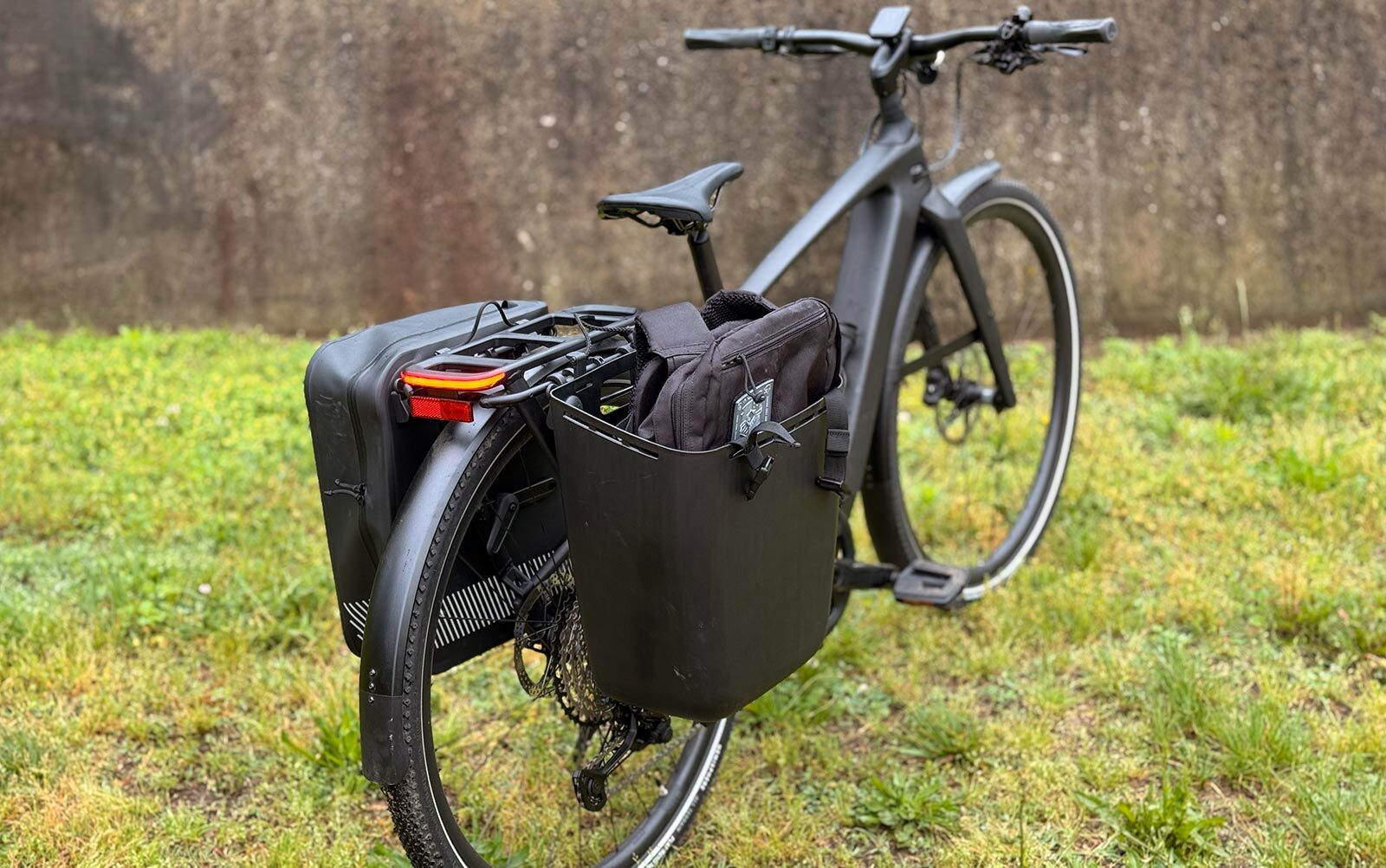
And, at the pinnacle of price and performance in the line, the $6,399 Specialized Turbo Vado SL 2 6.0 Carbon has a 240W motor and 35Nm of torque for a ride that’s subtle and responsive, amplifying your pedaling without ever overpowering it. The 36-pound carbon-framed beauty is an investment, but it holds its speed like a dream, giving you that “kid again” feeling when coasting. The Future Shock 3.2 system dramatically cuts down on wrist fatigue by absorbing road chatter at the stem. And the rack attachments range from weatherproof pannier to mobile cooler (both shown above), so it can be as professional or party as you wanna be. If you’re looking to splurge, any of Specialized’s carbon fiber offerings are among the best (the hours my husband has spent on the S-Works Turbo Creo 2 have been some of his favorite times).
Best folding e-bike for multimodal commuters: Brompton Electric G Line
See It
Pros
- Compact tri-fold design folds smaller than nearly any other e-bike
- Built for multimodal commuting with roller wheels for easy transport between train, bus, and office
- Removable battery housed in a front bag that doubles as handy storage for daily essentials
- Equipped for commuting with integrated front and rear lights, fenders with mudflaps, rear rack, and a bell
- Balance and handling like a full-size bike with a smooth-shifting 4-speed drivetrain
- 20-inch Schwalbe G-One Allround tires provide excellent grip and comfort on pavement and light gravel
- Available in three colors: adventure orange, forest green, traildust white
Cons
- Heavier than classic Bromptons (about 43 lb); easier to roll than carry
- Rocker-style PAS controls are less intuitive than standard buttons
- Folding requires practice due to larger 20-inch wheels
- No throttle or suspension, so rough roads send more feedback through the bars
Specs
-
Folded size
28.3 inches deep × 26.2 inches tall × 16 inches wide -
Motor
250W rear-hub motor -
Battery
345Wh capacity -
Removable battery
Yes (housed in front-mounted bag) -
Compliance
UL 2849 certified -
Riding range
Up to 45 miles -
Class
1 -
Top assisted speed
20 mph -
Throttle
No -
Bike weight
About 43 pounds -
Frame sizes
Small, medium, and large, fits riders from 5’ to 6’6” -
Connectivity
Brompton Electric app (iOS and Android)
The Brompton Electric G Line is the Swiss Army knife of e-bikes for riders who want one machine that can do it all, whether that’s commuting across town, tucking neatly into a closet, or sneaking in a weekend ride off-road. Compact, clever, and unmistakably British, it’s the ultimate e-bike for people short on space but unwilling to compromise on capability.
Brompton has long set the folding-bike standard, but the G Line takes that ingenuity electric. A whisper-quiet 250 W rear-hub motor, removable 345 Wh battery, and larger 20-inch wheels make it smoother and more stable than any Brompton before it. It rides and handles like a full-size bike—balanced, planted, and quick—even though it folds in seconds into a compact, briefcase-sized package.
It’s also one of the few e-bikes truly designed to move seamlessly between modes of transport. The rear rack includes built-in roller wheels, letting you pull or push the folded bike through stations, sidewalks, or office halls without lifting it. That small touch makes a huge difference for commuters juggling trains, elevators, and tight corridors.
Security and practicality come built in. Instead of locking it outside, you can roll the G Line indoors or under your desk. The removable battery pops off easily for recharging or safekeeping, making the bike far less appealing to would-be thieves. And since it’s fully equipped with front and rear lights, fenders with mudflaps, a bell, and a rear rack, it’s ready to ride straight out of the box.
On the road, it’s a lovely ride: thoughtful, composed, and more comfortable than you’d expect from a folder. The high-volume tires and well-judged geometry soften city streets and smooth out cracks and seams, even without suspension. Shifting feels crisp, and the assist blends naturally. It’s happiest on pavement and bike paths, but capable enough for the occasional detour onto gentler gravel. Even at the highest pedal assist level and the lights on, the G Line traveled a respectable 27 miles before running out of juice. (Read our full review here.)
At roughly $4,950, the Electric G Line is an investment for people who see a bike as a lifelong companion and an essential part of their lifestyle.
Best long-range folding e-bike: Velotric Fold 1 Plus
See It
Pros
- Class-leading 68-mile range
- Adjustable between Class 1, 2, and 3, with customizable top speed up to 28 mph
- Switchable torque and cadence sensors let you fine-tune responsiveness and efficiency
- Low 15-inch standover height makes mounting easy and stable under load
- Front suspension and 3-inch puncture-resistant tires smooth out city streets and trails
- Fully equipped for commuting: 130-lux adjustable headlight, brake light with turn signals, fenders, and sturdy rear rack (120-pound capacity)
- Apple Find My integration and USB-C phone charging port
- Available in Mango, Electric Blue, Stone Gray, and Pearl White
Cons
- At 63 lb, it’s better rolled or driven than carried
- Fold is compact but still bulky for train or subway commutes
- Battery insertion can be awkward for shorter riders
- Motor noise increases on high assist levels
- Folding pedals take practice
Specs
-
Folded size
37.8 inches long x 19.7 inches wide x 33.5 inches high -
Motor
750W (1,100W peak) rear hub -
Torque
75Nm -
Battery
624Wh -
Removable battery
Yes, lockable -
Compliance
UL 2271 and UL 2580 -
Range
Up to 68 miles through pedal assist or 45 miles using throttle -
Class
1-3 -
Top assisted speed
28 mph -
Throttle
Yes (removable) -
Bike weight
63 pounds -
Frame sizes
One size, fits riders from 4’9” to 6’5” -
Connectivity
Velotric app, Apple Find My
The Velotric Fold 1 Plus proves that a folding e-bike doesn’t have to compromise on power or endurance. With a 68-mile range and a 750W motor, it’s built to go the distance—whether that means a long daily commute or a few hours of weekend exploring. I see these bikes out in the wild all the time, especially around the Pentagon, usually piloted by camo-clad riders who look very happy to be heading home.
This thing is made for commuters (and you can read our full review here). It comes ready to roll with full fenders, a bright front light, a brake light with turn signals, and a sturdy rear rack that can carry up to 120 pounds—groceries, gear, or even a kid seat. The 20-inch wheels keep that weight close to the ground, giving the bike a stable, planted feel when starting, stopping, or turning.
It’s also impressively adaptable for a one-size-fits-all frame. The step-through design fits riders from 4’9” to 6’5”, with a low standover height that inspires confidence at lights or when carrying extra weight. The upright riding position, front suspension, and cushy saddle make it one of the most comfortable folders around.
Where the Fold 1 Plus really shines is in its ride customization. You can swap between torque and cadence sensors, tweak the assist levels, and even set the top speed or e-bike class. It’s a feature more brands are adding, but Velotric executes it especially well—making the bike easy to share among family members without compromising anyone’s preferred feel.
While some folding bikes are designed for train hopping, the Fold 1 Plus is more about easy storage and transport. It fits neatly in a hatchback or SUV (I’ve slipped it into a Honda Fit), though sedan owners should measure before committing. Velotric also adds two smart touches most folders skip: a long Velcro strap to keep everything closed when folded and a built-in stand that protects delicate components.
The Fold 1 Plus doesn’t make you choose between fun and practicality. It’s laid-back when you want to cruise and powerful when you need to hustle—and at about $1,500, it’s one of the most capable long-range folding e-bikes you can buy.
What to consider when searching for the best electric commuter bikes
Before you fall in love with a shiny new e-bike, think about what you really want out of your commute. Do you want a workout that makes you feel like a superhero, or a sweat-free cruise that gets you to work fresh as a daisy? Pedal-assist gives you “super legs,” throttles let you coast scooter-style, and many bikes now offer both so you can switch by mood or hill.
But here’s the catch that most first-time buyers don’t consider: e-bikes are heavy. The average commuter model tips the scales at 50 to 65 pounds, and moped-style or fat-tire versions can be 70+. That’s fine if you’ve got a garage or ground-floor storage, but not so fun if you’re wrestling it into an elevator or up a flight of stairs after a long day. Lightweight options in the 30 to 40 pound range are hitting the market, making them easier to handle, though you often give up suspension and a cushy ride. Folding e-bikes add another stow-and-go option for tight spaces.
Bottom line: Decide first how you want to ride and then be realistic about where you’ll store it and how much bike you actually want to haul around.
Classes
At their core, e-bike classes are meant to give you a quick snapshot of what a bike can (and can’t) do—especially how fast it’ll go with motor assist, and whether you need to pedal to make that happen. Many states also use these classes to set rules for where and how you’re allowed to ride, though that’s the wild west right now. In many states, e-bikes are treated like bicycles, but in others, like Alaska and New Mexico, they’re regulated more like mopeds or motor-driven cycles. (Check out the non-profit advocacy group People for Bikes’ guide for state laws.)
Here’s the breakdown:
| Class | How it works | Assist limit | What it means for you |
| Class 1 | Pedal-assist motor only | Stops assisting at 20 mph | Usually allowed on bike paths and trails |
| Class 2 | Throttle and pedal assist | Stops assisting at 20 mph | Throttle use may be restricted in some areas |
| Class 3 | Pedal-assist motor only | Stops assisting at 28 mph | Sometimes banned from shared-use paths and may have age and/or helmet rules |
Not every e-bike fits neatly into these categories. Some models ship as one class but can be changed to another via on-bike controls or an app. And while 20 mph might not sound especially fast on paper, it feels very different when you’re hitting that speed on two wheels in traffic.
Mid-drive vs. hub motor
The motor is the heart of an e-bike, and it completely changes how the ride feels. First, you’ll want to decide where the motor lives—hub or mid-drive—since that affects how the bike handles and climbs. Then, look at how big the motor is. Power is measured in watts, and while 250W used to be standard, it’s now the baby of the bunch. Most commuter bikes land in the 350 to 500W sweet spot, giving you plenty of push for city riding. 750W is the legal ceiling in the U.S.—any bigger and you’re in moped/motorcycle territory with licenses and insurance to match.
Mid-drive motors sit at the pedals and feel the most like riding a “real” bike—just with bionic legs. They’re more efficient because they use your gears to deliver extra torque, which makes them awesome for hills and longer rides. But here’s the catch: you’ve got to be comfortable shifting. If you’re not, mid-drives can be a little intimidating. I’ve seen newbies stall out or, worse, lurch forward when the gearing’s off. For confident riders who want maximum power for their effort, though, they’re hard to beat.
Hub motors, on the other hand, live in the wheel (usually the rear) and are all about simplicity. They’re slower to kick in, but the assist feels like that gentle push you got from a parent when you were first learning to ride. I actually love hub motors for beginners who struggle with gears because they don’t magnify your shifting errors.
Riding range
Step one: know your commute distance (round trip!) and what kind of terrain you’ll face. Every e-bike promises an “estimated range,” but the key word there is “estimate.” Your weight, your cargo, how steep your hills are, how much pedal assist you use, and even the weather all change how long that battery actually lasts. Flat road + low assist = you’ll cruise forever. Steep hills + max assist + headwind = you’ll be hunting for an outlet a lot sooner.
Pick a bike with a range that easily covers your ride there and back with extra miles to spare. Running out of juice halfway home is character-building, but not fun.
Batteries generally come in two flavors. Integrated batteries are sleek and theft-resistant because they can’t be pulled out, but the trade-off is that you’ll need to roll the whole bike to an outlet when it’s time to recharge. Removable batteries, on the other hand, are wonderfully convenient: You can pop them out to charge indoors or even carry a spare for longer rides. The downside? More seams and openings mean more opportunities for dust and water to sneak in.
Battery safety
Cheap batteries cause fires—and not just little sparks, but full-on, apartment-burning, news-making fires. That’s why certifications matter. UL 2849 is the gold standard, covering the entire electrical system—battery, motor, charger, and controller—to make sure everything works safely together. UL 2271 focuses only on the battery pack, testing it for durability and resistance to overheating or impact. Sometimes you’ll see EN 15194, the European equivalent.
If you see either certification, it means the bike has gone through rigorous testing. And in New York City and New York State, certification is required by law after a rise in fires tied to low-quality, uncertified e-bikes.
Security and tracking
Any e-bike is an investment, and nothing spikes your blood pressure like leaving it locked up on the street or even in the “secure” office bike room. A solid lock (or better yet, two) is still your first line of defense. But more and more manufacturers are baking security right into the bikes themselves.
Some motors won’t even turn on without a PIN code or Bluetooth connection to your phone, making them a lot less tempting for joyriders. Others integrate with Apple’s Find My network or GPS, so you can track your bike’s location if it disappears. (That said, if mine got swiped, I’m not about to show up at its “new home” solo.)
FAQs
E-bike classes are shorthand for how much assistance you get, how fast the motor will take you, and where you’re legally allowed to ride. Class 1 and 2 both cap out at 20 mph—Class 1 requires pedaling, while Class 2 adds a throttle. Class 3 ups the ante to 28 mph with pedal assist only, making it a favorite for commuters who want to keep pace with traffic.
But here’s the catch: not every trail, bike path, or park welcomes faster Class 3 bikes, and local rules can vary wildly.
There’s no single answer. It depends on how much you weigh, what you’re hauling, how you ride, and yes, even the weather.
On a mild, wind-free day with flat terrain and low pedal assist, you’ll squeeze out the longest range. But if your commute feels like it’s uphill both ways, into a headwind, with the assist cranked to max? That battery won’t last nearly as long. Cold temps don’t help either—they can sap power before you even start pedaling.
Published ranges are usually 20 to 50 miles, and my own experience backs that up. Just remember: headwinds can chew through both your energy and your battery faster than you think.
Yes. If you don’t see any mention of certification, move on. In places like New York City and New York State, it’s even required by law. Those rules came after a rise in fires and injuries linked to low-quality, uncertified lithium-ion batteries in e-bikes and scooters.
Manufacturers do have to pay to get certified, and you’ll sometimes see a mix of labels. Here’s what they mean:
UL 2271: Tests whether the battery pack is safe, durable, and resistant to overheating or impact.
UL 2849: The comprehensive option. It certifies the entire electrical system: battery, motor, controller, charger, and how they all work together under real-world conditions.
EN 15194: The European standard. It ensures e-bikes meet strict safety, electrical, mechanical, and performance criteria before they’re sold.
For steep climbs, mid-drive motors are the clear winners. They use your bike’s gears for extra torque and efficiency, so you get more power uphill without draining the battery as fast.
But don’t count out hub motors—they’re cheaper, simpler, and feel like a steady push from behind. They’re also more forgiving if you’re still working on shifting timing.
Think of tires as your e-bike’s shoes: grip, cushion, and stability matter. Stick to the pressure range printed on the sidewall, but on rough or wet roads, drop pressure about 10% for better contact. If you ride at 60 psi on a dry day, try around 54 when it’s rainy or bumpy.
Tire type makes a difference, too. Wider tires = more grip and cushion. Slimmer tires = lighter and faster. And don’t forget tread: slick or lightly grooved tires roll fastest on dry pavement, while tires with more pattern give you extra bite when it’s wet. Knobby treads are better for off-road rides.
No matter what, corner carefully and leave more braking room in the rain.
Some little things you can do are maintain proper tire pressure, use lower pedal assist modes, and avoid relying exclusively on the motor for throttle bikes. Occasionally, I have pushed the edge of my range and ended up with just 10 percent of battery life but a few miles to go. In those times, I grit my teeth and turn off assistance, saving whatever juice remains for hills.
Alternatively, you could carry a second battery as backup, though they will add significant weight to the ride. Some bike models also offer higher-capacity batteries as an additional purchase.
Plenty of e-bikes are sold as direct-to-consumer products that will arrive directly at your door. The best of these companies ship mostly assembled bikes with good literature, how-to videos, and send the tools you will need. Can you build your own bike? Probably. But the right question is, “Should you?” If you are familiar with bike parts or building traditional bikes, know how to properly use torque wrenches, and have some patience and confidence, go right ahead. If you aren’t, many local bike shops will receive your delivery and assemble the bike for you. Around the D.C. area, the going rate for assembly is about $200.
E-bikes can cost anywhere from $1,000 to more than $10,000; however, plenty of well-outfitted models fall between $1,500 and $3,000. Expect to see more premium features in the $4,000 and $6,000 price range. Yes, e-bikes start at higher price points than traditional bicycles, plus they require charging and weigh more. And they still require maintenance; eventually, batteries will degrade and need replacing. But they have their advantages. However, if you’re on a budget and feeling handy, there are kits to convert a bike to an e-bike.
Final thoughts on the best electric commuter bikes
Much like cars, there’s an e-bike model for nearly every type of rider, ranging from people who haven’t touched a pedal since childhood to longtime, hardcore cyclists. If tooling around occasionally is your thing, a budget electric bike may work. If you like to kick up some dirt, consider a fat-tire bike. But for commuting, we recommend investing in one of our picks above, which can withstand the wear and tear of regular riding in all sorts of weather.

2025 Home of the Future Awards
