

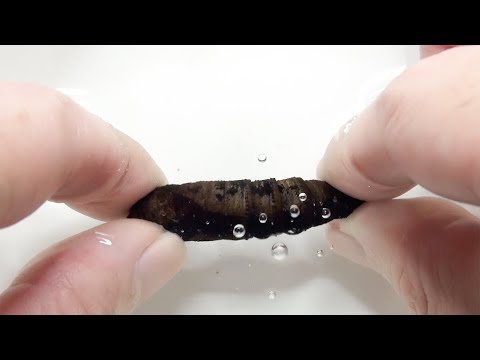
A caterpillar-looking bug hangs out on a stem, minding its own business. Suddenly, forceps emerge, moving towards the creature. As soon as they touch the chunky insect, it hisses and whips its body side-to-side.
The peeved individual is a mature larva of the buff-leaf hawkmoth (Phyllosphingia dissimilis), and its irritation is warranted, since the forceps are meant to imitate a predator. In fact, it’s desired. This scene is from a lab where researchers were investigating how the species’ larvae and pupae make their shockingly noisy defense sounds.

Hawkmoth larvae and pupae produce sounds through spiracles / エゾスズメ幼虫と蛹は気門から音を出す
Scientists had previously documented some moths making noises to keep predators away during various life phases. “We became interested in this topic when we noticed that the larvae and pupae of a hawkmoth species produced surprisingly loud sounds when stimulated,” Shinji Sugiura, an ecologist at Kobe University and co-author of a study recently published in the Journal of Experimental Biology, said in a statement. Larva is the second stage of many insects’ metamorphosis, and it takes place after the animal hatches from the egg and before it becomes a pupa.
To study this noise making, Sugiura and his colleagues conducted experiments on buff-leaf hawkmoth larvae and pupae in which they mimicked an attack, similar to a bird peck or predator bite, by touching the bugs with forceps. During the simulation, they noted the animals’ resulting noise and body movement, in addition to analyzing their internal organs’ involvement in producing sound.
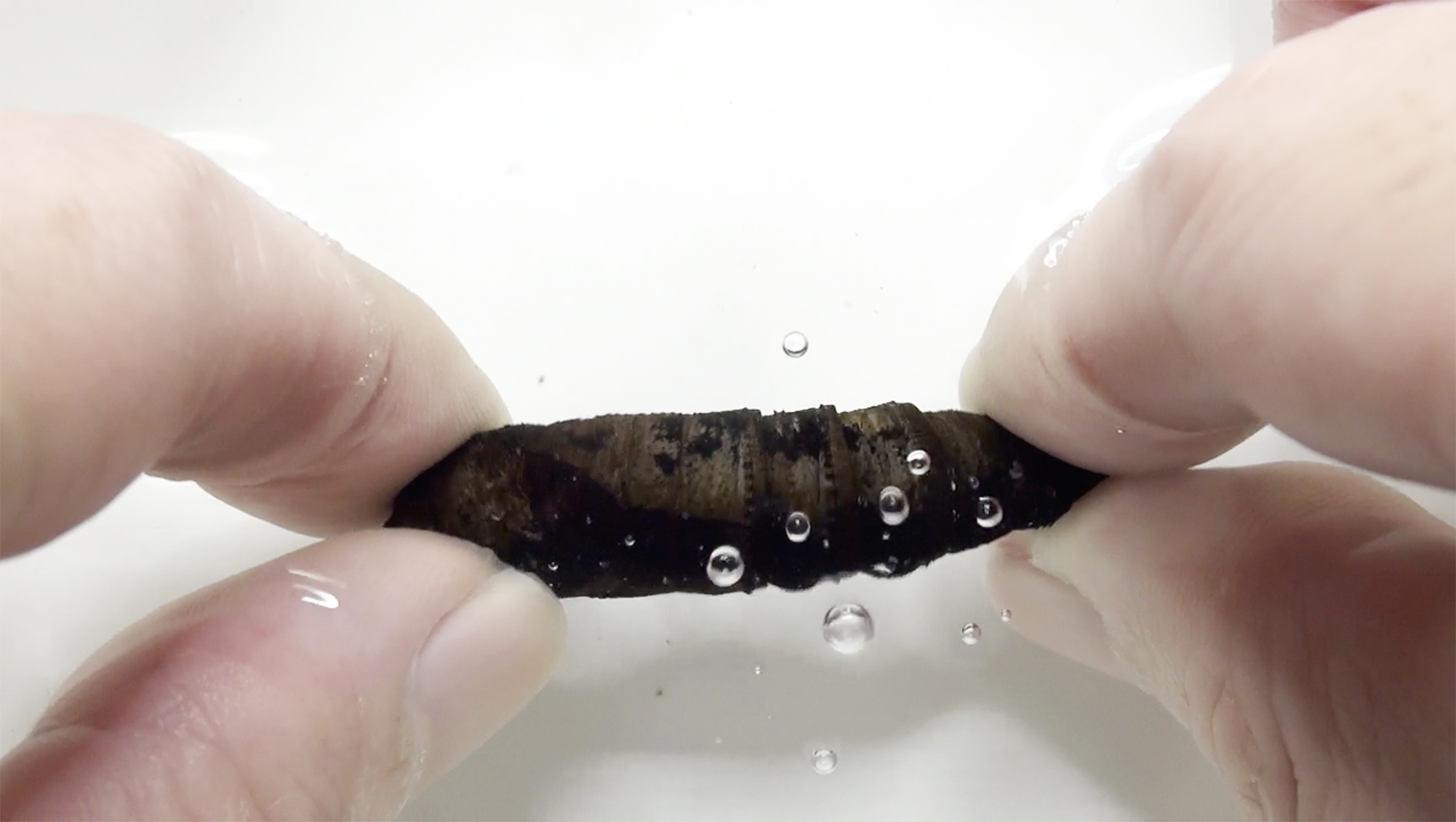
According to the study, most of their mature larvae and half of the pupae responded to physical contact by making noise and moving quickly. The team conducted some of their tests underwater, revealing that the animals’ respiratory openings were unleashing these hisses, producing bubbles.
“Until now, pupal sound production was thought to occur only through physical friction between body parts or against the substrate. This is the first evidence demonstrating a sound production mechanism in pupae that is driven by forced air,” explained Sugiura.
“Larvae and pupae of this species have one pair of small openings (spiracles) on the thorax and eight pairs on the abdomen. They take in air through these spiracles,” he added to Popular Science. “In this species, larvae and pupae produce sounds by expelling air through specific spiracles like a whistle.”
Except for the noise itself doesn’t sound like a whistle. The buff-leaf hawkmoth larvae and pupae’s acoustic patterns are comparable to snakes’ warning sounds.
“Because hawkmoth larvae and pupae are likely preyed upon by birds and small mammals—animals that may themselves be attacked by snakes—we hypothesize that this hawkmoth species acoustically mimics snake warning signals to protect itself,” Sugiura said in the statement.
It will require further study to determine if other groups of animals have similar mechanisms and how potential predators respond to the furious noises.

2025 PopSci Outdoor Gift Guide
