

Introduction
The Affordable Care Act (ACA) transformed health insurance into a consumer-driven marketplace where millions of Americans compare plans, evaluate costs, and make coverage decisions every year.
For health plans, the challenge is no longer simply enrolling members—it’s understanding them.
Traditional analytics answers questions like:
- How many members enrolled this month?\
- Which counties experienced the highest growth?\
- What was the overall retention rate?
These metrics are useful but treat the entire population as a single group.
In reality, ACA consumers have very different behaviors, communication preferences, healthcare utilization patterns, and financial considerations.
A 28-year-old first-time enrollee may need education about preventive care, while a family managing chronic conditions may need care coordination and pharmacy support.
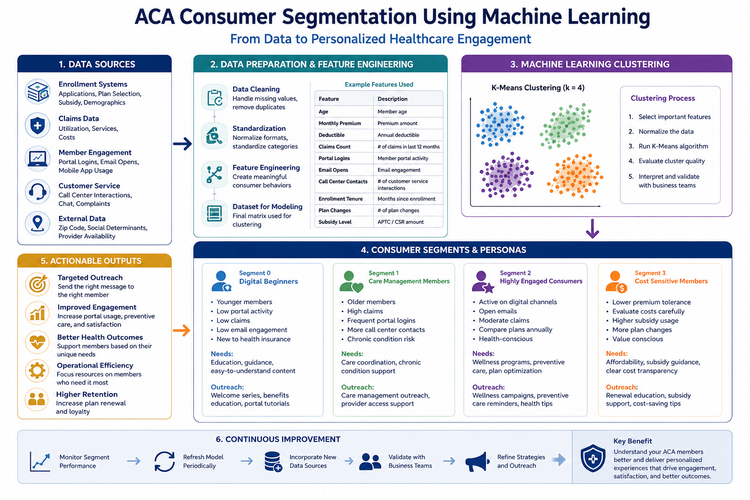
Rather than sending identical outreach campaigns to every member, healthcare organizations can use machine learning to automatically identify groups of consumers with similar characteristics and deliver more personalized experiences.
In this tutorial, we’ll build a simple consumer segmentation model using Python and Scikit-Learn.
Suppose an ACA health plan has 500,000 members.
Sending the same email to every member is rarely effective.
Instead, the organization wants to identify:
- Digital-first consumers\
- Cost-sensitive shoppers\
- High healthcare utilizers\
- Members who rarely engage with the health plan\
- Consumers who may need additional education
Machine learning allows us to discover these groups without manually defining them.
Assume we have the following variables collected from enrollment systems, member portals, and engagement platforms.
| Variable | Description |
| ——————– | —————————– |
| Age | Member age |
| Monthly Premium | Monthly premium amount |
| Deductible | Annual deductible |
| Claims Count | Number of claims submitted |
| Portal Logins | Member portal usage |
| Email Opens | Marketing engagement |
| Call Center Contacts | Customer service interactions |
import pandas as pd

data = {\
"member_id":[1001,1002,1003,1004,1005,1006,1007,1008],\
"age":[28,45,62,31,54,39,27,58],\
"premium":[120,35,20,280,75,210,15,60],\
"deductible":[6500,2500,500,7000,1200,5000,0,1000],\
"claims":[1,8,16,0,10,3,5,14],\
"portal_logins":[2,12,18,1,9,4,7,15],\
"email_opens":[3,15,20,1,10,5,6,18],\
"call_center":[0,2,5,1,4,1,2,6]\
}

df = pd.DataFrame(data)

print(df.head())\
Output:
member_id age premium deductible claims portal_logins ...\
1001 28 120 6500 1 2\
1002 45 35 2500 8 12\
...\
Healthcare variables exist on different scales.
Premium values may range from 0–500 while portal logins range from 0–20.
Without normalization, larger values dominate the clustering algorithm.
from sklearn.preprocessing import StandardScaler

features = [\
"age",\
"premium",\
"deductible",\
"claims",\
"portal_logins",\
"email_opens",\
"call_center"\
]

X = df[features]

scaler = StandardScaler()

X_scaled = scaler.fit_transform(X)\
We’ll divide the population into four consumer segments.
from sklearn.cluster import KMeans

model = KMeans(\
n_clusters=4,\
random_state=42,\
n_init=10\
)

df["consumer_segment"] = model.fit_predict(X_scaled)\
View the results:
print(df[\
[\
"member_id",\
"consumer_segment"\
]\
])\
Example output:
member_id consumer_segment

1001 0\
1002 2\
1003 1\
1004 0\
1005 3\
Machine learning creates the groups.
Healthcare analysts interpret what they mean.
summary = df.groupby(\
"consumer_segment"\
)[features].mean()

print(summary)\
Example output:
| Segment | Characteristics |
| ——— | ——————————————— |
| Segment 0 | Young, low engagement, low utilization |
| Segment 1 | Older, high claims, frequent portal users |
| Segment 2 | Moderate utilization, digitally engaged |
| Segment 3 | Cost-conscious, frequent customer service use |
These are not predefined categories.
They emerge naturally from the data.
Machine learning produces numbers.
Business teams need actionable insights.
segment_name = {\
0:"Digital Beginners",\
1:"Care Management Members",\
2:"Highly Engaged Consumers",\
3:"Cost Sensitive Members"\
}

df["consumer_persona"] = df[\
"consumer_segment"\
].map(segment_name)\
Now every member belongs to a business-friendly persona.
| Member | Persona |
| —— | ———————— |
| 1001 | Digital Beginners |
| 1002 | Highly Engaged Consumers |
| 1003 | Care Management Members |
Instead of sending identical campaigns, we can automate recommendations.
def outreach_strategy(persona):

if persona == "Digital Beginners":\
return "Send benefit education and portal tutorials"

if persona == "Care Management Members":\
return "Assign care management outreach"

if persona == "Highly Engaged Consumers":\
return "Promote wellness and preventive services"

if persona == "Cost Sensitive Members":\
return "Provide subsidy and renewal guidance"

df["recommended_action"] = df[\
"consumer_persona"\
].apply(outreach_strategy)\
Result:
| Member | Persona | Recommended Action |
| —— | ———————— | ———————— |
| 1001 | Digital Beginners | Benefit education |
| 1002 | Highly Engaged Consumers | Wellness campaign |
| 1003 | Care Management Members | Care management outreach |
This approach allows healthcare organizations to move beyond static dashboards and simple enrollment reports.
Instead of asking:
How many members enrolled this month?
Organizations can ask:
Which members are most likely to benefit from preventive care education?
Which consumers need additional support during renewal?
Which population prefers digital engagement instead of call center outreach?
Consumer segmentation provides a scalable way to answer these questions.
A production implementation would typically include:
- SQL data extraction from enrollment systems\
- Python feature engineering pipelines\
- Automated clustering refreshes\
- Tableau dashboards for business users\
- Human review of consumer personas\
- Continuous monitoring as member behavior changes
Healthcare organizations should also evaluate segmentation results for fairness, transparency, and business relevance, ensuring that machine learning supports—not replaces—human decision-making.
The future of ACA analytics is shifting from reporting population averages to understanding individual consumer needs.
By combining enrollment data, engagement metrics, and machine learning, analysts can identify meaningful consumer segments and deliver more personalized outreach strategies.
The goal is not simply to classify members into clusters, but to transform healthcare data into actionable insights that improve member experience, increase engagement, and help consumers make better use of their health coverage.
