

From the start, cars were built wrong. At least, that’s what Chrysler’s head of automotive research, Carl Breer, thought in 1930. Automobiles had never been built to be aerodynamic, he posited, and he was right. A few years earlier, he’d consulted aviation pioneer Orville Wright (the younger Wright brother), who suggested he build a wind tunnel. The results were damning: Every car Breer tested was more aerodynamic running backward than forward. That’s because early cars were boxy behemoths, built like motorized carriages.
At the time, Buckminster Fuller—American architect, designer, and futurist—was reaching a similar conclusion but from an altogether different angle. While reading Toward an Architecture, the 1923 manifesto of Swiss-French architect and theorist Charles-Édouard Jeanneret, better known as Le Corbusier, Fuller encountered a table of wind resistance diagrams. The table revealed that an ovoid body—blunt nose, tapering tail—came closer to aerodynamic perfection than anything else a designer could draw. He immediately sketched the blueprint for a car.
Breer and Fuller had simultaneously discovered the teardrop.
The shape’s automotive moment, however, proved brief. The physics were right, but the designs were hard to sell, and the abundance of cheap fuel for most of the 20th century made aerodynamic efficiency optional in a way that suited automotive makers in Detroit just fine. Now the teardrop is returning, mostly in electric vehicles like the Lucid Air, Hyundai Ioniq 6, and Mercedes-Benz EQS where battery range matters. The superior physics were understood nearly a century ago. The practical benefits, it turns out, were discretionary—until now.
Teardrop-shaped cars are just better
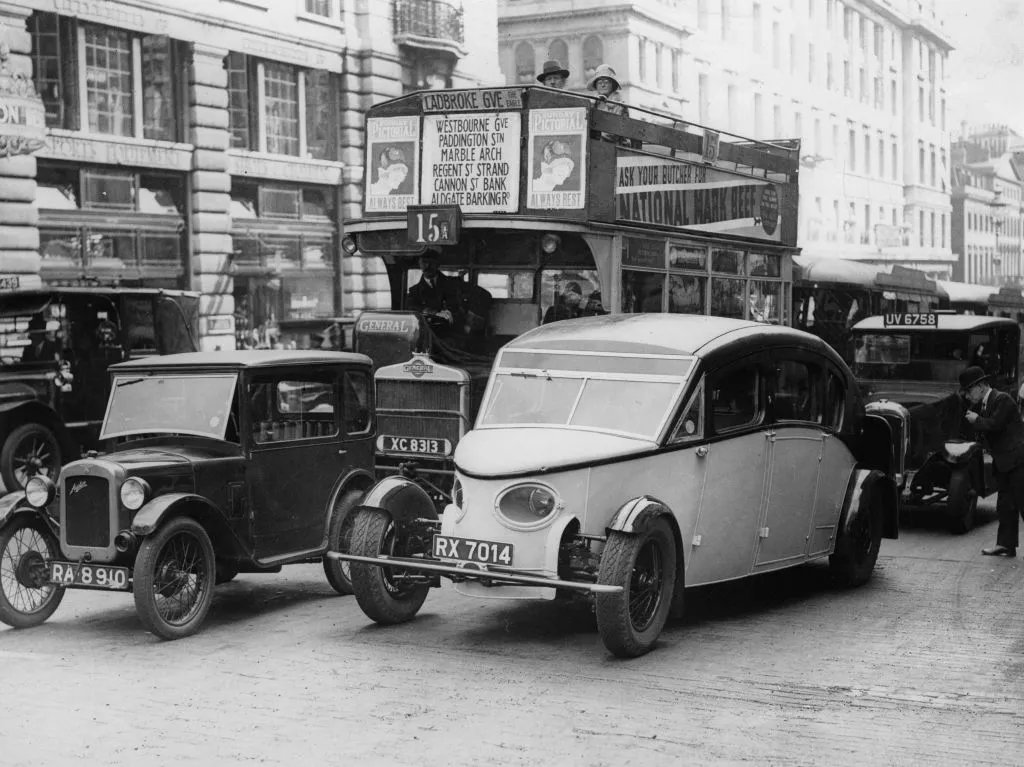
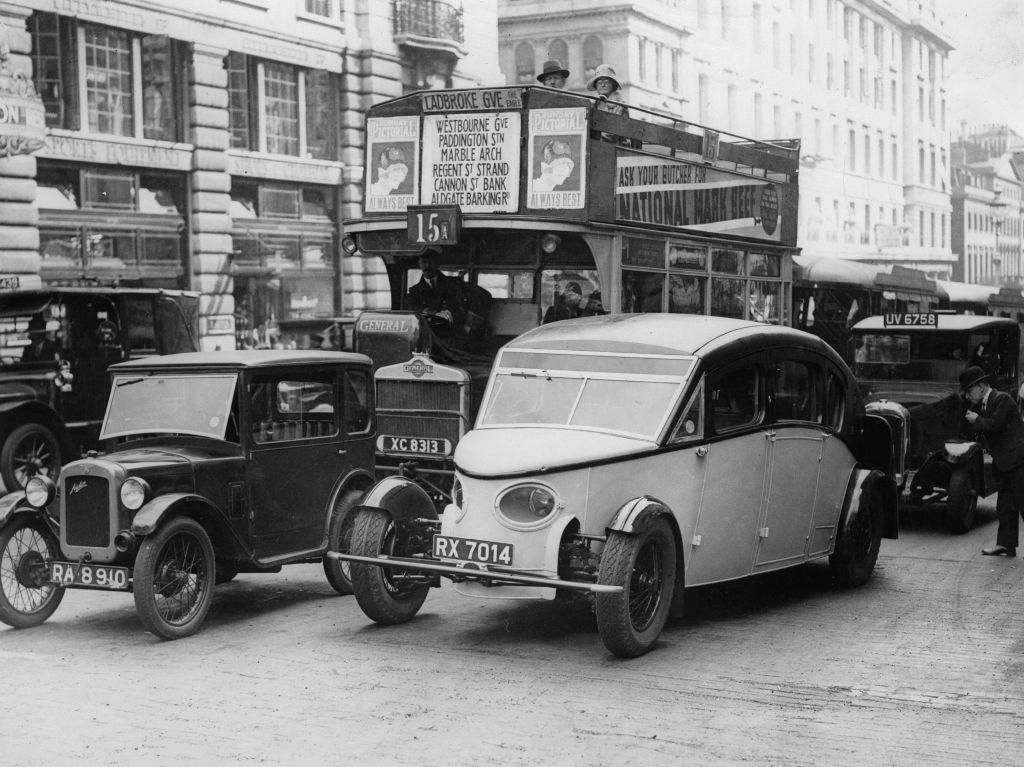
In December 1930, Popular Science introduced American readers to Sir Dennis Burney, designer of the colossal English airship R-100. Burney had just built a car so aerodynamic that, as Popular Science noted, “the wheels scarcely touch[ed] the ground” at 80 miles per hour. In fact, the car ran faster with its heavy metal body on than when stripped to its chassis.
Burney had simply applied the logic of airships to the road, including a rear-mounted engine, sunken headlamps, and no projecting parts. With its “crescent-shaped back,” it looked, the magazine observed, like a “monster beetle” scooting through London traffic. It also cut fuel consumption in half.
The physics behind the teardrop shape were not new, but they were new to cars. As Popular Science’s Robert E. Martin explained in a February 1934 feature of the streamlining movement, wind pressure increases dramatically the faster a car goes. That means “eighty-five percent of the engine’s power is required just to force the body through the air” at highway speeds.
Engineers like Carl Breer, who had begun taking aerodynamic principles seriously, built wind tunnels and carved wooden test blocks into every imaginable shape. All of it was done to improve wind resistance, also known as the drag coefficient or Cd. Eventually Breer and others all came to the same conclusion: The ideal car shape had a blunt, rounded nose in front and a long, tapering tail—just like a teardrop.
In a teardrop configuration, air flows smoothly around the widest point and rejoins cleanly in its wake, creating minimal turbulence, similar to the cross-section of an airplane wing. A perfect teardrop achieves a drag coefficient near 0.04. Every conventional car of the era, with its flat radiator face and boxy cabin, had the geometry exactly backward, posting drag coefficients closer to 0.70. In the 1930s, cars moved through the air more like a brick wall than a gliding bird.
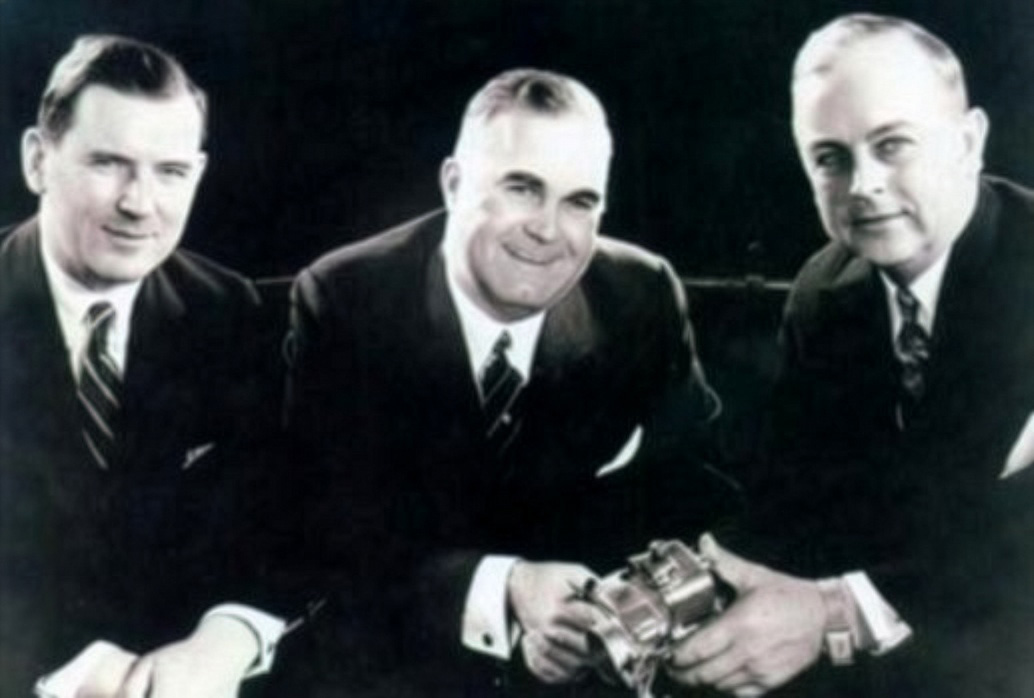
After dozens of experimental models, by late 1932, Breer and his colleagues at Chrysler, Owen Skelton and Fred Zeder—a team dubbed the Three Musketeers—had developed a hand-built prototype that would become the Airflow, Detroit’s most ambitious answer to the teardrop’s aerodynamic ideal.
While Breer’s team was quietly refining its design through painstaking engineering and wind-tunnel trials, another man was moving even faster.
The first teardrop car—the Dymaxion
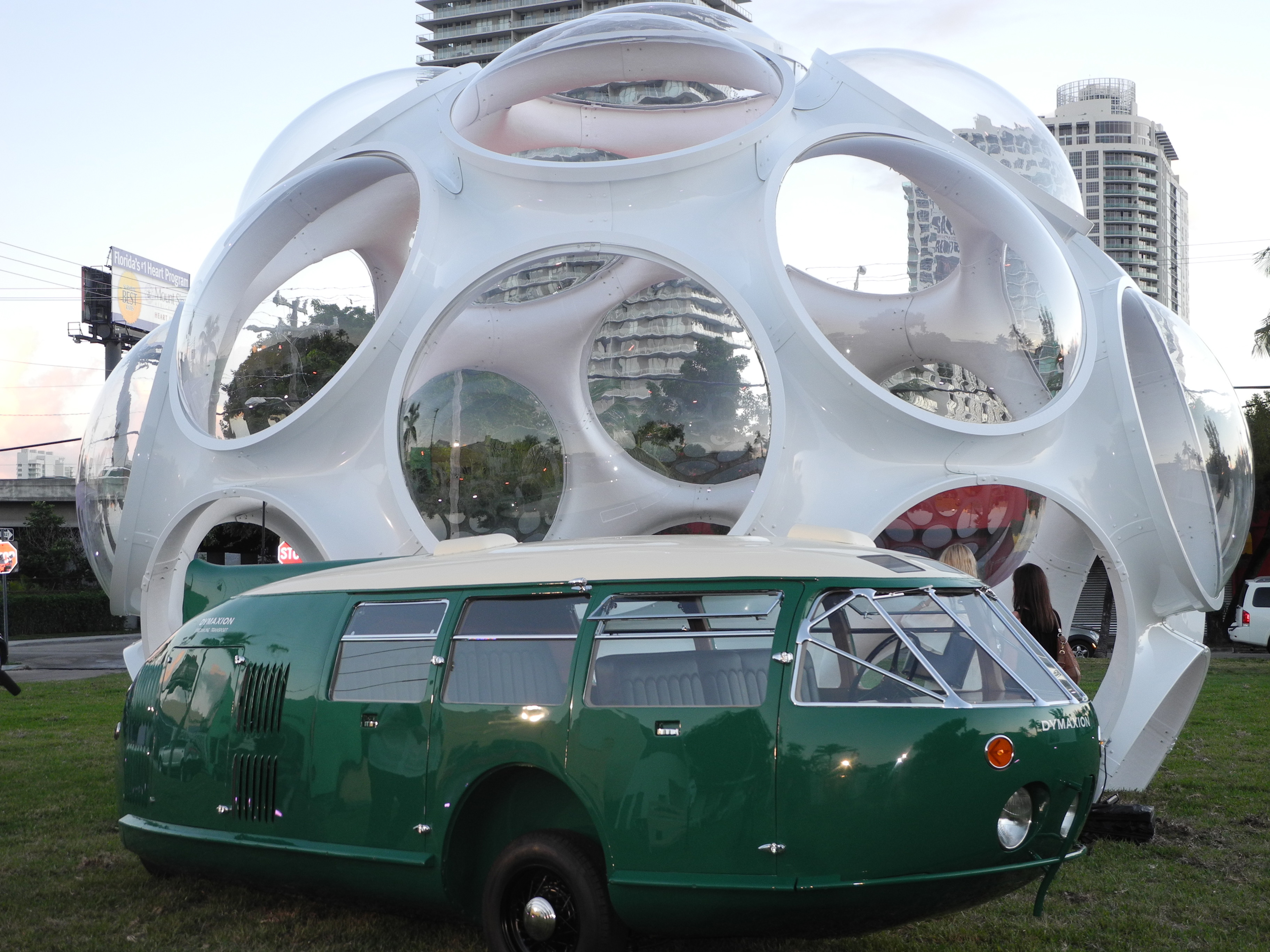
Buckminster Fuller was not a man who let engineering get in the way of a good idea. In 1928, when he encountered Le Corbusier’s ovoid diagram, he didn’t see a starting point for careful research, he saw the automotive future. Fuller copied the shape, added three wheels and inflatable wings, and began telling anyone who would listen that his car was about to reinvent transportation.
According to a 2022 biography by Alec Nevala-Lee, Inventor of the Future, it took Fuller five years to find funding for his Dymaxion car. Fuller coined “Dymaxion” from dynamic maximum tension, which encapsulated his philosophy of doing more with less. He applied the term to other inventions as well, such as the Dymaxion house, the Dymaxion bathroom, and the Dymaxion map—all of which were meant to be hyper efficient.
Fuller eventually found an unlikely financial sponsor for his Dymaxion car: Nannine Hope Dale Biddle, a socially prominent Philadelphian who had recently made national headlines by abandoning her husband and three young children to seek adventure in the Alaskan wilderness. Snowbound for 11 days in an isolated cabin before a chartered airplane pulled her out, Biddle, whose family’s fortune came from silk imports and Pennsylvania Railroad stock, was well-acquainted with the risks of chasing an unconventional idea wherever it led.
To bring the Dymaxion car to life, Fuller teamed up with William Starling Burgess, a financially-strapped, four-times-divorced ship and aircraft engineer. The partnership was fraught with tension from the first day. When Burgess put both their names on the sign outside their Bridgeport, Connecticut, workshop, Fuller seethed. In his 1934 Popular Science streamlining craze feature, Martin referred to Fuller’s prototype as “the Dymaxion of W. Starling Burgess, the Dream Car”—an attribution that suggested who Martin believed was doing the actual engineering.
The car that emerged from that uneasy collaboration was nearly 20 feet long, several feet longer than the 1930s 13-foot average, and seated eleven passengers inside an aluminum shell. It had three wheels—two front, one back—and was steered from the rear like a boat.
When the Dymaxion car debuted in July 1933 in Bridgeport, the fanfare eclipsed its serious engineering problems. The rear wheel wobbled and suffered severe tire wear. Worse, the car experienced lift at high speeds, making it difficult to steer, a problem that was never solved.
On the morning of October 27, 1933, the Dymaxion was being driven through Chicago when it skidded on Lake Shore Drive, rolled, and killed its driver, Francis Turner. Two passengers were seriously injured. In his biography of Fuller, Nevala-Lee reconstructed the crash from contemporary newspaper accounts, official records, and Fuller’s own contemporaneous notes. Fuller claimed the car had been struck by another car. In fact, it had rolled on its own because it lacked basic safety architecture, which Fuller acknowledged in private correspondences.
The Dymaxion—the teardrop movement’s most famous artifact—never recovered. Biddle pulled her support, later married Burgess, and Detroit hardly shrugged at Fuller’s Dymaxion sideshow.
Why the teardrop craze collapsed
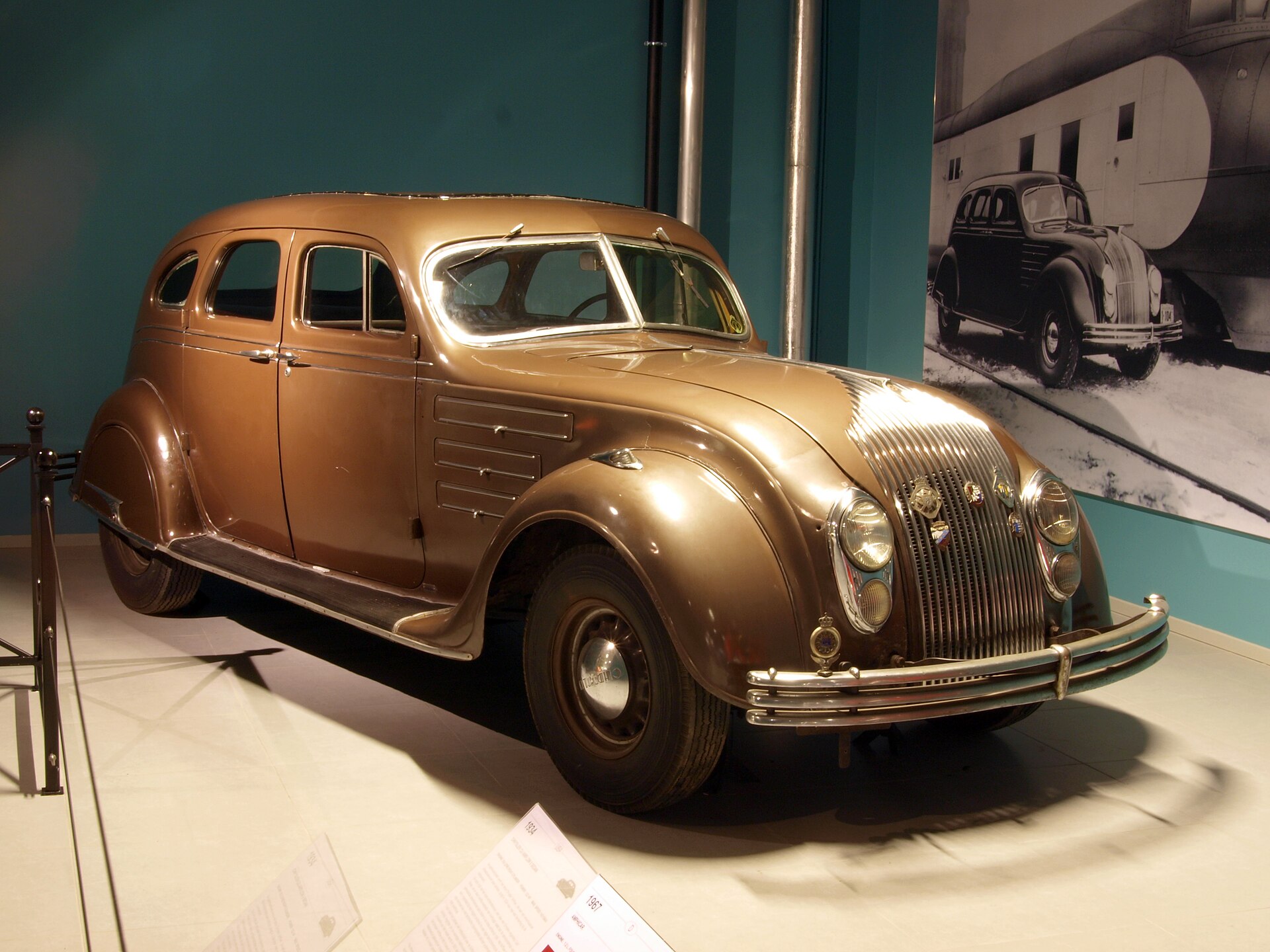
While Fuller was staging his Dymaxion debut, Breer’s team at Chrysler was putting the finishing touches on the car that would bring the teardrop ideal to American showrooms at scale. The Chrysler Airflow, introduced at the January 1934 New York Automobile Show along with its mid-range DeSoto model, was the most aerodynamic mass-produced car ever built up until that point.
“In the last year or two,” wrote The New Yorker, “there have been several tentative moves toward breaking away from the conventional box-on-wheels shape, but nothing quite so radical as the Airflow Chryslers and DeSotos.” Time magazine, previewing the 1934 auto show, called the new DeSoto “an approach to the sweeping curve of a tear drop.” It was Walter Chrysler’s bid to eliminate the automobile’s boxy behemoth legacy; as the magazine put it, Chrysler wanted to claim “the distinction that he made the buggy a bugaboo [a ghost, i.e. relic of the past].” After numerous prototypes, the Three Musketeers had finally built the car that physics demanded.
But the pricey new models did not impress the American public. Critics called the Airflow bug-eyed and rhinocerine, according to a 1977 retrospective by Howard Irwin in Scientific American. Irwin also noted that one reviewer compared the Airflow’s rounded front end to a human face covered with a stocking.
A Chrysler advertising blitz promoted the Airflow’s “floating ride,” improved speeds, and engine performance. What the ads chose not to mention was the one advantage the physics actually guaranteed—fuel efficiency of 18 to 22 miles per gallon, high for a car its size. But fuel efficiency was on neither manufacturers’ nor consumers’ minds.
DeSoto sales fell 47 percent in the first summer. Chrysler, facing financial pressure, rushed to graft increasingly conventional grilles onto the rounded nose, retreating year by year from the very aerodynamic principles that made the car more efficient. By 1937, the Airflow was discontinued. The most carefully engineered car of its era had lasted four years.
The problem wasn’t the shape or the science: It was the American consumer. Across the Atlantic, the Tatra 77, introduced in 1934, had demonstrated that a teardrop-shaped car could find an audience. The Tatra’s rear-mounted engine, dramatically tapered tail, and stabilizing rear fin made it one of the most aerodynamic mass-produced cars of the decade, and it sold—in Europe.
A version of the teardrop design found its way into Ferdinand Porsche’s Volkswagen Beetle, developed the same year the Airflow debuted, and drawing on the same European teardrop tradition embodied by the Tatra. But the Beetle’s rounded shape came at a significant aerodynamic cost. The Tatra 77, committed to the teardrop ideal, achieved a real-world drag coefficient of approximately 0.36. The Beetle, with its friendlier face and clipped version of the ideal teardrop tail, landed at 0.46, barely better than the boxy sedans the streamliners had set out to replace.
In the 1940s, seven years after the Airflow’s disastrous debut, General Motors introduced fastback profiles with tapered rear ends almost identical to the Airflow across all its divisions simultaneously—Pontiac, Oldsmobile, Buick, Cadillac, and eventually Chevrolet—under the marketing banner “Sport Dynamic.” This time, nobody called the shape rhinocerine.
It sold steadily for nearly a decade before GM discontinued it in the early 1950s, yielding to consumer demand for wide-bodied cars and tail fins. The teardrop had proved it could find an American audience, but it couldn’t find a reason to stay. With gasoline cheap and abundant, consumers weren’t concerned with fuel efficiency. Detroit built what the market demanded, and American consumers wanted the box.
Teardrop-shaped cars return—slowly
Boxy cars held their ground almost exclusively for half a century. But as electric vehicles make headway today, the calculus of car design is shifting. Every fraction of drag coefficient that engineers can shave translates directly into miles of range, and range is what sells electric cars. For the first time since Breer built a wind tunnel, the physics argument has become a commercial argument. The teardrop isn’t just graceful—it’s necessary.
The Lucid Air, currently the most aerodynamic passenger car in the world, achieves a drag coefficient of 0.197—a number that would have seemed absurd to Breer, lower than anything his wind tunnel could have predicted for a full-size passenger sedan. The Mercedes-Benz EQS follows at 0.20. The Hyundai Ioniq 6, at 0.21, may be the most significant of the group because it’s the first teardrop-inspired car priced within reach of mainstream buyers.

Introducing Future | Lucid Air | Lucid Motors
The Lucid Air, a luxury electric car, is currently the most aerodynamic passenger car in the world, achieving a drag coefficient of 0.197. Video: Introducing Future | Lucid Air | Lucid Motors, Lucid Motors
Visually, these cars share what 1930s designers were reaching for with a roofline that begins falling before you expect it to, a rounded nose that pushes through air rather than confronting it, and seamless body transitions. They are not true teardrops—no mass-produced car can be because appendages like wheel wells, windows, and mirrors all conspire against the ideal. But they are closer than anything that has existed between the Airflow’s discontinuation in 1937 and today.
Even so, history has a way of repeating itself. Automotive reviewers called the Mercedes EQS a
“jellybean” or “egg-shaped.” It isn’t a big seller. Kia, meanwhile, deliberately designed its new EV3 with a boxier silhouette, as did the Rivian R2—the teardrop shape, in other words, had to be hidden. And sales of Hyundai’s aerodynamically superior Ioniq 6 continue to trail the boxier Ioniq 5’s, which is notably cheaper. Buyers keep choosing the box.
The problem is us
The teardrop shape was always right. Breer knew it in 1930 when he reviewed the results of his wind tunnel. Martin knew it in 1934 when he offered Popular Science readers a progression of silhouettes, asking what the car of the future would finally look like. Even Fuller knew it, though he spent more energy managing his investors and reputation than solving his engineering problems.
What nobody could solve was us. We keep telling automotive engineers we want efficiency and then we buy the box—SUVs, minivans, pickups. The teardrop keeps winning the physics argument, but we still aren’t taking the physics seriously.
In A Century in Motion, Popular Science revisits fascinating transportation stories from our archives, from hybrid cars to moving sidewalks, and explores how these inventions are re-emerging today in surprising ways.
Related ‘A Century in Motion’ Stories

2025 PopSci Best of What’s New
