

According to CIRP (Consumer Intelligence Research Partners), 39% of iPhone buyers had their previous phone for three years or more. 33% of iPhone users kept their previous phone for two years or less. Inside that data, there is more information, some of it makes sense, and some of it is surprising.
79% of those replacing their iPhone in less than one year had a long-lasting battery
The graphs shared by CIRP show the condition of iPhone owners’ battery and display when they replaced that unit. These consumers replaced their iOS-powered handset during the 12 months ended March 2026.
The longer an iPhone user held his device, the better the screen looked to him
These graphs show that of those who replaced their iPhone within one year, 79% said that the battery lasted most of the day or all day without stopping for a charge. As you might expect, this percentage declined over time as the battery degrades. After three years or longer, only 50% of users were able to go most of the day or all day without charging the cell.
Counter-intuitively, the graph showing those iPhone owners retiring their phone for a new model ran in reverse after 72% reported having a perfect screen when they upgraded their iPhone before the one-year mark. After declining to 45% for those who kept using their iPhone for one year but less than two years, a strange thing happened.
Of those iPhone owners who replaced their phones after two years but before three years, 53% said that their screen was perfect. Surprisingly, that rose to 59% for those who continued to use the same iPhone for three or more years.
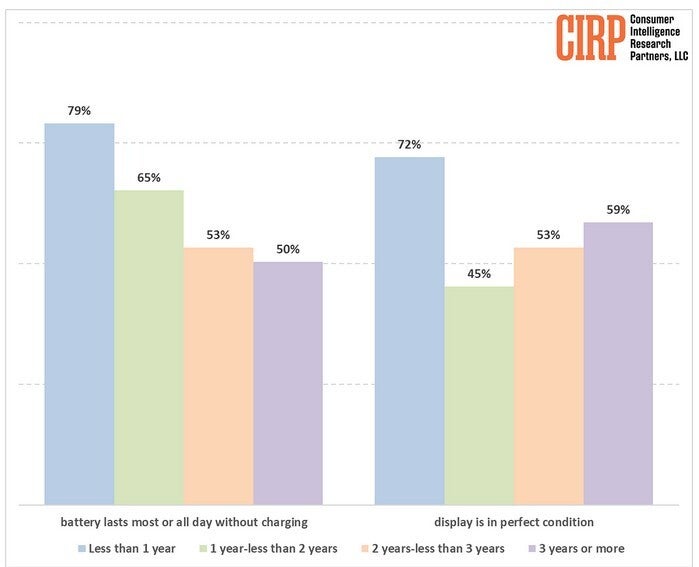
Graph shows conditions of the battery and screen on iPhone units replaced in less than a year, going out to longer than three years. | Image by CIRP
Batteries degrade over time, but displays can be shattered at any moment
One could blame this on the deteriorating eyesight of iPhone users over the years, but CIRP has another theory that makes more sense. Battery life declines over time, while the condition of an iPhone screen can change with one clumsy drop or fall. The big drop in the percentage of iPhone users with a perfect display who replaced the phone in one year but less than two indicates that some consumers upgrading quickly do so after their phone had suffered early screen damage.
Of course, iPhone users can simply replace a bad battery or get a screen repair for less than the cost of buying a new iPhone. Yet, most of them do not go this route and elect to upgrade to a new model instead.
Some iPhone users prefer to go caseless to show off the design of the device. But even those who do use protection can have butterfingers and drop their phones. Really, this is the only legit reason why an iPhone user should feel the need to replace their iPhone before two years have gone by.
Some will hold on for three year before upgrading. This is done to finish paying off the phone via the 36-monthly invoice credits they received from their carriers as part of a deal.
Some iPhone owners upgrade not because they need to, but because they can
To be honest, I’m getting slow and laggy too, which may be why I prefer using my Pixel 6 Pro over my iPhone 15 Pro Max.
