

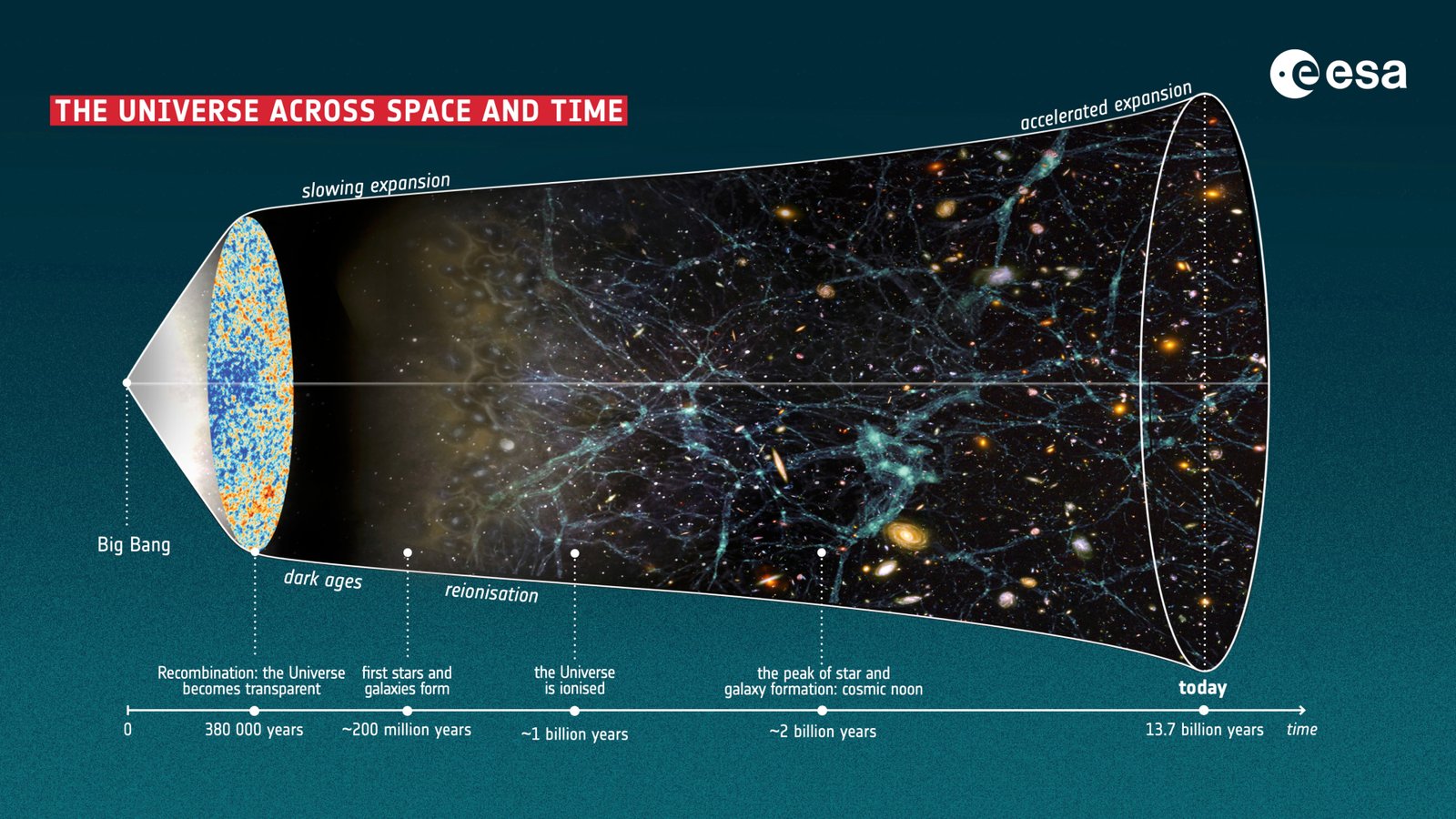
Scientists have long assumed our universe would continue on for trillions of years, but a new study presents a much shorter life span for the cosmos: Our universe might last only another 33 billion years.
That’s just a cosmic blink before everything collapses in on itself — a process dubbed the “Big Crunch,” where expansion reverses, causing all matter and space-time to collapse back into an extremely dense state similar to the conditions of the Big Bang. While long considered a discarded possibility for the fate of the universe, because of accelerating cosmic expansion, this new research has reopened the surprising — and slightly unsettling — option.
The journey to this dramatic conclusion started with our quest to map the cosmos, where we’ve focused on dark energy, the mysterious force that’s pushing the universe apart at an accelerating rate. Recent data from the Dark Energy Survey (DES) and the Dark Energy Spectroscopic Instrument (DESI) mapped hundreds of millions of galaxies to probe this expansion. These crucial tools suggest, with extremely high confidence that the dark energy “equation of state” — its pressure-to-energy density relationship, which dictates its effect on expansion — isn’t simply a static number. Instead, its influence appears to be changing over time.
This strange dynamic opens the door for alternative explanations for what dark energy might be made of . This has led to the axion dark energy (aDE) model, which proposes that dark energy comprises both an axion field, which would be an ultra-light form of dark matter that sloshes around the universe, plus a cosmological constant, or fixed background expansion baked into the structure of space-time.
In the new paper, which was uploaded to the preprint server arXiv, the researchers applied this hybrid model to DES measurements. They discovered that this combination likely can explain the DES and DESI results, but with a twist: In the far future of the universe, the interplay of the axion field and the cosmological constant actually actively pulls the universe back together, leading to that ultimate Big Crunch.
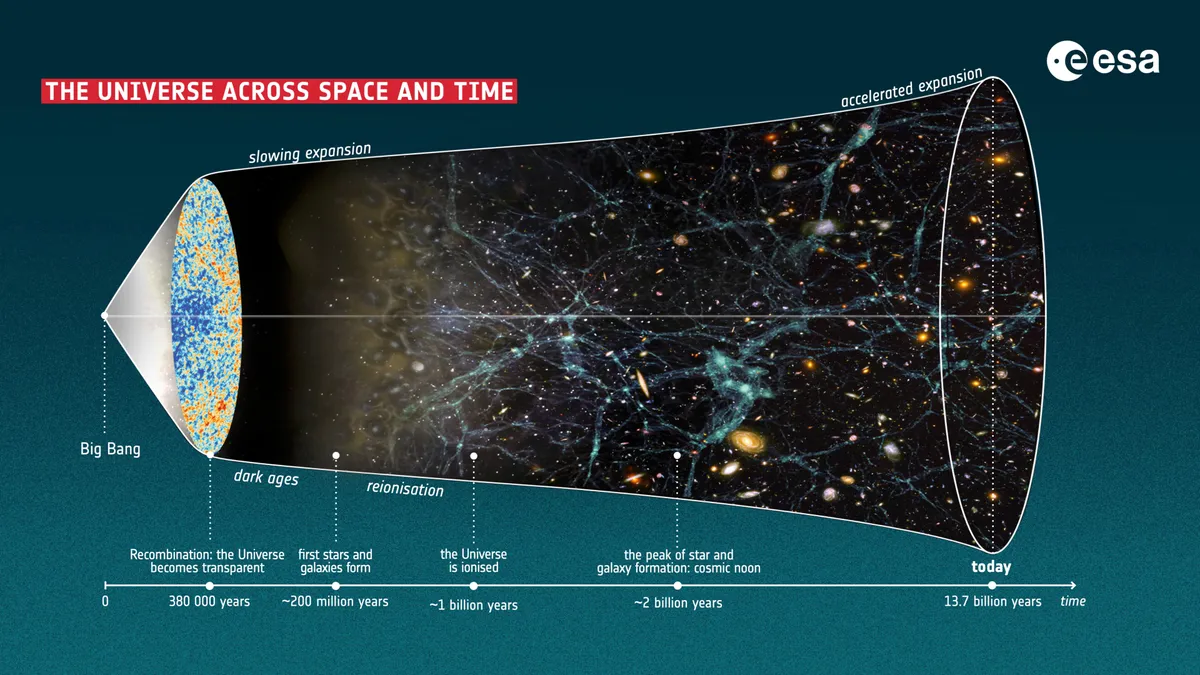
By taking the model that best matched observations and running the simulation forward in time, researchers calculated a precise moment of cosmic demise: 33.3 billion years from now. This dramatically shorter future contrasts sharply with the trillion-year lifespan often traditionally considered. Instead of cosmic expansion stretching the universe out like a lonely, eternal highway, we get a cosmic U-turn that takes us back to the start of our journey.
This is fresh territory, and while evidence compels us, science always comes with caveats. The DES and DESI observations suggesting the cosmological constant isn’t static are intriguing, but it still needs verification. This model depends on many variables, and several different combinations of them could still explain observations, though a negative cosmological constant — and a resulting Big Crunch — remains the most likely in their analysis.
More data is needed to rigorously test this model. The cosmos is a complicated beast; our understanding continually evolves. As we pursue increasing data streams, we piece together the greatest story ever told — but that story might end sooner than we expected.
