

There’s a gaping 2,000-pound hole in Earth’s food web. Saber-toothed cats with 7-inch-long fangs, sloths the size of elephants, wombats the size of cars, and many of the world’s largest mammals disappeared between 50,000 and 10,000 years ago. While 10,000 years may seem long ago to humans, that’s a blink of an eye in evolutionary time, and the disappearance of these megafauna still impacts us today. of.
According to a study published in the journal Proceedings of the National Academy of Sciences (PNAS), disappearing megafauna fundamentally reshaped the food web for modern animals. These effects are also more pronounced in North and South Americas than in other continents.
The world’s food webs all have the same basic principle—animals that eat are then eaten by others. When an animal goes extinct, the complex web of relationships shifts among the surviving species. If a predator disappears, their prey’s population may go unchecked, with a series of cascading effects. Based on previous research into large-animal extinction and food webs, study co-author and Michigan State University ecologist Lydia Beaudrot thought that the extinction of mammals weighing over three pounds could still have an effect tens of thousand years later.
Related Extinction Stories
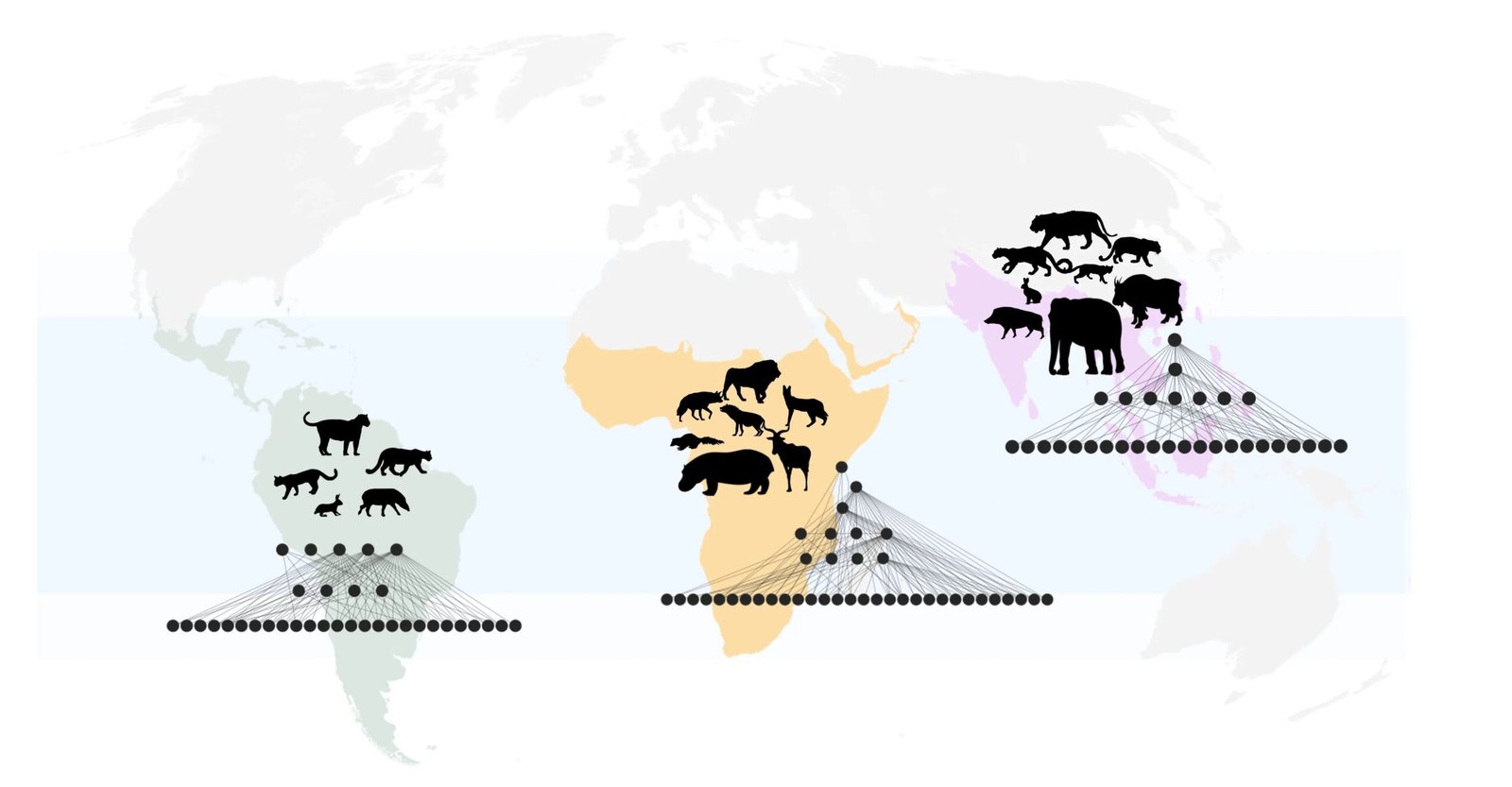
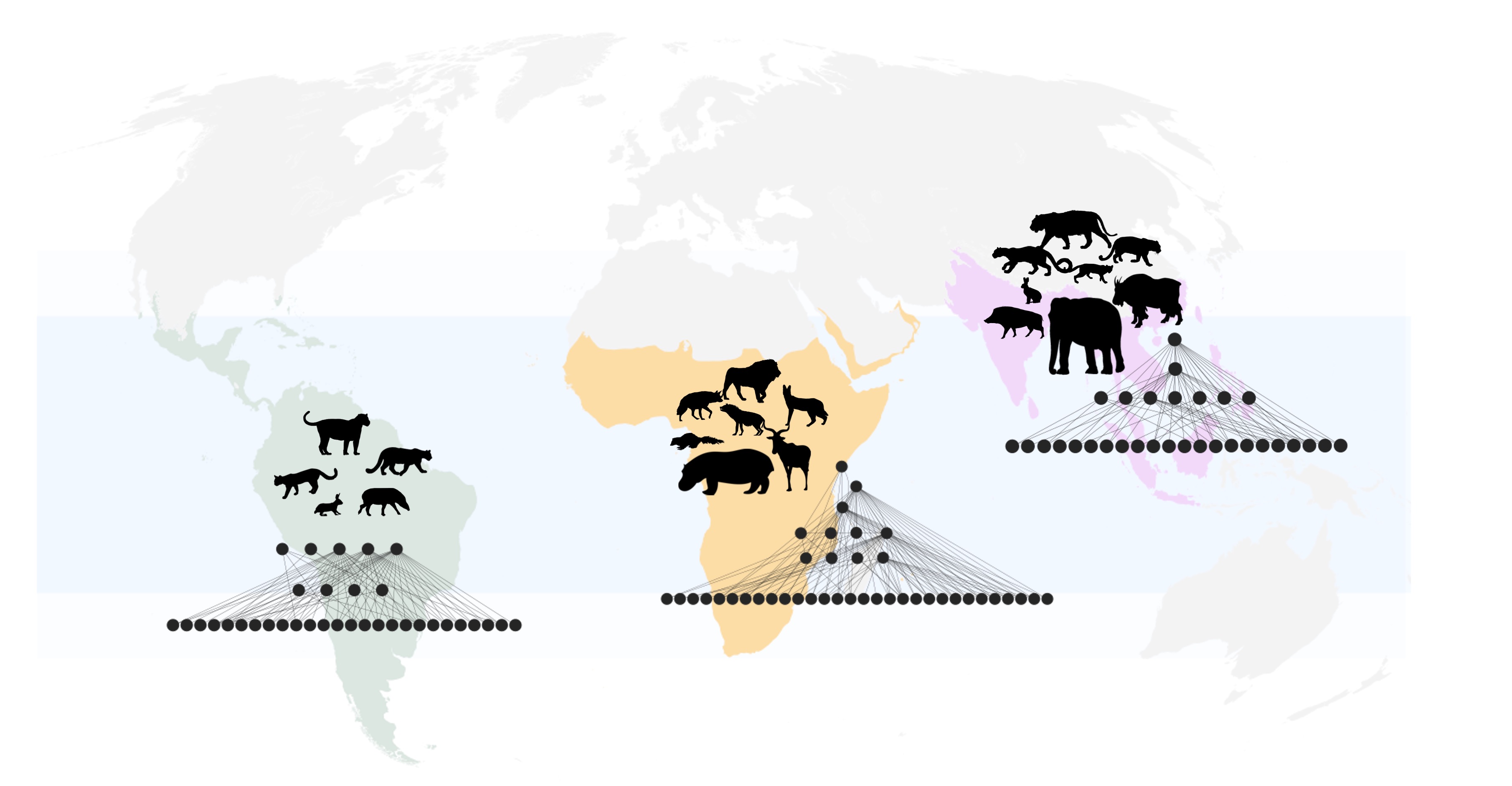
To investigate this hunch, Beaudrot and her team analyzed the predator-prey relationships in 389 locations across tropical and subtropical regions of the Americas, Africa, and Asia. Their study included over 440 mammals including lions, wolves, bears, and elephants.
While the basic animal-eats, animal-gets-eaten structure remains true in all food webs, the number and types of species vary greatly between locations. Overall, the study found that food webs today have fewer, smaller prey in North and South America than they do Africa and Asia.
When they studied prey characteristics such as body mass and activity patterns, the team found that predators in the Americas typically stick with prey with a narrower range of traits, with less overlap among them.
According to the team, the differences between the continents does not just stem from varieties in weather or seasons. Instead, the severity of past extinctions played a significant role in food webs. While each region suffered their share of losses, the Americas were hit the hardest. These continents have lost more than three-quarters of all mammals over 100 pounds during the last 50,000 years.
One example is giant deer. South America was once home to giant deer, including Morenelaphus brachyceros. These roughly 440-pound deer went extinct 10,000 to 12,000 years ago. When they disappeared, there was less prey for predators like saber-toothed cats and dire wolves. The loss of the deer essentially thinned out the food web.
“A lot of the lower part of the food web was lost,” Chia Hsieh, a study co-author and MSU community ecologist, said in a statement.
Why most of Earth’s massive mammals disappeared is still up for debate. Some scientists believe that climate and environmental stresses are to blame. Others say hungry humans spreading out from Africa into other parts of the world played lead to their demise.
Understanding extinction events of the past helps scientists better understand the potential long-term impacts of species facing the same fate now. Nearly half of all animals weighing over 20 pounds are classified as vulnerable, endangered, or critically endangered by the International Union for the Conservation of Nature (IUCN). Additionally, the planet may be experiencing a sixth mass extinction event.
The team plans to study whether historical extinctions make certain communities more vulnerable going forward.
“By studying the past, we can also try to understand what to expect in the future,” Hsieh concluded.

2025 PopSci Best of What’s New
