

I’ve been at Kotaku for three weeks now and have already been hard at work blessing and/or cursing you all with my weird niche interests and opinions. You’ve already heard me ramble about a spelling bee game show and a video game that doesn’t want you to play it. But it has been suggested to me that, on a semi-regular basis, you all might be forced to consider my thoughts on a tiny little video game company that’s just breaking out into the mainstream in a big way.
You know. Nintendo!
Of the big three console makers, I think it’s fair to say Nintendo has had the majority of my loyalty since childhood, but my journey with its games is somewhat different from those of most of my peers. I played an NES in 15-minute spurts in an after-school program, and an N64 at a neighbor’s house. I had a Game Boy Color and Advance, but the first console I owned was a GameCube and I mostly used it to play Baten Kaitos and Tales of Symphonia over and over. I can tell you loads about weirdo niche Nintendo DS games like Contact and Heroes of Ruin. I unironically love the Wii U. But at the same time, I didn’t play Metroid until last year, and just finally finished Ocarina of Time a few months ago. I’m a die-hard Mario Sunshine fan, but never played 64. I’ve had some unusual blind spots around Nintendo’s earlier history that I’ve only recently been getting around to clearing up, even as I’ve deeply immersed myself in its present and future covering its labor issues, its financial reports, its modern games, and its community for almost a decade now.
So I’m going to take some space each month to write a bit about Nintendo. That’s a broad umbrella, and with time we’ll see what all that covers. I don’t want to get sucked into the weird rumor factory/speculative whirlpools that make up so much of Nintendo online discussion these days. But I do want to use this space to explore the parts of Nintendo that might be overlooked for whatever reason. Maybe it’s a weird blip in an earnings report that didn’t make the headlines, or a strange anecdote from the development of a recent game. Maybe one of Nintendo’s many robust fan communities is doing something really, really cool. I want to use those explorations to think deeply about what this company is, who all is contained in and impacted by its largeness, and how those people, from top to bottom, are shaping the future of the things we’re all playing.
So with that in mind, we should obviously start this first piece with…
Zelda 2: The Adventure of Link
(is not that bad)
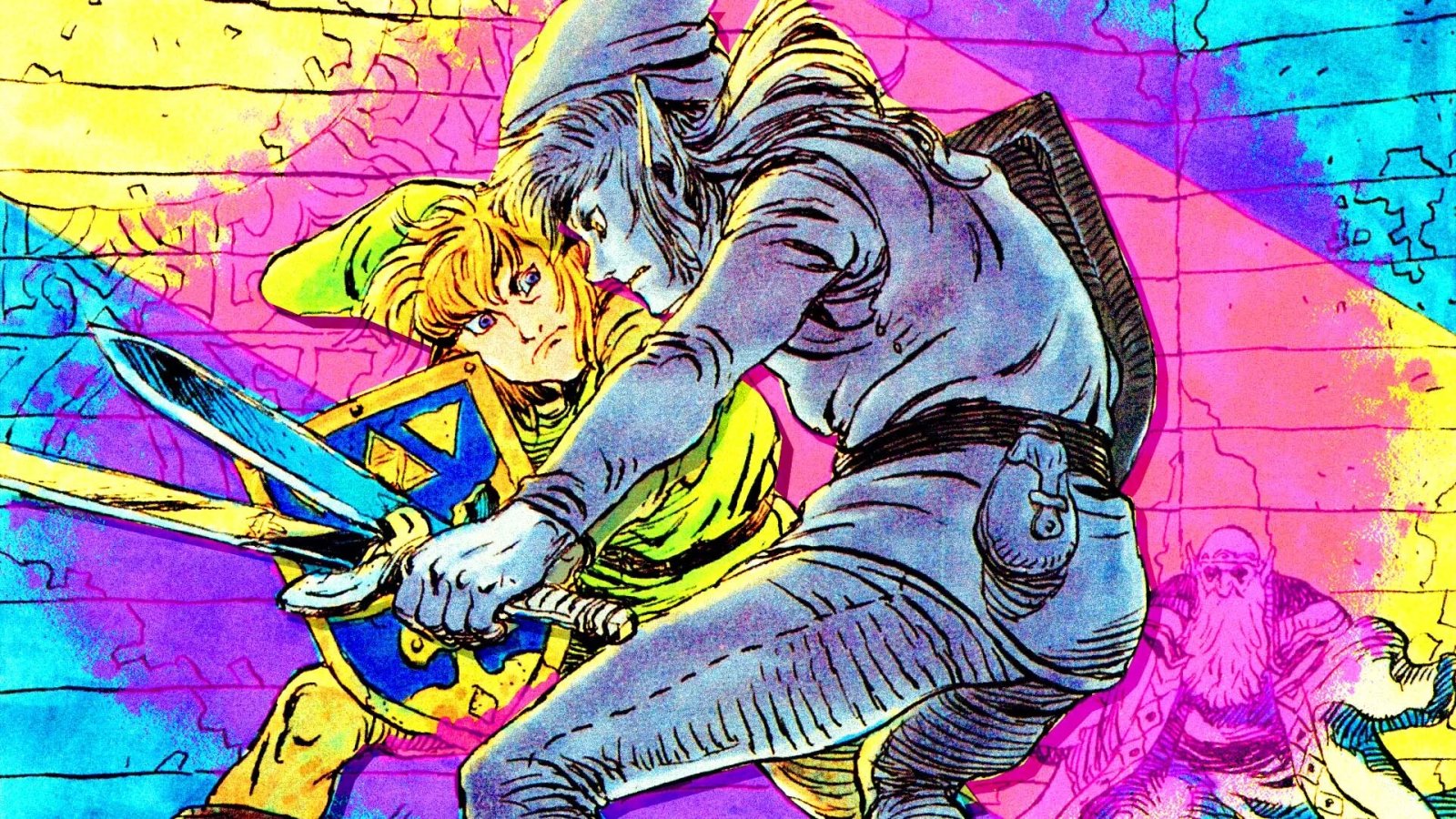
Zelda 2: The Adventure of Link is on my mind this week because of a 2003 interview with Shigeru Miyamoto that was dug up from the Swedish magazine Superplay, resurfaced thanks to Retro Gamer‘s 40 years of Zelda issue and shared via Gamesradar. In it, Miyamoto was pretty brutal! Zelda 2 is technically the direct sequel to the original The Legend of Zelda chronologically and a product of an era in which Nintendo still didn’t know what The Legend of Zelda was going to be long-term. But in spite of that necessary grace, Miyamoto rags on it awfully hard here, essentially relegating it to a spin-off:
It was my idea, but the actual game was developed by another team, different people to those that made the first game. Compared to Legend of Zelda, Zelda II went exactly what we expected… All games I make usually get better in the development process, since good ideas keep coming, but Zelda II was sort of a failure…We actually see A Link to the Past as the real sequel to Legend of Zelda. Zelda II was more of a side story about what happened to Link after the events in Legend of Zelda.
Conveniently, this passage reentered circulation this week at the same time that I’ve been playing Zelda 2 myself for the first time thanks to the magic of Nintendo Switch Online. It’s funny to hear Miyamoto’s harsh remarks on Zelda 2, because the game was apparently very well-received in its time, both reviewing and selling well. But in the years since, its reputation has tanked, especially as the Zelda series branched in a very different direction. Friends repeatedly warned me away from Zelda 2, citing its difficulty and obtusity, and I’m convinced the person who coaxed me into finally playing it was at least partially doing so as a bit.
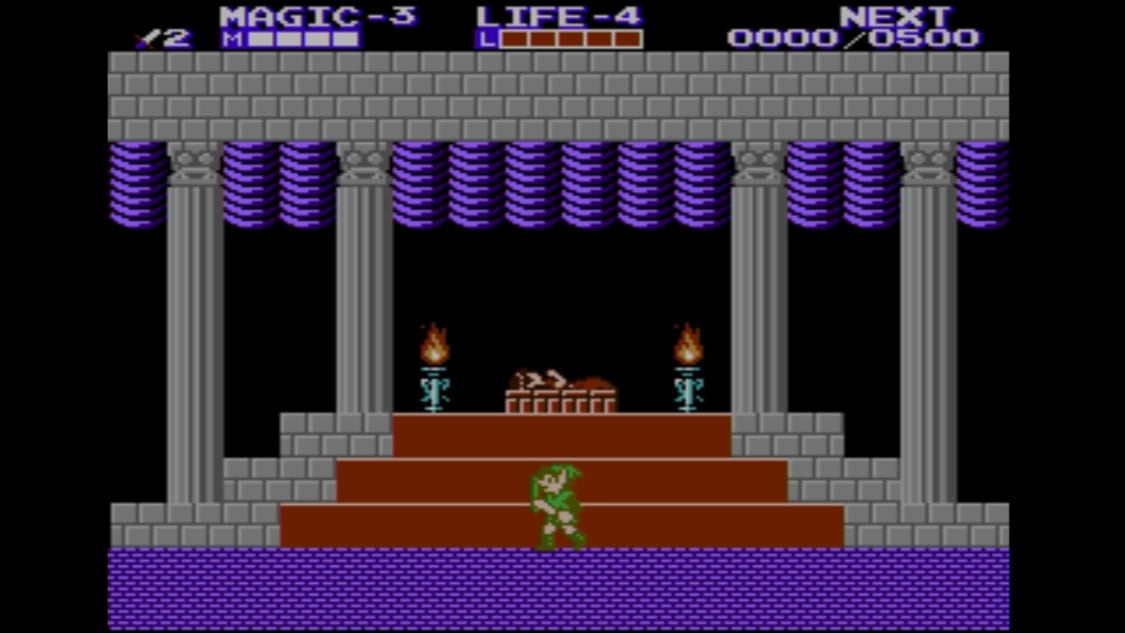
And it’s, uh…a little rough! I am not playing using the overpowered SP version Nintendo provides in its online catalog, and I am barely using the Rewind feature of NSO and instead accepting most of my deaths as personal failures, even though I do not think most of them are. Zelda 2 is extraordinarily clunky to play in 2026. Link moves slow and does not jump high, and the timing and placement of his sword attacks require a frustratingly high level of precision, especially against highly mobile enemies. I have no idea where I’m going or what my objective is at any given time. I’m at a part right now where I think I’m supposed to be doing something to get across a bridge in the water town, but no one is explaining what that might be. And every time I die, I get sent back halfway across the continent and have to do several caves again to get back to what I was trying to accomplish before.
Is it weird to say I kinda like it, though?
Writing about Zelda 2 often focuses on the ways in which it is very, very different from the original The Legend of Zelda, but I’m personally finding Zelda 2 to be remarkably similar. Both games get at a sort of open-world mystique that the Zelda series really lost for a number of years before circling back with Breath of the Wild. You know, that feeling of walking out into the open and navigating it on pure curiosity. Of walking into a temple decorated with weird statues and filled with haunting music, and having no clue if you’re supposed to be there or not. It’s not just that developers hadn’t quite sorted out what tutorials needed to be like yet, either. Zelda 2 has the same weird mystery lifeblood in it that the folks at FromSoftware clearly sampled for the Souls series, where you’re expected to just sort of roam and look at stuff until something jumps out at you, or poke your sword at something cautiously while you figure out exactly how and how fast it’s able to kill you. It makes the moment when you finally kill it right back that much sweeter.
That experience has me curious what Miyamoto envisions Zelda 2 might have been had he and his own team been allowed to develop it to completion. He outright admits that the final version of Zelda 2 is essentially his original vision for it, but like any creative, he’s looking back at the rough draft and groaning and wanting to revise. I’m sad he sees it as a “failure” rather than simply a different possibility for the series, especially since people really seem to have liked it at the time. The Zelda franchise went the way it went not because Zelda 2 was a failure for players, but because it was seemingly a failure to Miyamoto and his team, who then committed to the top-down, puzzle-focused formula with Link to the Past. To great success, sure! Link to the Past is incredible! This was probably the correct choice! But it wasn’t fated. This could have gone the other way. Who’s to say that, had Miyamoto worked directly on Zelda 2, the final version wouldn’t have been better, or good but different? What if Zelda was, in 2026, primarily a sidescrolling franchise?
I’m pondering all this at a time where the Zelda franchise as a whole is at an interesting crossroads. Fans loved Breath of the Wild and Tears of the Kingdom, but the general consensus is that no one really wants a third game exactly like that. Top-down Zeldas like Echoes of Wisdom are still fun and do fine, but the Link to the Past formula is no longer the franchise’s primary identity, which instead has adapted and grown around the immediately and obviously successful Ocarina of Time. What, then, will the next “real” Zelda sequel be? The pressure to define Zelda after the wild success of both Breath and Tears is extremely high, not just from fans, but from investors. It feels very possible that Nintendo could come up with something that, by comparison to those, is another Zelda 2-level failure—critically acclaimed, selling fine, but doomed to go down in history as not a “real” sequel.
I don’t think Zelda‘s going the way of the sidescroller any time soon, but I do think there’s something to ponder here with regard to who determines what the identity of a franchise like Zelda fundamentally is: Is Zelda what critics say it is? Fans? Developers? Historians? Some combination of those? Or is it simply whatever the game of the moment is? What I think we can say definitively at this time is that The Legend of Zelda’s overarching identity is not Zelda 2, and probably never will be. My personal hope is that its next major, mainline iteration will be something new and surprising that I cannot imagine at this time, in the same way I don’t think anyone outside Nintendo imagined Ocarina, or Breath of the Wild, until they were in front of us.
Still, after playing it for a bit, I’m not sure a series for which Zelda 2 was the foundation would be all that bad. Maybe I’ll pick up Demon’s Souls after this…if I can ever manage to find the dang hammer and finish this game.
