

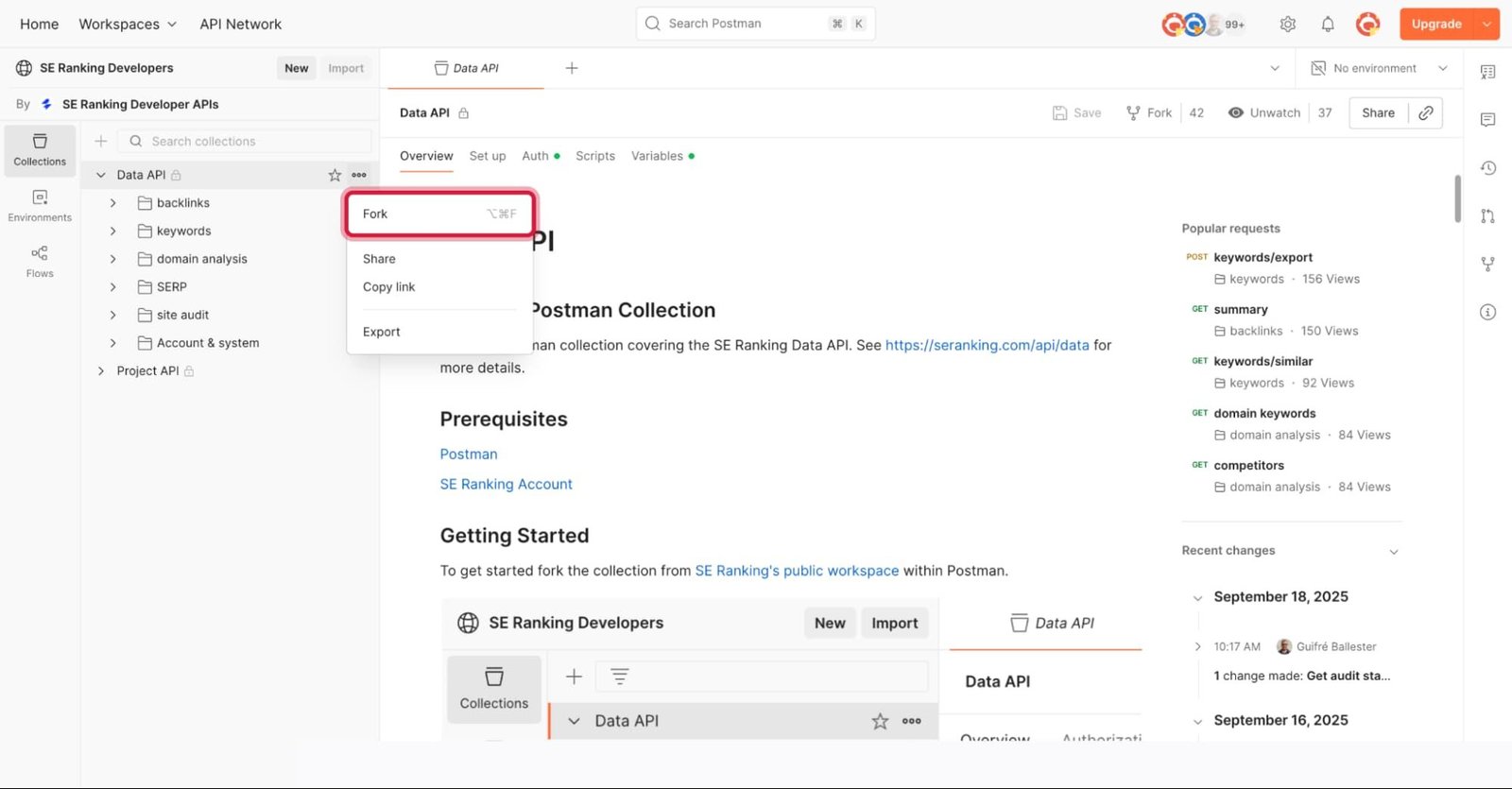
DataForSEO is a solid API platform for raw SERP data, keyword metrics, and backlink feeds. It works well for teams that want to build custom tooling or pipe data into dashboards. The problem? It is pure infrastructure. No interface, minimal support for non-developers, and pricing that scales fast once you are pulling data at volume.
The best DataForSEO alternatives fall into two categories:
- Hybrid platforms like SE Ranking, which give you both the API and a working product.
- API-first platforms like Bright Data SERP API, Ahrefs API, SerpAPI, and Semrush API
Which one you need depends entirely on whether your team writes code or runs campaigns. This article breaks them all down.
TL;DR: What Is the Best DataForSEO Alternative?
SE Ranking is the best DataForSEO alternative for most GEO, AEO, and SERM practitioners. It is a full SEO platform with white-label reporting, rank tracking, competitor monitoring, API access, and a UI that agencies and in-house teams can actually use without engineering resources. Pricing is transparent and scales based on project size — not raw API call volume. For teams working across SaaS, e-commerce, IT, and outsourcing verticals, SE Ranking covers 80–90% of what DataForSEO powers in custom builds, without requiring you to build anything at all. It is our pick as the best DataForSEO competitor for day-to-day expert work.
Comparison Table of DataForSEO Alternatives at a Glance
| Tool | Type | Best For | Pricing Model | API Access | UI Included | White-Label |
|---|---|---|---|---|---|---|
| SE Ranking | Full SEO Platform | Agencies, GEO/AEO/SERM teams | Pay-as-you-go ($50 minimum) | Yes | Yes | Yes |
| Bright Data SERP API | Data Infrastructure | Large-scale SERP scraping | Pay-per-GB / custom | Yes | No | No |
| Ahrefs API | SEO Data API | Backlink & keyword data feeds | Credits-based | Yes | Yes (main product) | No |
| SerpAPI | SERP Scraping API | Developers, custom pipelines | Pay-per-search | Yes | No | No |
| Semrush API | SEO Data API | Enterprise data access | Units + subscription | Yes | Yes (main product) | Partial |
SE Ranking API
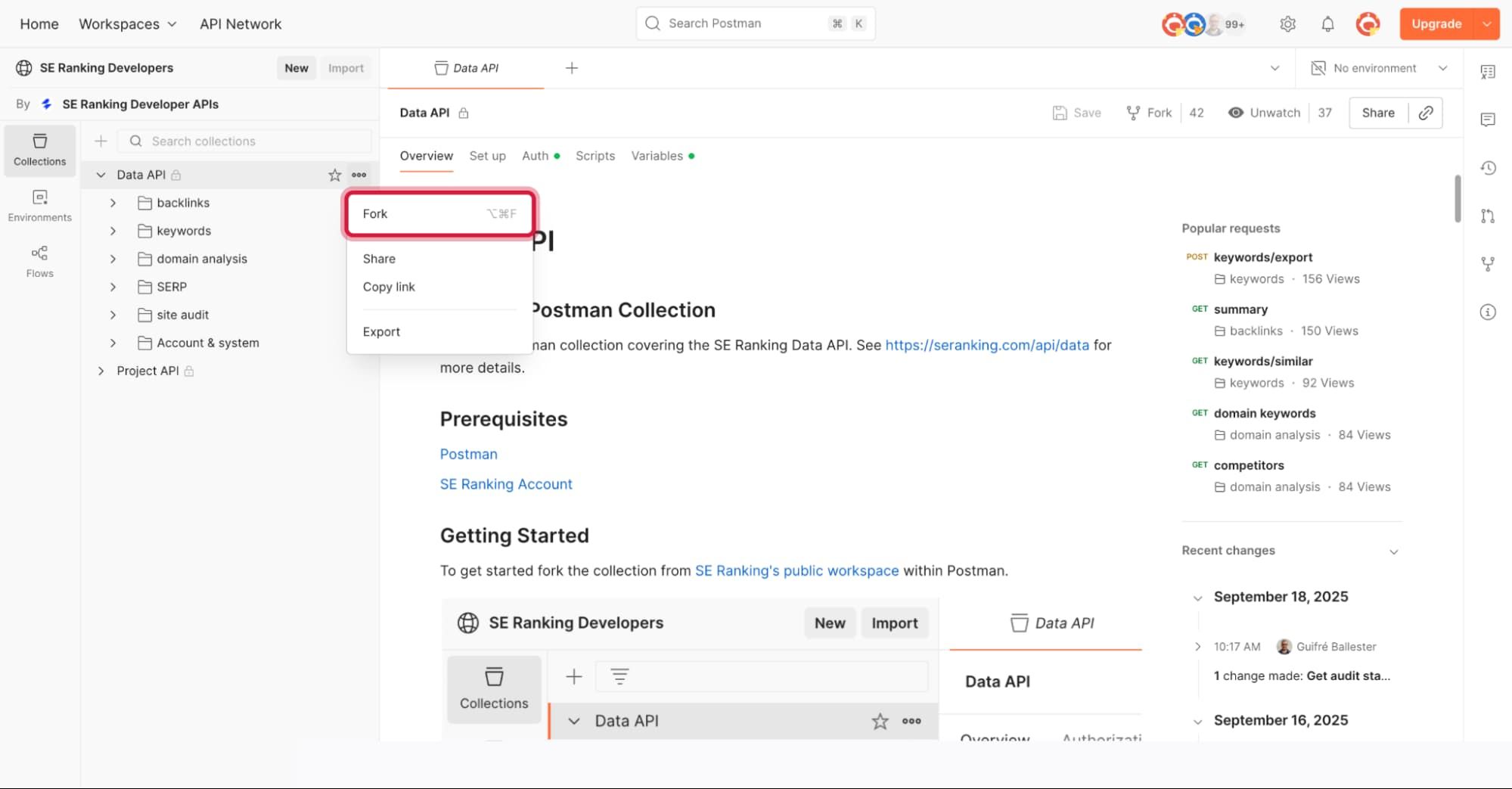
SE Ranking is a cloud-based SEO platform covering AI search visibility, rank tracking, keyword research, competitive analysis, site audits, backlink monitoring, and content tools. It is built for agencies and in-house teams. The API gives programmatic access to ranking data, keywords, and competitor metrics, but most users operate through the UI.
Key Features of SE Ranking
- Daily, weekly, or on-demand rank tracking across Google, Bing, Yahoo, and YouTube
- Competitor tracking with visibility scoring — useful for SERM work across branded and non-branded queries
- Keyword research database covering 5+ billion keywords
- White-label reports with custom branding and scheduled delivery
- API endpoints for rankings, keyword data, and project management
- Local rank tracking by ZIP code or city — strong for GEO campaigns
- AI-assisted content editor and on-page checker
- Backlink monitoring with referring domain metrics
- Google Search Console and Google Analytics integrations
- Multi-user access with role-based permissions
Pros and Cons of SE Ranking
Pros:
- Full-featured platform — no separate build required
- White-label reports are genuinely good, not an afterthought
- Local rank tracking is more granular than most DataForSEO competitors
- Pricing is predictable and does not penalize scale the same way API-volume tools do
- Covers GEO, AEO, and SERM use cases within a single product
- Fast onboarding — teams are productive within a day
Cons:
- Backlink index is smaller than Ahrefs
- No first-party SDKs
- Migrating from DataForSEO means remapping endpoints
Pricing of SE Ranking
- The pay-as-you-go tier requires a $50.00 minimum deposit for 250,000 credits
- Core Plan ($129/month or $103.20 billed annually): 10 projects & 1 seat, 2,000 keywords + 100 prompts daily, 5 GEO domains, 250k audit pages/month, 25k API credits with MCP access, rank tracking, unlimited keyword/backlink research, site audit, and integrations (GA, GSC, Looker Studio, Matomo)
- Growth Plan ($279/month or $223.20 billed annually): 30 projects & 3 seats, 5,000 keywords + 250 prompts daily, 15 GEO domains, 2M audit pages/month, 100k API credits with MCP access, all Core features plus historical data, collaboration tools, page monitoring, and dedicated support
- Agency Pack (+$69/month, annual): add-on with 30 projects, 30 client seats, full white-label platform & reports, unlimited scheduled reports with AI summaries, agency catalog placement, and lead generator
- AI Search Add-on ($89/month or $71.20 annually): 200 prompts, tracking across AI platforms (ChatGPT, Perplexity, AI Overviews), unlimited competitor research, SE Visible dashboard, and automated reporting
- API Add-on ($149/month, annual): 12M credits, access to backlinks, domain analysis, keyword research, AI search, and website audit APIs for automation
- SMM Platform (from $33/month): social media scheduling, collaboration workflows, content planning, analytics, and asset management
- SEO Data API (from $179/month): standalone API with scalable volume, access to backlinks, domains, AI search queries, MCP integration, and automation via tools like Looker Studio, n8n, and Make
- 24M Credits Plan ($318/month effective): 24M credits/year (billed $3,816/year upfront), suitable for large-scale API usage and automation workflows
Best Use Cases of SE Ranking
- Agencies managing SEO across multiple clients who need white-label reporting
- SERM specialists monitoring brand visibility in search results across markets
- GEO campaigns requiring local rank tracking at city or ZIP-code level
- AEO work tracking featured snippets, People Also Ask, and zero-click results
- SaaS and e-commerce teams who want a single platform without engineering overhead
- Outsourcing companies that need clear reporting for clients in multiple verticals
Bright Data SERP API
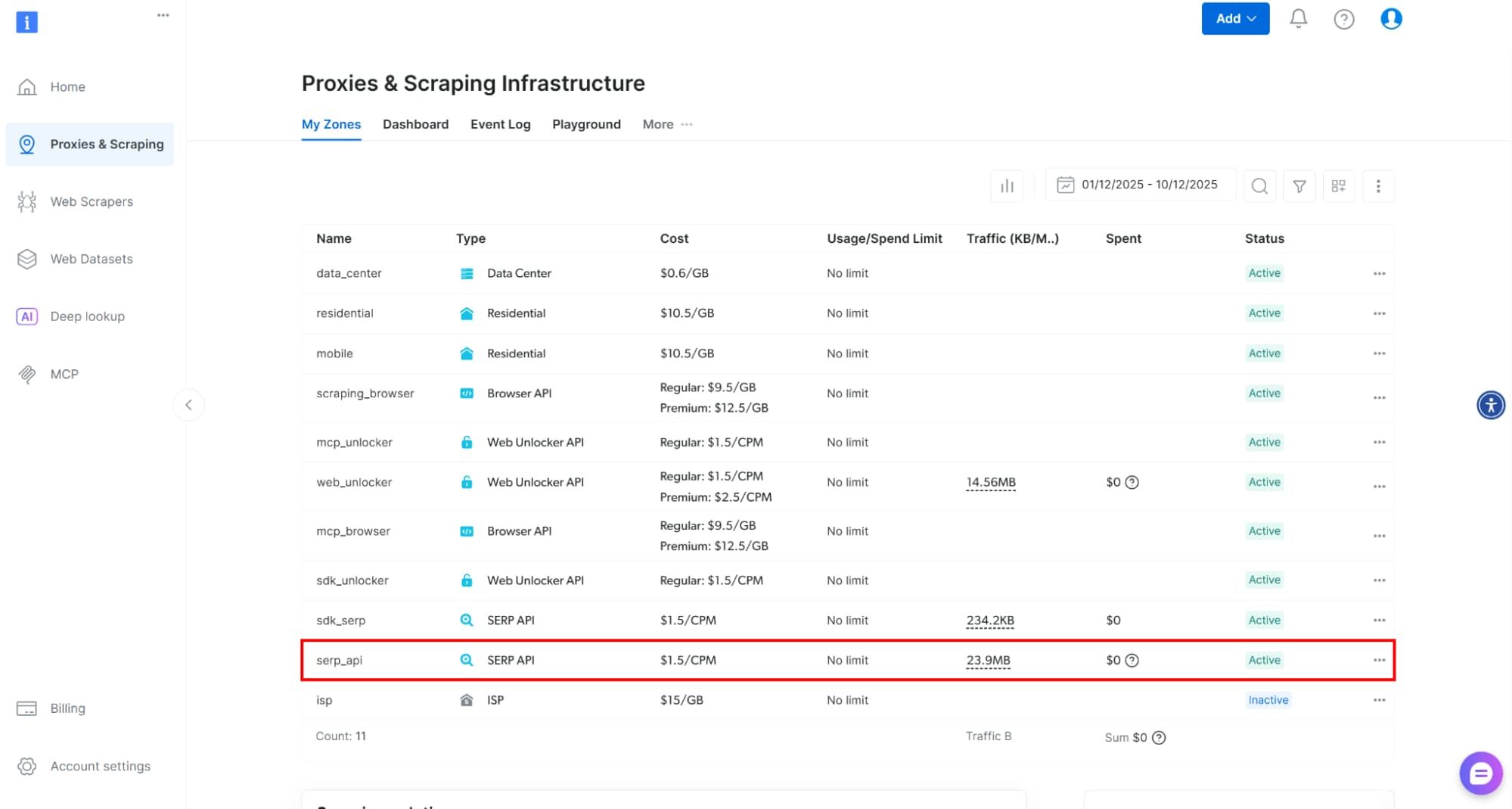
Bright Data is a data collection infrastructure company. Its SERP API is a scraping layer that returns structured SERP data — organic results, ads, local packs, featured snippets — for any search engine. It is not an SEO tool. It is raw data infrastructure for teams that build.
Key Features of Bright Data SERP API
- SERP scraping across Google, Bing, DuckDuckGo, Baidu, Yandex, and others
- Returns structured JSON: organic listings, ads, rich results, Knowledge Panels
- Real browser rendering for JavaScript-heavy SERPs
- Geo-targeted requests by country, state, city, or ZIP
- Residential and datacenter proxy network for high-volume, low-block scraping
- Dataset API for pre-collected SERP snapshots
- Webhook support for async data delivery
- Compliance features for GDPR/CCPA-sensitive deployments
Pros and Cons of Bright Data SERP API
Pros:
- Among the most reliable SERP data sources available — coverage and uptime are both strong
- Geo-targeting is precise, which matters for international GEO campaigns
- Returns rich result types (FAQs, carousels, image packs) that fewer alternatives to DataForSEO support fully
- Scale is essentially unlimited for teams with the budget
Cons:
- No UI — purely API/data
- Pricing is complex and can get expensive fast at scale
- No built-in rank tracking, keyword research, or competitor tools
- Requires developer resources to get value from the data
- Not a practical option for non-technical SERM or AEO practitioners
Pricing of Bright Data SERP API
- Pay-per-GB consumption model — rates vary by product tier
- SERP API starts at roughly $0.001 per SERP record (varies by volume and plan)
- Custom enterprise pricing for large-volume contracts
- Free trial with credits available on registration
- No standard monthly subscription tiers — pricing is negotiated for scale
Best Use Cases of Bright Data SERP API
- Engineering teams building proprietary SERP monitoring tools
- Market intelligence platforms that need SERP data at high volume
- International GEO research requiring precise geo-targeted SERP snapshots
- AI training data collection involving search result pages
- Competitive intelligence pipelines where raw structured data matters more than UI
Ahrefs API
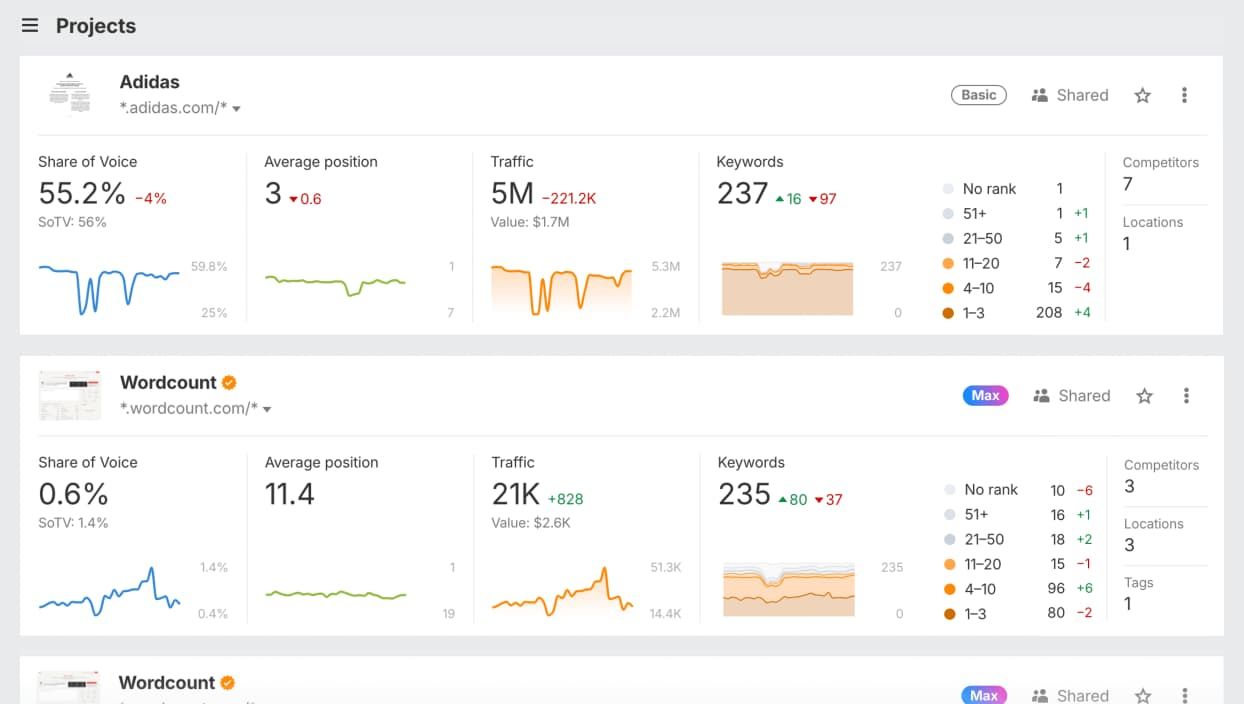
Ahrefs is one of the best-known SEO platforms. Its API exposes the same data that powers the main product — backlink index, keyword metrics, organic traffic estimates, content gap data — for programmatic access. It is not a standalone alternative; it is a way to pipe Ahrefs data into external systems.
Key Features of Ahrefs API
- Backlink data: referring domains, anchor text, link type, domain rating
- Keyword data: search volume, keyword difficulty, CPC, SERP history
- Organic traffic estimates per domain or URL
- Top Pages, Content Gap, and Site Explorer data via API
- Domain metrics (DR, UR, organic traffic) in bulk
- Historical SERP data for keyword ranking movement
- Structured JSON responses across all endpoints
- Access to Ahrefs’ web index — one of the largest available
Pros and Cons of Ahrefs API
Pros:
- The backlink index is the most comprehensive available, period
- Keyword difficulty scores are more trustworthy than most DataForSEO competitors
- Historical data depth is strong — useful for SERM reputation tracking over time
- API response quality is consistent
Cons:
- API credits are expensive — this is one of the pricier alternatives to DataForSEO for high-volume pulls
- No SERP scraping — does not return live SERP layouts, only stored index data
- API access only available on advanced plans
- Rate limits are restrictive at lower tiers
- Not suitable for GEO local rank tracking or AEO rich result monitoring
Pricing of Ahrefs API
- API access requires Ahrefs Advanced ($449/month) or Enterprise ($1,499/month)
- API calls consume credits; credits purchased separately or included in plan
- No standalone API-only pricing
- Annual discounts available
Best Use Cases of Ahrefs API
- Link-building teams that need backlink data in bulk for external tools
- SERM analysts tracking link acquisition around a brand over time
- Keyword research at scale for SaaS or e-commerce content teams
- Competitive analysis pipelines comparing domain authority across multiple sites
- Agencies already on Ahrefs Advanced who want to automate reporting
SerpAPI
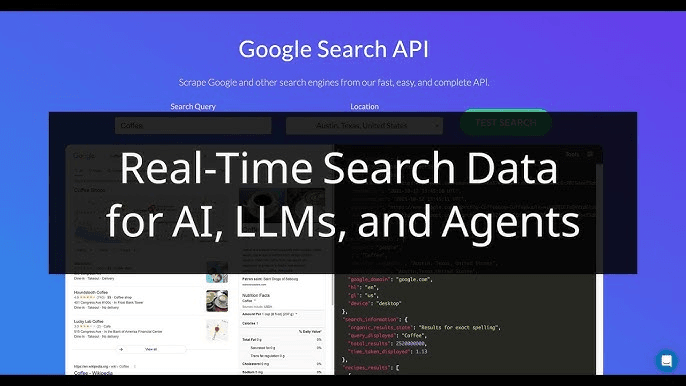
SerpAPI is a search engine results page scraping service. Developers send a search query and get back structured JSON representing the full SERP — organic results, ads, featured snippets, local results, and more. It is one of the most developer-friendly best DataForSEO alternatives for clean, fast SERP data retrieval.
Key Features of SerpAPI
- Supports Google, Bing, Baidu, Yahoo, DuckDuckGo, Naver, YouTube, Google Maps, and others
- Returns fully structured JSON for every SERP element type
- Google-specific features: Shopping, Jobs, News, Images, Local, Scholar SERPs
- Geo-targeting by country, city, or coordinate
- Device targeting — desktop and mobile SERP variants
- Language and safe-search parameter support
- Historical SERP data available via API
- Batch search endpoint for queuing multiple queries
- Generous documentation and playground for testing
Pros and Cons of SerpAPI
Pros:
- Excellent documentation — among the easiest DataForSEO alternative services to integrate
- Wide engine coverage in a single API
- JSON output is clean and consistently structured
- Good fit for AEO research — People Also Ask, featured snippets, and rich results appear in responses
- Reliable uptime and fast response times
- Pay-per-search model keeps costs predictable for low-to-mid volume
Cons:
- Costs scale linearly — high-volume use gets expensive
- No rank tracking product, no backlink data, no keyword research
- No UI beyond the playground and account dashboard
- Requires development work to get business value from the data
- Not a direct replacement for DataForSEO at large enterprise scale
Pricing of SerpAPI
- Free plan: 100 searches/month
- Developer: $50/month — 5,000 searches
- Production: $130/month — 15,000 searches
- Business: $250/month — 30,000 searches
- Enterprise: Custom — 100,000+ searches/month
- Annual billing gives roughly 20% off
Best Use Cases of SerpAPI
- AEO research tracking featured snippets, PAA boxes, and rich result appearance
- GEO work validating local pack rankings with geo-targeted SERP requests
- Developers building keyword monitoring or content tools for SaaS products
- Agencies needing SERP data for client reporting without building scraper infrastructure
- Research projects studying SERP layout changes across industries
- IT and tech companies integrating SERP signals into proprietary dashboards
Semrush API
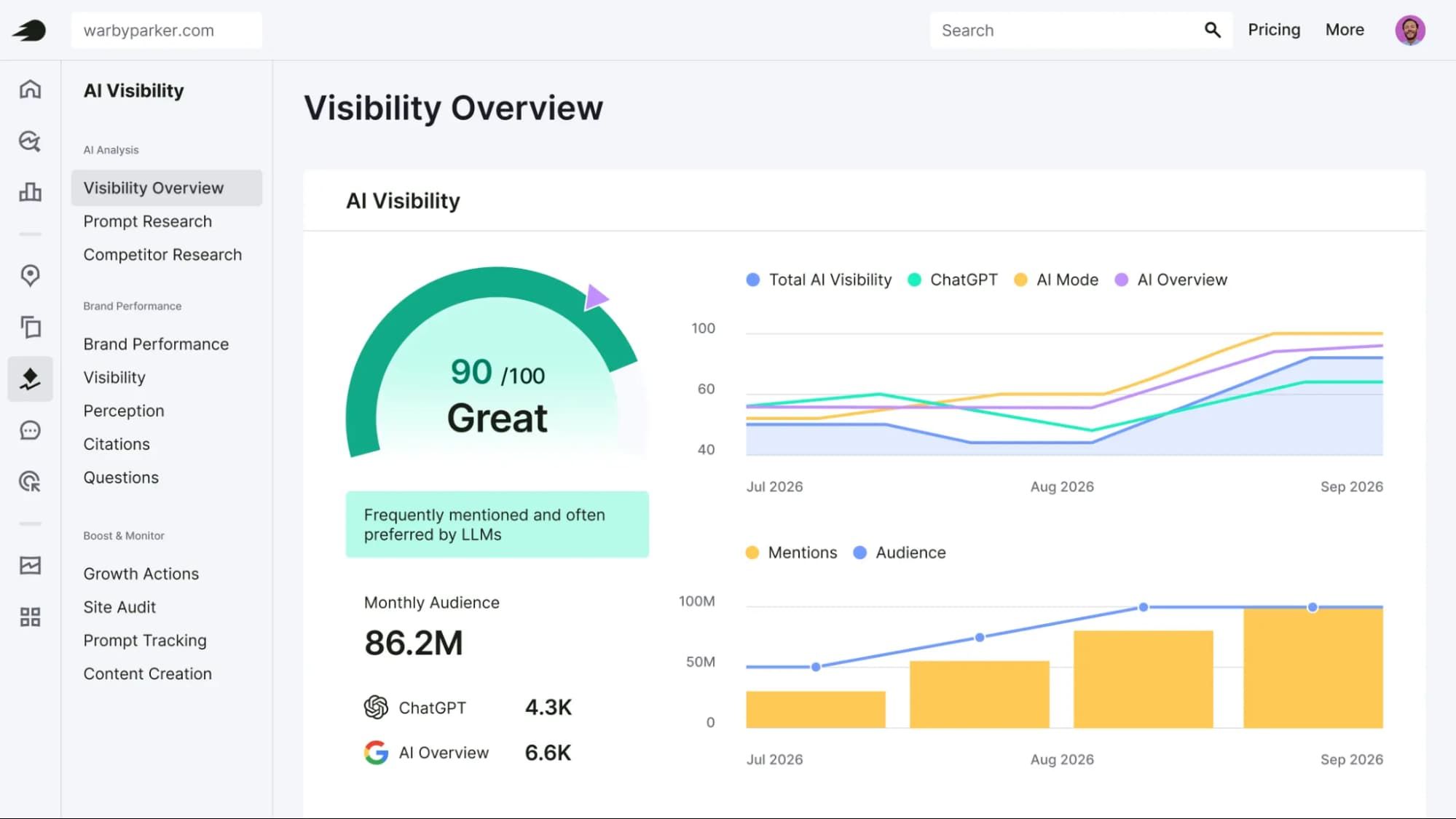
Semrush is a comprehensive SEO, PPC, and content marketing platform. Its API gives programmatic access to keyword data, domain analytics, backlink data, advertising research, and traffic analytics. As a DataForSEO competitor, Semrush API is most relevant for teams already using Semrush who want to automate or extend their workflows.
Key Features of Semrush API
- Domain analytics: organic and paid traffic estimates, top keywords, visibility trend
- Keyword research: volume, difficulty, intent, CPC, competitive density
- Backlink data: referring domains, anchor text, authority scores
- Advertising research: competitor ad copies, landing pages, spend estimates
- Traffic Analytics: estimated traffic breakdown by source, country, and device
- Position Tracking API for programmatic rank monitoring
- Social media listening endpoints via Semrush Social
- Content audit and topic research endpoints
- 55+ databases covering 142 countries
Pros and Cons of Semrush API
Pros:
- Broadest data coverage of any tool in this list — SEO, PPC, content, and social in one API
- Traffic Analytics data is among the best third-party traffic estimation available
- Strong for SERM work: brand visibility, share of voice, and reputation tracking all accessible via API
- Geographic databases are deep — good for international GEO campaigns
- 55 country-specific keyword databases
Cons:
- API units are expensive and deplete fast on data-heavy queries
- API access only available on Pro, Guru, or Business plans
- Extra API units can add significant cost
- Rate limits are restrictive on Pro
- White-label not natively supported; requires external reporting tools
- API documentation has a steep learning curve
Pricing of Semrush API
- Pro: $139.95/month — 3,000 API units/day included
- Guru: $249.95/month — 5,000 API units/day included
- Business: $499.95/month — 10,000 API units/day included
- Additional API units purchased in bundles
- Annual billing saves ~17%
- Custom Enterprise pricing available
Best Use Cases of Semrush API
- SERM teams monitoring brand share of voice and competitive visibility across markets
- Enterprise SEO teams that need keyword and traffic data piped into BI tools
- Agencies running both SEO and PPC campaigns who need a single data source
- E-commerce brands tracking visibility against competitors in shopping results
- IT companies building internal SEO reporting dashboards using enterprise-grade data
- Teams already on Semrush who want to automate repetitive reporting
Conclusion
DataForSEO fills a real need — cheap, flexible, raw SERP and keyword data at scale. But most GEO, AEO, and SERM practitioners do not need raw infrastructure. They need data they can act on, reports they can share, and tracking they do not have to build from scratch. So:
- SE Ranking is the best DataForSEO alternative for the majority of expert practitioners working across agency and in-house contexts. It covers AI search visibility, rank tracking, competitor analysis, local SEO, and SERM use cases without requiring a developer on standby.
- SerpAPI and Bright Data are the right picks for teams with engineering resources and specific data pipeline needs.
- Ahrefs API wins on backlink data quality.
- Semrush API wins on breadth, especially for enterprise teams that need PPC and traffic analytics alongside SEO.
Pick based on your workflow, not on feature count. The best DataForSEO competitors are the ones your team will actually use.
FAQ
1. What are the main differences between DataForSEO and its alternatives?
DataForSEO is a pure data API — no UI, no built-in reports, no campaign management. Most alternatives to DataForSEO, like SE Ranking, include a working product alongside API access. The tradeoff is flexibility: DataForSEO gives you more control over data structure; platforms give you speed to value.
2. Which DataForSEO alternative is best for GEO?
SE Ranking supports geo-targeted rank tracking at city and ZIP-code level. Bright Data SERP API is the strongest option if you need bulk geo-targeted SERP snapshots for large-scale analysis. For most GEO campaigns, SE Ranking’s local rank tracking feature covers the requirement without additional development.
3. Which tool is the best DataForSEO alternative for AEO?
SerpAPI returns the most complete structured data for AEO-relevant SERP features — People Also Ask, featured snippets, knowledge panels, and AI Overviews. SE Ranking also tracks featured snippet appearances.
4. Which DataForSEO alternative is best for SERM?
SE Ranking and Semrush API are the strongest best DataForSEO competitors for SERM. SE Ranking lets you monitor branded keyword rankings and competitor visibility over time. Semrush’s Share of Voice metric and Traffic Analytics make it useful for tracking brand perception through search data at enterprise scale.
5. Is SE Ranking actually a DataForSEO competitor?
Yes. SE Ranking covers a large portion of what teams build with DataForSEO — rank tracking, keyword research, backlink monitoring, and competitive analysis — but through a ready-to-use platform. It is a DataForSEO competitor in the sense that it replaces the need to build a custom tool on top of DataForSEO’s raw API.
6. How does SerpAPI compare to DataForSEO for SERP scraping?
Both return structured SERP data. DataForSEO is generally cheaper at very high volumes and supports more search engines. SerpAPI has better documentation and faster integration, which matters for small teams. For most developers, SerpAPI is easier to start with. DataForSEO is better if you are running millions of queries per month.
7. What are the best DataForSEO alternatives for agencies?
SE Ranking is the top pick — white-label reports, multi-project management, and team collaboration are all native. Semrush is also widely used in agency contexts, especially where clients have both SEO and PPC needs. SerpAPI works well for agencies building proprietary tools for clients.
8. Can I use Ahrefs API as a standalone DataForSEO alternative?
Not really. Ahrefs API requires an active Ahrefs subscription at the Enterprise tier. It gives you excellent backlink and keyword data, but it does not provide live SERP scraping or local rank tracking. It is best used as a supplement to a platform like SE Ranking, not a standalone replacement for DataForSEO.
9. Which alternative to DataForSEO has the best pricing for small teams?
SerpAPI offers 100 free searches per month, then $50/month for 5,000 searches. SE Ranking starts at a minimum of $50 (pay-as-you-go), with a 14-day free trial and 100,000 credits. Both are reasonable. For teams that need a full platform rather than just an API, SE Ranking gives more value per dollar.
