

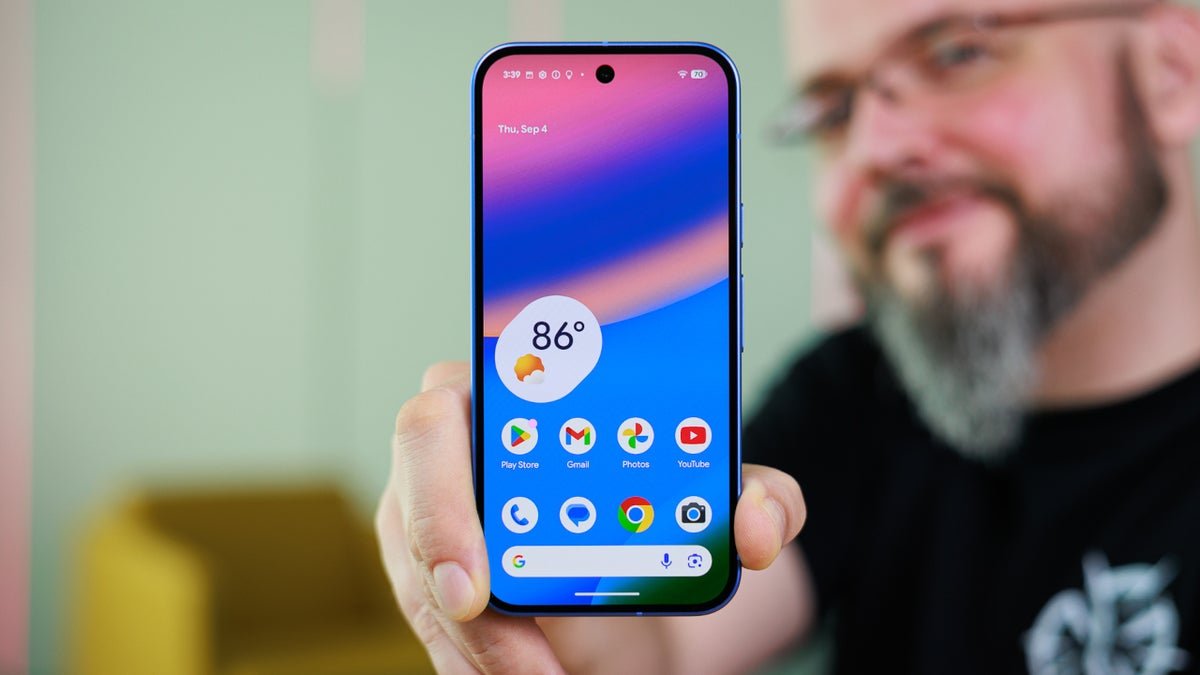
There are different ways to get a reading on your heart rate. Most smartwatches from Apple, Samsung, Google, and other companies will give you a real-time reading counting how many times your heart beats in one minute. Another device you can buy, the pulse oximeter, will give you a reading once you squeeze the spring-loaded hinge, place your finger into the opening, and let the clip close securely.
Currently, smartwatch users can get real-time heart rate readings on their wrists
With a smartwatch, all you need to do is wear the device and tap on a button before the reading appears within seconds. A good resting heart rate is 60 to 100 beats per minute (BPM), although a heart rate in the range of 50 BPM to 70 BPM shows better cardiovascular fitness.
A completely non-tech way to figure out your heart rate is to place the tips of your index and middle fingers on your wrist, just below the base of your thumb. Count the beats for 15 seconds and multiply by four to get your beats per minute. For the record, your maximum BPM is the number 220 minus your age.
Using smartphones to track users’ heart rates can help many more lives than smartwatches
Google wrote in its report that “Smartphones present a unique opportunity to broaden access to health tracking — today, around five billion people already own a device with powerful sensors capable of monitoring their health.” In 2022, Google showed how phone owners could place a single finger on their handset’s camera for on-demand heart rate measurement.
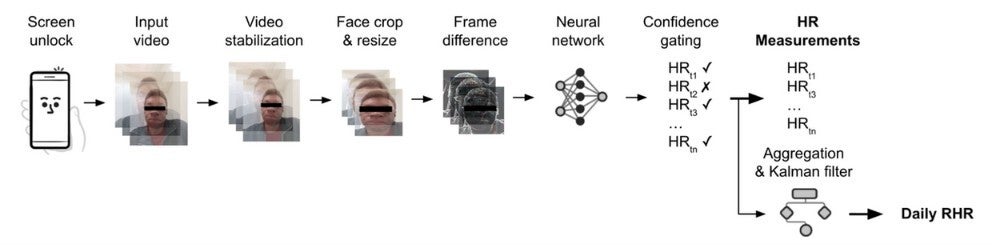
Clips of a user’s face help PHRM estimate HR and daily RHR. | Image by Google
This system, called Passive Heart Rate Monitoring (PHRM), uses a smartphone’s front-facing selfie camera to analyze changes to the skin as blood moves through the body. You can’t see the changes with the naked eye, but video taken in the first few seconds after face unlock activity can spot it.
Eight-second facial video clips run through a neural network can estimate users’ heart rates
Deep learning is applied to the video to estimate HR and RHR that is close to the numbers derived by an ECG and a wearable device, respectively. Software developed by Google processes 8-second facial video clips and runs them through a neural network to predict HR. These predictions are aggregated over the course of a day. With PHRM, HR and RHR can be computed in the background during normal smartphone use.
While using smartphones to track users’ heart rates has been around for some years, Google’s approach is different since it doesn’t require users to start the process. Google’s system can, as noted earlier, use the selfie camera during normal phone use to estimate the user’s resting heart rate over time.
Google trained the system using more than 350,000 video clips taken by almost 700 people who participated in the test. Since darker skin can make it harder to take camera-based blood flow readings, Google used a diverse group of test subjects.
More work needs to be done
To test this system in the real-world outside the controlled environment of a lab, Google had participants use their own phone for a week at the same time they had donned ECG equipment and a Fitbit tracker. Google’s system reportedly continued to perform well.
More work remains to be done. Even though the system still delivers accurate readings for those with dark skin tones, collecting these readings has been hard. Errors in the readings were also discovered to occur when the subjects were talking or moving their heads.
Once Google irons out the wrinkles, smartphones could become a widely-used health tool. Since more people use smartphones than smartwatches, Google’s system can help many more people get health-related readings from their phones than the number who get such data from their smartwatches. Privacy could be assured with the use of a facial recognition biometric.
