

For the past few years, prompt engineering has been one of the most discussed topics in artificial intelligence.
Developers shared prompt templates.
Companies hired prompt engineers.
Social media became filled with examples of carefully crafted prompts designed to produce better AI outputs.
At first, I was fascinated by it.
Like many developers, I spent countless hours experimenting with prompts. I tested different structures, instructions, formatting techniques, and role-playing methods. Sometimes small changes produced surprisingly different results.
Prompt engineering felt like a superpower.
But the more I worked with AI systems, the more I realized something important:
Prompt engineering is useful, but function calling is what transforms an AI model into a practical software system.
That realization changed how I build AI applications.
The Early Days of Prompt Engineering
When large language models first became widely accessible, prompts were everything.
Developers discovered that wording mattered.
A simple instruction could produce mediocre results, while a carefully crafted prompt could generate significantly better outputs.
People experimented with techniques such as:
- Chain-of-thought prompting
- Role prompting
- Few-shot examples
- Structured output prompts
- Multi-step instructions
These techniques helped improve reliability and consistency.
For many applications, prompt engineering remains valuable today.
The problem is that prompts alone have limits.
The Limitations of Prompt Engineering
Imagine asking an AI model:
“What’s the weather in Lagos right now?”
Without external access, the model cannot reliably provide live information.
Now imagine asking:
“Analyze my database and tell me which products are underperforming.”
Again, the model cannot access the database.
Or perhaps:
“Check my website and identify technical SEO issues.”
The model cannot inspect a website on its own.
No matter how sophisticated a prompt becomes, the model remains limited by the information available inside its context window.
At some point, better prompts stop solving the problem.
You need tools.
That’s where function calling enters the picture.
What Is Function Calling?
Function calling allows an AI model to interact with external systems.
Instead of relying entirely on its internal knowledge, the model can request actions.
These actions might include:
- Searching the web
- Calling APIs
- Querying databases
- Reading files
- Sending notifications
- Running calculations
- Triggering workflows
Rather than generating answers from memory alone, the model can gather real information before responding.
This dramatically expands what AI applications can accomplish.
From Text Generation to Task Execution
The biggest difference between prompt engineering and function calling is simple.
Prompt engineering improves responses.
Function calling enables actions.
This distinction is critical.
A model that only generates text remains a chatbot.
A model that can use tools becomes an agent.
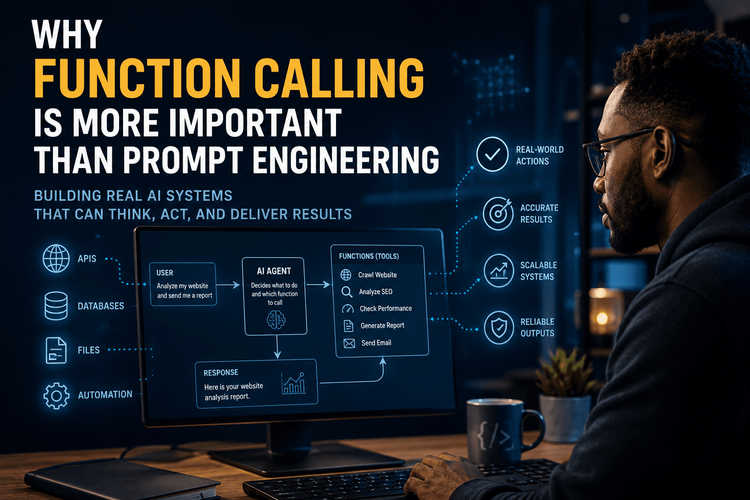
For example, if a user asks:
“Generate an SEO audit for my website.”
A prompt-engineered chatbot might provide generic advice.
A prompt-engineered chatbot might provide generic advice
An AI agent using function calling can:
- Crawl the website.
- Analyze metadata.
- A model that only generates text remains a chatbot.
- Detect technical issues.
- Generate recommendations.
The result is based on actual data rather than assumptions.
That’s a completely different level of capability.
Why I Changed My Development Approach
When I started building AI applications, most of my effort went into prompt optimization.
I spent hours refining instructions.
I adjusted wording repeatedly
I experimented with countless prompt variations.
Eventually, I noticed something surprising.
The biggest performance improvements didn’t come from prompt changes.
They came from adding tools.
Once I connected APIs, databases, crawlers, and custom functions to the model, the quality of the system improved dramatically.
The model became more useful because it could access information and perform actions.
The prompt mattered.
But the tools mattered more.
Building Real AI Agents
Today, many developers talk about AI agents.
In my experience, function calling is one of the foundations that makes agents possible.
An agent typically needs to:
- Understand goals
- Choose tools
- Execute actions
- Analyze results
- Continue workflows
Without function calling, these capabilities become extremely difficult to implement effectively.
The model needs a bridge between reasoning and execution.
Function calling provides that bridge
It allows intelligence to connect with real-world systems.
Function Calling Creates Better Architecture
Another reason I value function calling is software architecture.
Prompt engineering often encourages placing more logic inside prompts.
This can become difficult to maintain
Function calling encourages a different approach.
Instead of embedding business logic into prompts, developers create dedicated functions.
Each function performs a specific task.
The model decides when those functions should be used.
This creates systems that are:
- Easier to maintain
- Easier to scale
- Easier to test
- Easier to improve
From a software engineering perspective, that’s a major advantage.
Does Prompt Engineering Still Matter?
Absolutely.
Prompt engineering remains important.
A poorly designed prompt can still produce poor results.
Clear instructions, structured outputs, and effective context management continue to play valuable roles.
However, I no longer view prompt engineering as the most important skill in AI development.
I view it as one component of a much larger system.
The most powerful AI applications combine:
- Good prompts
- Function calling
- External tools
- Reliable workflows
- Structured architecture
The magic happens when these pieces work together.
Looking Ahead
As AI technology continues to evolve, I believe the industry will focus less on prompt tricks and more on system design.
The future isn’t about finding the perfect prompt.
It’s about building intelligent systems that can reason, gather information, interact with tools, and execute tasks.
That’s where function calling shines.
It transforms language models from text generators into software components capable of participating in real workflows.
Final Thoughts
Prompt engineering helped introduce developers to the power of large language models.
It remains a valuable skill.
But if I had to choose between mastering prompt engineering and mastering function calling, I would choose function calling every time.
Prompts improve conversations.
Function calling builds products.
And in my experience, the future of AI development belongs to developers who understand how to connect intelligence with action.
