

- Up to 25 MHz of cellular spectrum.
- Up to 20 MHz of AWS-1 spectrum.
- Up to 10 MHz of AWS-3 spectrum.
- Up to 20 MHz of PCS spectrum.
FCC: Verizon customers will be better off after this deal is approved
While approving the deal between Array Digital Infrastructure, UScellular’s new name, and Verizon, the FCC made it clear that consumers will be better off with Verizon owning these airwaves. The FCC said that the transaction will improve Verizon‘s “network coverage, capacity and performance, resulting in a stronger ability to meet increasing customer demand and provide a better customer experience.”
FCC Chairman Brendan Carr said that the FCC’s decision to approve spectrum license ownership changes is due to wireless firms trying to benefit from scale, which Carr says is important in “today’s modern connectivity market.” The chairman points out that the companies purchasing spectrum lately have been immediately using the new spectrum and putting it to use. As a result, Carr says that the FCC is “facilitating as many transactions and auctions as we can do to help make that happen.”
Five months ago, AT&T had a spectrum purchase approved by the FCC
Verizon‘s public policy and government affairs senior vice president Kathy Grillo said that the FCC approval will allow Verizon to better serve its customers and strengthen its network, which she characterized as “already-robust.”
At the time, Carr’s comments mirrored almost word-for-word what he would say five months later when the FCC approved Verizon‘s $1 billion deal with Array Digital Infrastructure. In December, the FCC chair said that AT&T‘s transaction will end up “enhancing AT&T‘s network coverage, capacity and performance resulting in a better customer experience.”
Carr and the FCC made eliminating DEI programs the price carriers had to pay to play the merger game
AT&T, T-Mobile, and Verizon might not have received the thumbs up from the FCC for their transactions in 2025 and 2026 had they not eliminated their diversity, equity, and inclusion (DEI) programs. Carr was appointed Chairman of the FCC in January 2025, and two months later he said that wireless firms will need to stop these programs in order to get regulatory approval for corporate mergers and spectrum deals.
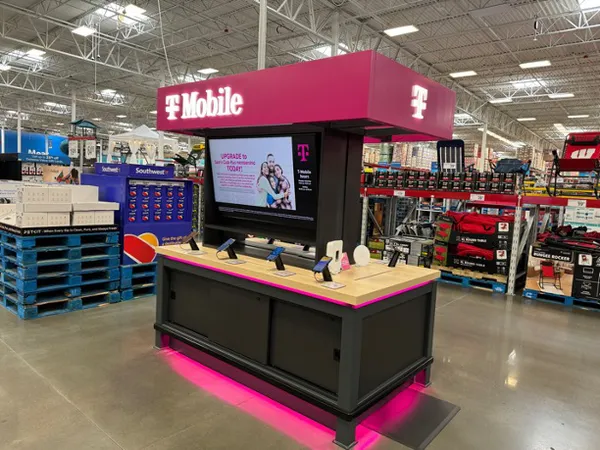
Former UScellular store in Wisconsin is now a T-Mobile location. | Image by T-Mobile
Carr considers DEI programs to be a form of discrimination based on race, gender, and other protected categories. He said that the FCC has a legal obligation to make sure that merger applicants and spectrum license holders comply with federal anti-discrimination law.
Democratic FCC Commissioner Anna Gomez disagreed, pointing out that this was political pressure forcing companies to take actions that were not typically part of a merger review.
Array Digital Infrastructure has plenty of spectrum left to monetize
Currently, Array Digital Infrastructure owns 30% to 40% of UScellular’s spectrum holdings. Most of these airwaves are believed to be low and mid-band spectrum with a small amount belonging to the high-band millimeter wave (mmWave) category. Array Digital said it will “opportunistically monetize” the remaining spectrum it holds as it transitions into a wireless tower and infrastructure company after doing business for so many years as a wireless carrier under its old name.
I would be surprised if the demand isn’t still there for the mid-band spectrum. While not as fast as mmWave, it travels much longer distances than the latter and also penetrates buildings better. Low-band spectrum is not as fast as mid-band and mmWave, but it does cover more distances than the other two.
As a result, low-band is used for nationwide 5G while mid-band is used the most by carriers for their faster 5G services. Due to the short distances they travel, the fastest signals found with mmWave spectrum are limited to dense areas like major cities and are hardly used by the carriers in the U.S.
