

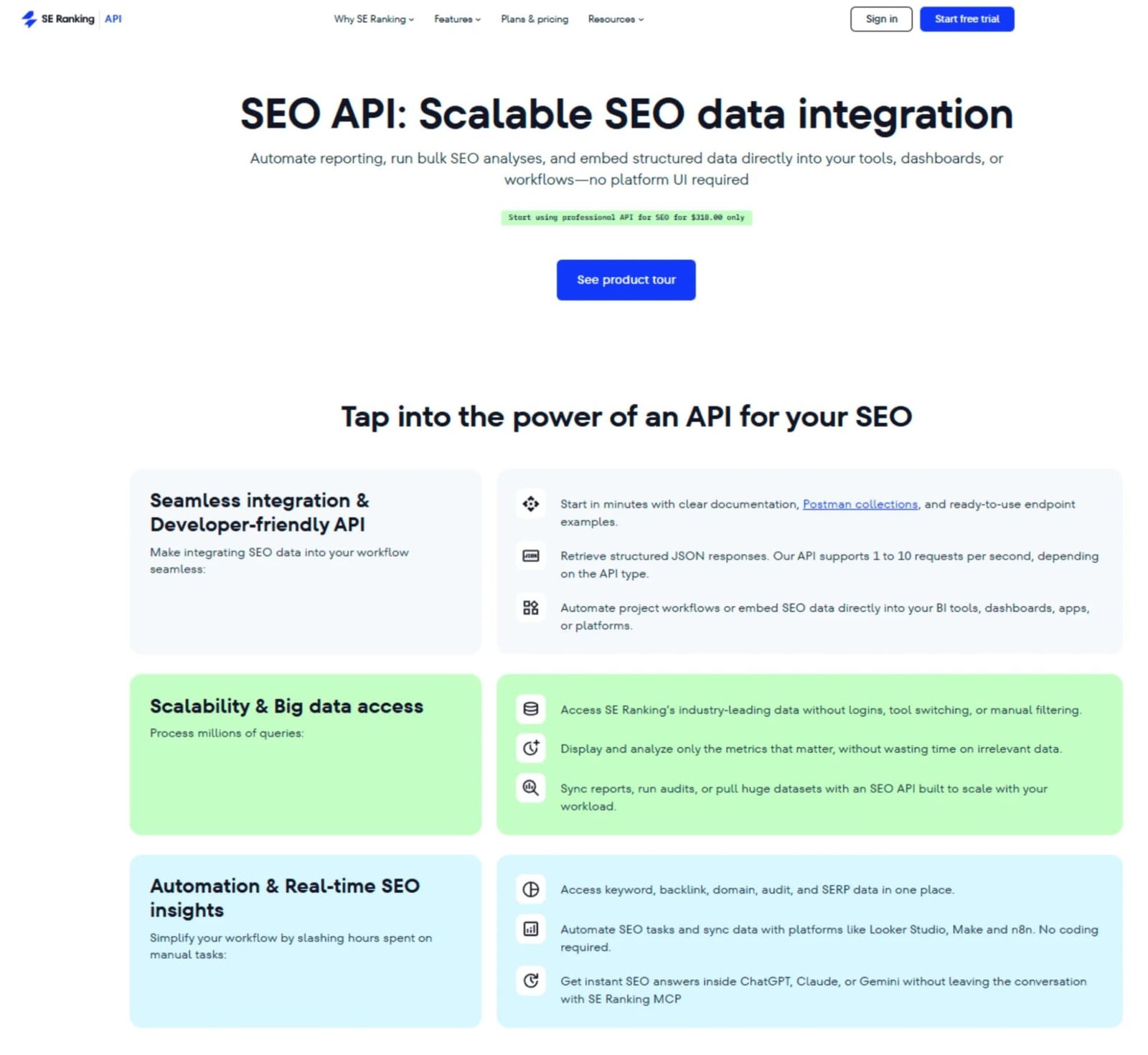
TL;DR: What is the Best SEO data API?
For digital experts prioritizing a balance between raw data accessibility, AI readiness, and platform-integrated automation, SE Ranking is the definitive choice for the best API for SEO in 2026. While providers like DataForSEO offer lower raw costs for simple queries, SE Ranking provides a unique dual-architecture consisting of a high-volume Data API and a Project API. It enables both massive data harvesting and complete automation of SaaS-based project workflows. Its official support for the MCP differentiates it from its peers. It allows developers to connect search data directly to LLMs like ChatGPT or Claude without custom middleware. Its AI Search API allows for the tracking of specific citation frequencies within generative results — a mission-critical feature for modern brand defense.
As of mid-2026, the transition to AI-driven search has reached a critical mass, with over 55% of search engine results pages (SERPs) featuring an AI Overview layer that significantly impacts traditional click-through rates. For the professional marketer, the most effective SEO analytics API must provide more than just organic positions. It must offer a SEO analysis API that quantifies brand presence within LLM responses and facilitates seamless integration with the Model Context Protocol (MCP) to allow AI agents to act upon search insights in real-time.
This article provides an exhaustive, technical comparison of the 10 leading SEO API services, designed specifically for professionals who manage millions of requests and require absolute data integrity to fuel their business intelligence pipelines.
Comparison of Top 10 SEO Data API Providers
The following table presents a detailed cross-section of the 2026 market, highlighting the architectural strengths and economic barriers for the leading SEO data API providers.
| Provider | Core Strength | Data Architecture | AI/AIO Tracking | Primary Protocol | Entry Cost |
|---|---|---|---|---|---|
| SE Ranking | AI Integration | Dual (Data + Project) | Native MCP Support | RESTful JSON | $50.00 |
| DataForSEO | Programmatic Scale | Raw Data Stack | High (Structured) | Unified REST | $50.00 |
| Serpstat | All-in-One Budget | Analytics + Big Data | Multi-Model Mentions | RESTful JSON | $129.00 |
| SerpAPI | Scraping Fidelity | Real-time Scraper | 100+ Search Engines | JSON/HTML | $25.00 |
| Zenserp | Latency & Speed | Real-time Scraper | High Geolocation | RESTful JSON | $49.99 |
| Bright Data | Infra Scalability | Proxy-Led Scraper | 98.44% Success Rate | Raw JSON/HTML | $1.50/1K |
| Ahrefs | Link Intelligence | Proprietary Index | Brand Radar AI | V3 REST API | $1,499.00 |
| Semrush | Marketing Suite | Integrated Analytics | AI Visibility Toolkit | RESTful/CSV | $499.95 |
| Authoritas | eCommerce Depth | Browser Emulation | AIO Snapshot Tech | RESTful JSON | $399.99 |
| Majestic | Backlink History | Historical Index | Flow Metrics (TF/CF) | RESTful API | $399.99 |
SE Ranking Best API for SEO
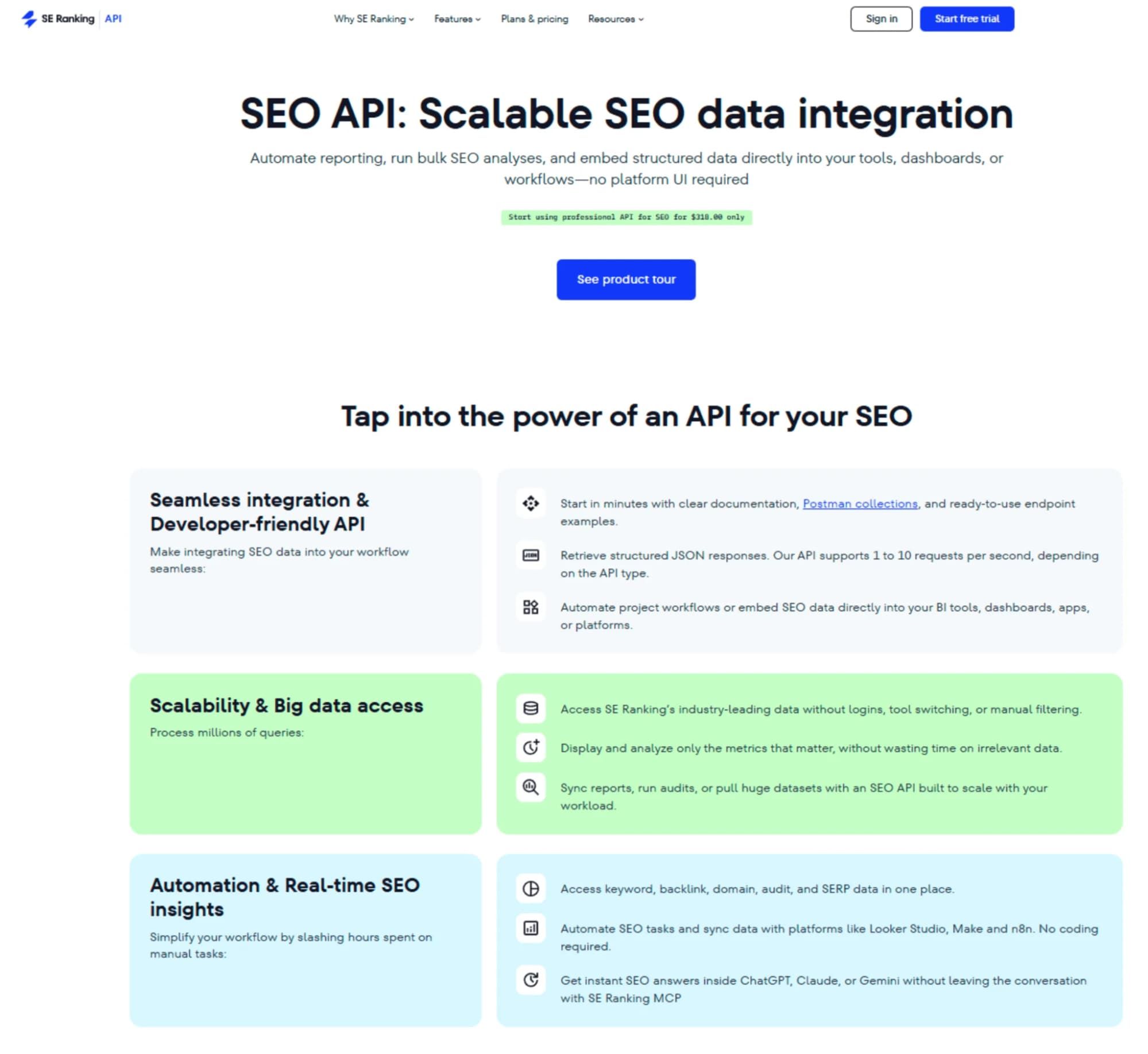
The infrastructure behind SE Ranking has evolved to become an essential API for SEO metrics for agencies that need to bridge the gap between high-level reporting and raw data extraction. Its platform architecture is uniquely split into two functional tiers: the Data API and the Project API.
Data API provides a firehose of raw metrics from a database of over 5.4 billion keywords. Project API allows for the programmatic manipulation of search engines, keywords, and audit settings within a specific account. This bifurcation allows for SEO API automation that is both broad in its market reach and deep in its site-specific monitoring.
Features of SE Ranking
- Scalable Big Data Access: Access to 5.4 billion keywords and 2.2 billion domain profiles across 188 countries.
- Model Context Protocol (MCP): Native support for connecting SEO data to AI assistants like Claude and ChatGPT without custom code.
- AI Search API: Analyze brand visibility across AI platforms, including OpenAI ChatGPT, Google Gemini, Perplexity AI, AI Overviews, and AI Mode.
- AI Search Service: Endpoints provide AI search overviews, Share of Voice leaderboards, prompt discovery, and competitor visibility comparisons.
- Hyperlocal Tracking: Rank tracking accuracy down to decimal latitude and longitude coordinates.
- Postman Collection: Ready-to-use collections for rapid developer prototyping.
- Structured JSON Output: Clean, consistent response objects designed for immediate ingestion into BI tools.
- Domain Analysis API: Aggregated SEO metrics, including estimated organic traffic, keyword visibility, and ranking distribution.
- Keyword Research API: Generate keyword ideas, related queries, and variations to support content gap analysis and scalable opportunity discovery.
- Backlinks API: Retrieve backlink and referring domain data with authority and quality indicators to evaluate link-building opportunities and risks.
- Website Audit API: Get a site health score with detailed issue breakdowns, such as broken links, indexing errors, and on-page optimization gaps.
SE Ranking is best for
- Agencies requiring a top SEO API that provides both a client-facing dashboard and a raw data layer for custom internal tools.
- AI developers who need a SEO analysis API to feed real-time search context into RAG-based chatbots.
- SEO professionals focusing on local visibility who require granular, storefront-level ranking data.
Pros & cons of SE Ranking
Pros:
- 188 countries, 420M domains, and 6B pages crawled daily.
- Seamless integration between platform projects and API data.
- Official MCP server support.
- Competitive pay-as-you-go pricing for data.
- Backlinks, keyword research, domain analysis, website audit, AI Search, and Project Management APIs all run from a single credit balance under one subscription.
- AI Search API includes competitor leaderboards, brand prompt discovery, and query-level visibility tracking across major LLMs.
- Pre-built integrations for Make, n8n, and Looker Studio simplify no-code automation.
- Free 14-day trial with 100K API credits and full endpoint access.
Cons:
- Backlink index, while large, is secondary to link-specialist tools like Ahrefs.
- No official SDKs.
- Higher throughput may require support approval.
- Migrating from another SEO data API provider requires endpoint remapping and integration updates.
Pricing overview of SE Ranking
- The pay-as-you-go tier requires a $50.00 minimum deposit for 250,000 credits
- Core Plan ($129/month or $103.20 billed annually): 10 projects & 1 seat, 2,000 keywords + 100 prompts daily, 5 GEO domains, 250k audit pages/month, 25k API credits with MCP access, rank tracking, unlimited keyword/backlink research, site audit, and integrations (GA, GSC, Looker Studio, Matomo)
- Growth Plan ($279/month or $223.20 billed annually): 30 projects & 3 seats, 5,000 keywords + 250 prompts daily, 15 GEO domains, 2M audit pages/month, 100k API credits with MCP access, all Core features plus historical data, collaboration tools, page monitoring, and dedicated support
- Agency Pack (+$69/month, annual): add-on with 30 projects, 30 client seats, full white-label platform & reports, unlimited scheduled reports with AI summaries, agency catalog placement, and lead generator
- AI Search Add-on ($89/month or $71.20 annually): 200 prompts, tracking across AI platforms (ChatGPT, Perplexity, AI Overviews), unlimited competitor research, SE Visible dashboard, and automated reporting
- API Add-on ($149/month, annual): 12M credits, access to backlinks, domain analysis, keyword research, AI search, and website audit APIs for automation
- SMM Platform (from $33/month): social media scheduling, collaboration workflows, content planning, analytics, and asset management
- SEO Data API (from $179/month): standalone API with scalable volume, access to backlinks, domains, AI search queries, MCP integration, and automation via tools like Looker Studio, n8n, and Make
- 24M Credits Plan ($318/month effective): 24M credits/year (billed $3,816/year upfront), suitable for large-scale API usage and automation workflows
Use Cases of SE Ranking
- Automating Agency Dashboards: Piping daily rank changes and site audit health scores into Looker Studio via the Project API.
- AI Search Performance Analysis: Tracking the frequency of brand citations in ChatGPT or Google AI Overviews to measure GEO success.
- Bulk Competitor Benchmarking: Using the Domain Analysis service to programmatically compare the organic visibility of 500 domains simultaneously.
DataForSEO SEO API Services
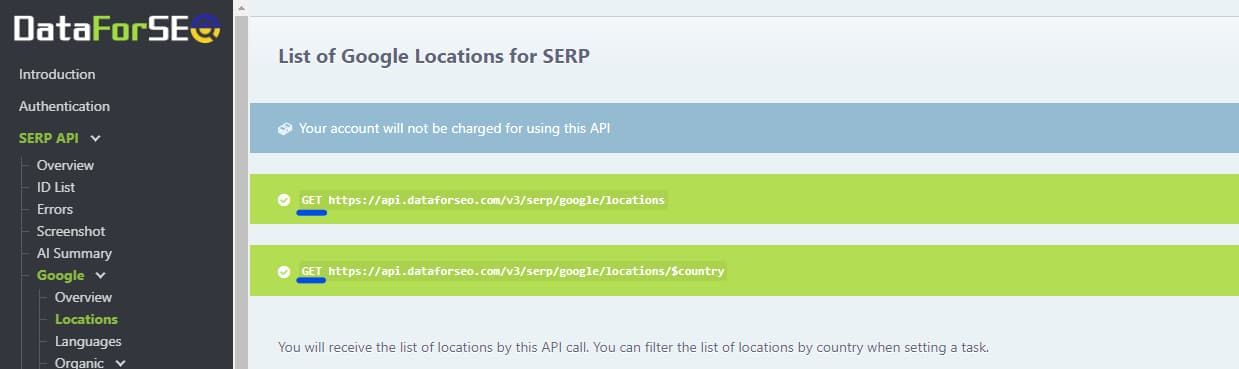
In the realm of SEO API services, DataForSEO is often cited as the gold standard for purely programmatic SEO due to its low-latency responses and highly granular pricing. It functions as a developer-first powerhouse, offering a unified API stack that handles the complexities of proxy management and parser maintenance so that teams can focus on data science.
Features of DataForSEO SEO API Services
- Unified API Stack: Coverage for SERPs, keywords, backlinks, and on-page technical data.
- Pay-As-You-Go Model: No recurring monthly subscriptions; users only pay for successful requests.
- Three-Tier Priority System: Options for Live (real-time), High Priority (1 minute), and Normal Priority (5 minutes) delivery.
- Multi-Platform Support: Data retrieval from Google, Bing, Yahoo, YouTube, Baidu, and Naver.
- Business Data API: Live local review and business information from Pinterest, Reddit, and Tripadvisor.
- Labs API: Historical keyword intelligence and experimental data sources for deep research.
- Merchant API: Price and product monitoring for Amazon and Google Shopping.
DataForSEO SEO API Services is best for
- SaaS developers building their own internal search engine rankings API tools or rank trackers.
- Data scientists requiring massive, structured datasets for training machine learning models on consumer search behavior.
- Programmatic SEO professionals who need to manage millions of keyword queries at the lowest possible cost.
Pros & cons of DataForSEO SEO API Services
Pros:
- Industry-leading price-per-request ($0.0006).
- Excellent technical documentation.
- Extremely high rate limits for concurrent requests.
Cons:
- No visual interface for non-technical stakeholders.
- $50 minimum deposit requirement.
- Non-English coverage can be less dense than premium platforms.
Pricing overview of DataForSEO SEO API Services
- Standard SERP Call: $0.0006 per request (Normal Priority).
- Live SERP Call: $0.002 per request (Instant).
- Backlinks API: $100.00 minimum monthly commitment (redeemable for data).
- Trial Funds: $1.00 credited instantly upon registration.
Use Cases of DataForSEO SEO API Services
- Programmatic Page Generation: Using the Labs API to identify low-competition, high-volume keyword clusters for auto-generated content sites.
- Competitor Market Analysis: Programmatically pulling backlink data for 10,000 URLs to identify outreach targets in a single afternoon.
- Local Reputation Monitoring: Building a dashboard that aggregates reviews from 20+ sources for national restaurant chains via the Business Data API.
Serpstat SEO Software API
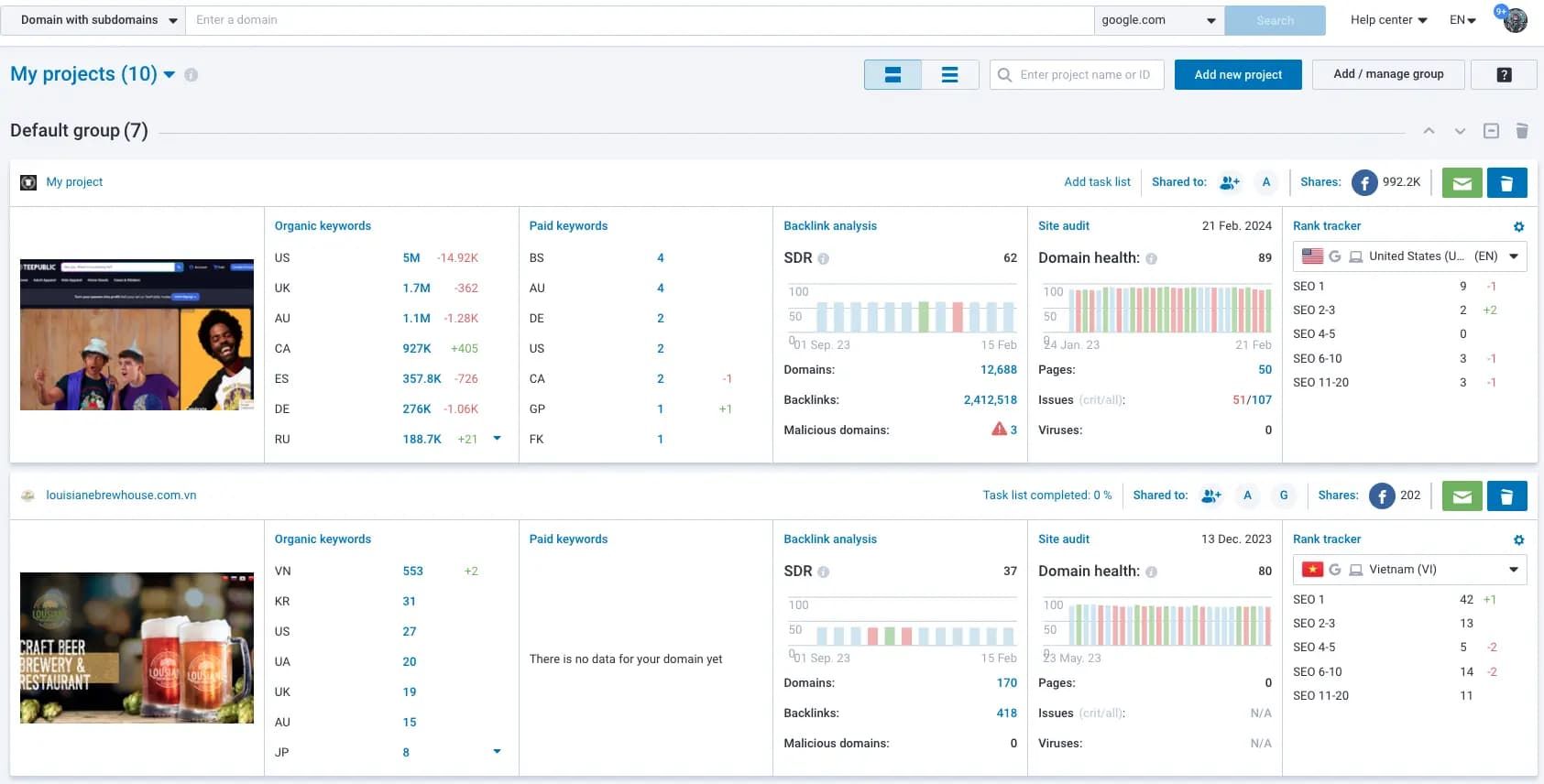
As a comprehensive SEO software API, Serpstat bridges the gap between affordable entry-level tools and high-end enterprise suites. It is built for agencies that prioritize time-saving automation and require a massive keyword database (over 8.6 billion entries) without the prohibitive costs associated with more established competitors.
Features of Serpstat
- Big Data Engine: Access to a database containing 8.62 billion keywords and 2.21 billion domains.
- Keyword Clusterization: Automated grouping of keywords by thematic similarity to streamline content strategy.
- Unused Credit Rollover: A unique feature where unused API credits do not expire at the end of the month.
- Reseller Permission: Formal support for reselling Serpstat data through custom third-party applications.
- Site Audit API: Comprehensive technical diagnostic tools providing Health Scores and issue prioritization.
- AI Platform Monitoring: Multi-model coverage to track brand presence across ChatGPT, Gemini, and others.
Serpstat is best for
- Growing digital agencies that need a reliable SEO analytics API for consistent client reporting.
- Content marketers who use SEO metrics API data to identify long-tail keyword opportunities and thematic gaps.
- Budget-conscious teams that require high keyword volumes but want to avoid the high overhead of Semrush or Ahrefs.
Pros & cons of Serpstat
Pros:
- Intuitive user interface.
- Excellent training resources.
- Competitive pricing for high-volume data resellers.
Cons:
- API access is gated behind mid-tier plans.
- Some regional databases may have lower keyword density than premium tools.
Pricing overview of Serpstat
- Team Plan: $129.00/month for unlimited projects and 50,000 keyword checks.
- Agency Plan: $499 per 2.5 million rows.
- Individual Plan: $69.00/month for freelancers (no API functionality).
Use Cases of Serpstat
- Automated SEO Auditing: Scheduling weekly technical audits for 100 client sites and delivering reports via API.
- Keyword Portfolio Management: Clustering 50,000 keywords into semantic groups to plan year-long editorial calendars.
- Competitor Paid Search Research: Pulling historical PPC data to identify seasonal bid fluctuations for top-tier rivals.
SerpAPI Search Engine Rankings API
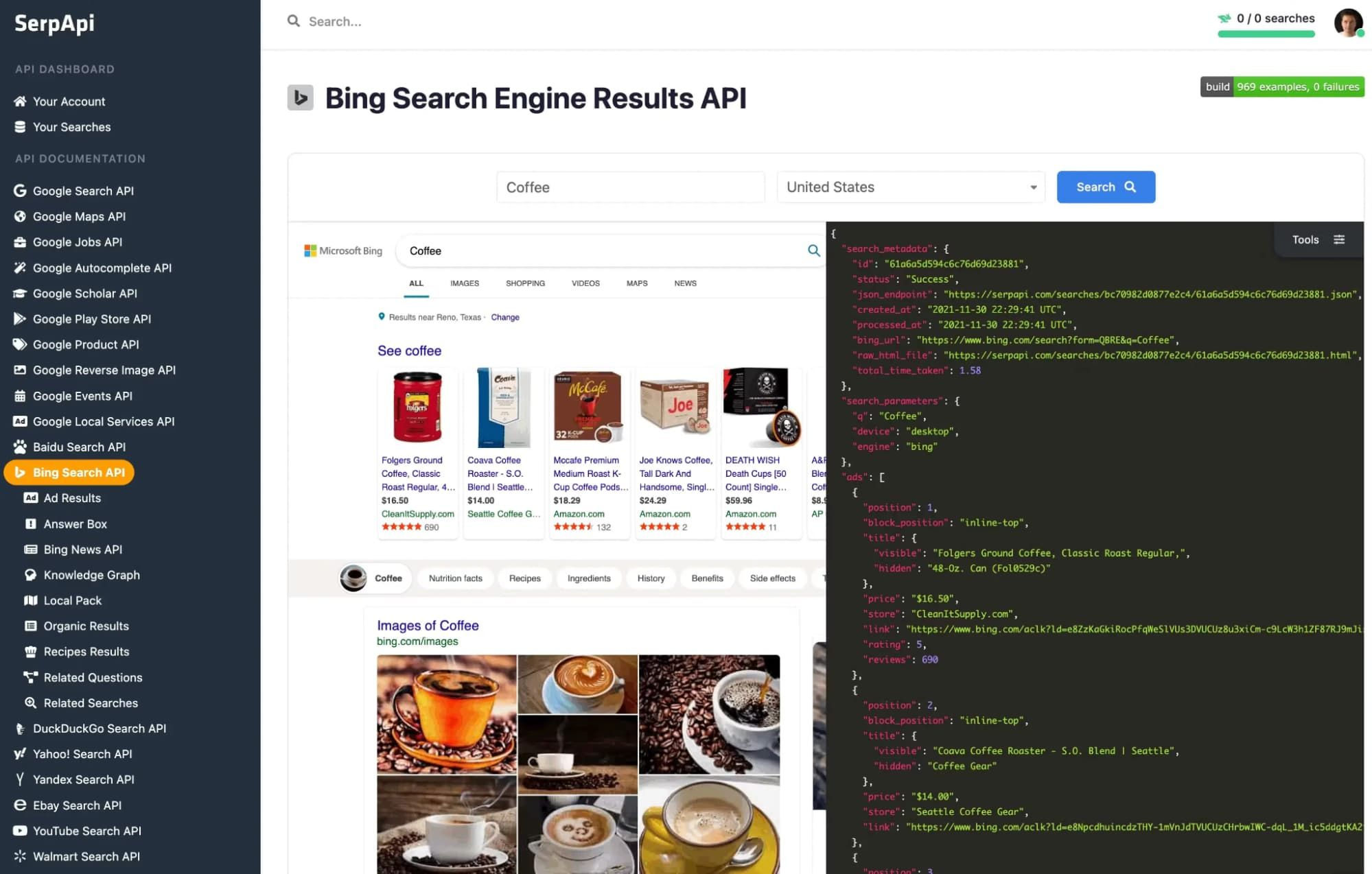
For digital experts who require a pure search engine rankings API that can handle the most aggressive search engine anti-bot systems, SerpAPI is an essential asset. It provides a dedicated scraping infrastructure that focuses on returning the most accurate, real-time results from any location on Earth without the need for the user to manage proxies or solve CAPTCHAs.
Features of SerpAPI
- 100+ Search Engines: Support for Google, Bing, Yahoo, Yandex, DuckDuckGo, and specialized engines like Google Scholar.
- U.S. Legal Shield: Comprehensive compliance and legal protection for all data scraping operations.
- ZeroTrace Mode: High-anonymity scraping designed to avoid fingerprinting and ensure raw data accuracy.
- Ludicrous Speed: A high-throughput mode that processes requests at maximum server capacity for real-time needs.
- Interactive Playground: A browser-based sandbox to test API parameters and view JSON/HTML responses instantly.
- Advanced Parsing: Automatic extraction of featured snippets, Knowledge Graph, and PAA elements.
SerpAPI is best for
- Developers who need a high-fidelity SEO integration API that just works, without worrying about proxy infrastructure.
- Academics and researchers using Google Scholar for large-scale citation and publication analysis.
- Enterprise teams requiring high-compliance scraping with full legal indemnity.
Pros & cons of SerpAPI
Pros:
- Unmatched success rates.
- Extremely clean structured JSON.
- Excellent customer support for complex technical integrations.
Cons:
- Higher cost-per-request than data-aggregator APIs.
- Lack of a historical metric database.
- No credit rollover on standard plans.
Pricing overview of SerpAPI
- Starter Plan: $25.00/month for 1,000 searches.
- Developer Plan: $75.00/month for 5,000 searches.
- Production Plan: $150.00/month for 15,000 searches.
- Big Data Plan: $275.00/month for 30,000 searches.
Use Cases of SerpAPI
- Real-time Rank Verification: Powering a customer portal that allows users to see their live search position on-demand.
- Local SEO Benchmarking: Retrieving the top 100 results for a local business across 500 different ZIP codes to map regional dominance.
- AI Content Validation: Scraping current SERPs to fact-check AI-generated content before publication.
Zenserp SEO Analytics API
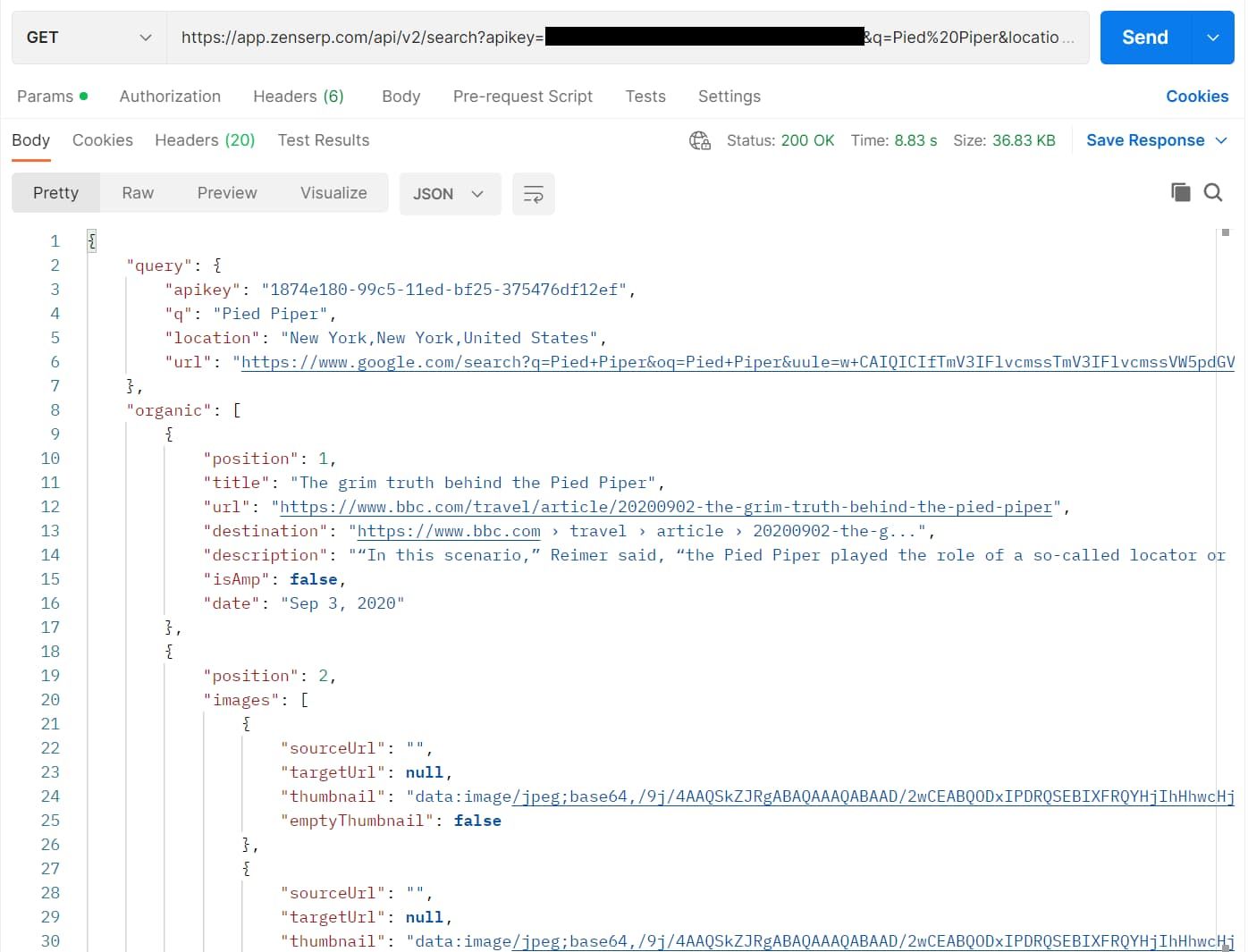
In the competitive market for an analytics SEO API, Zenserp differentiates itself by prioritizing low latency and an exceptionally user-friendly developer experience. It provides a RESTful interface that allows for the extraction of geolocated results across all search types, including images, news, and videos, with a focus on high speed and minimal setup time.
Features of Zenserp
- Ultra-Low Latency: High-speed retrieval of data designed for applications where response time is critical.
- Request Builder Tool: A dashboard feature that generates ready-to-use API code for Python, Java, Node.js, and more.
- Unlimited Concurrency: Most paid plans allow for unlimited simultaneous requests to maximize throughput.
- Geotargeting Parameters: Support for precise country and city-level search result extraction.
- Multiple Data Formats: Returns data in JSON, HTML, and CSV depending on the user’s requirements.
- Knowledge Graph Support: Advanced parsing of images, news, and complex SERP features.
Zenserp is best for
- Digital experts who need a top SEO API that can be integrated into an application in minutes, not days.
- High-speed monitoring apps that require sub-second SERP snapshots for day-trading or event-based keywords.
- Small dev teams that want a generous free tier to build and test proof-of-concept SEO tools.
Pros & cons of Zenserp
Pros:
- Highly scalable infrastructure.
- Intuitive developer dashboard.
- Very cost-effective starting plans.
Cons:
- Advanced analytics (like link history) are not included.
- Documentation is less extensive than enterprise-grade scrapers.
Pricing overview of Zenserp
- Small Plan: $49.99/month for 25,000 searches.
- Medium Plan: $149.99/month for 100,000 searches.
- Large Plan: $299.99/month for 250,000 searches.
- Free Plan: 50 requests per month with no credit card required.
Use Cases of Zenserp
- Live SERP Snapshotting: Capturing and storing the HTML of top-ranking pages to monitor content changes among competitors.
- Geographic SEO Performance Comparison: Comparing organic visibility across ten different countries for a global product launch.
- Keyword Opportunity Discovery: Using the Keyword Search Volume endpoint to programmatically identify high-traffic, low-cost terms.
Bright Data SERP API
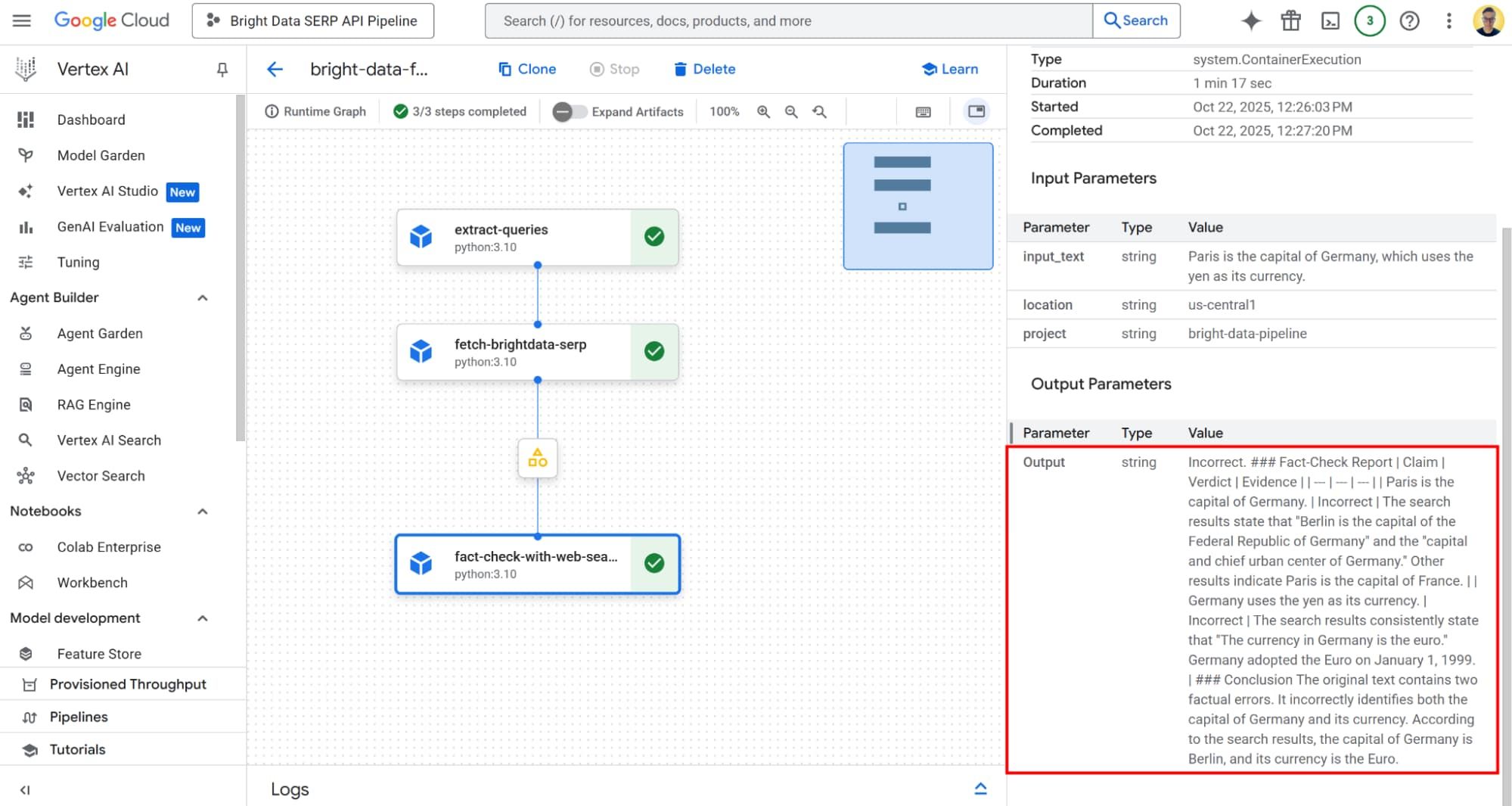
The Bright Data SERP API is widely considered the most robust SEO API services solution for enterprises that require massive scale and absolute reliability. By leveraging a proxy network of over 150 million IPs, Bright Data can bypass almost any anti-scraping wall, achieving an independently verified success rate of over 98% — the highest in the industry.
Features of Bright Data SERP API
- Unmatched IP Network: Access to over 150 million residential, mobile, and datacenter IPs globally.
- Highest Success Rate: 98.44% success rate in independent benchmarks across difficult-to-scrape domains.
- Data Firehose Delivery: Real-time web data streams delivered directly into enterprise data lakes.
- Pre-Built Scrapers: Ready-to-use scrapers for 120+ major websites, requiring zero custom coding.
- SOC 2 and GDPR Compliance: Enterprise-grade security and compliance standards for regulated industries.
- JavaScript Rendering: Native support for scraping single-page applications (SPAs) and heavy dynamic content.
- Flat-Rate Success Pricing: Users only pay for successful requests, with no wasted spend on failed attempts.
Bright Data SERP API is best for
- Large-scale enterprises requiring a top SEO API to feed internal business intelligence or AI training pipelines.
- Organizations in the legal or finance sectors that require fully compliant and auditable data collection.
- Developers who need to build enrichment workflows in tools like Clay or Zapier at a massive scale.
Pros & cons of Bright Data SERP API
Pros:
- Industry-leading success rates.
- Massive scalability.
- Excellent anti-detection technology.
Cons:
- Complex pricing models with high monthly minimums for top-tier support.
- Significant learning curve for non-developers.
Pricing overview of Bright Data SERP API
- Pay-as-you-go: $1.50 per 1,000 requests with no monthly commitment.
- Growth Plan: $499.00/month for 380,000 results ($1.30/1K).
- Enterprise Scale: $1,999.00/month for 2 million results ($1.00/1K).
- Free Trial: Available to test high-volume scraping infrastructure.
Use Cases of Bright Data SERP API
- Market Share Monitoring: Tracking domain-level visibility across 10 million keywords to calculate real-time market dominance.
- E-Commerce Price Intelligence: Scraping search results and product pages across global markets to adjust dynamic pricing.
- LLM Knowledge Base Training: Gathering billions of data points from the web to train custom AI models for specific industry verticals.
Ahrefs SEO Integration API
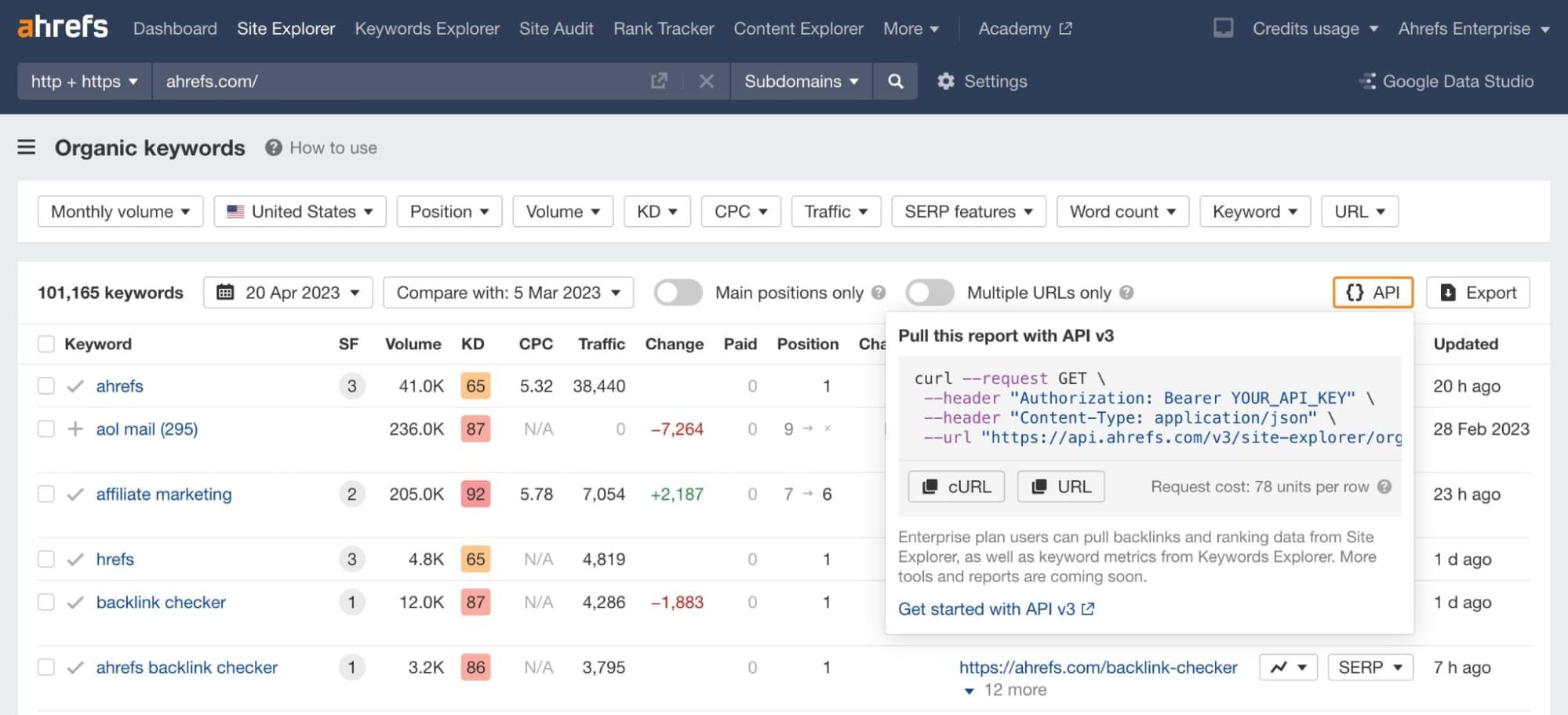
As the most powerful SEO integration API for link intelligence, Ahrefs offers programmatic access to a massive proprietary index that is the industry standard for backlink analysis and technical site depth. It is designed for elite SEO consultants who require real-time link detection and high-depth keyword analytics to drive their strategy.
Features of Ahrefs
- Proprietary V3 API: Modern access to Site Explorer, Keywords Explorer, and technical Audit metrics.
- 15-Minute Link Discovery: The fastest backlink detection in the industry, with new links appearing almost instantly after crawling.
- Brand Radar AI: An advanced brand monitoring tool that tracks citations and visibility within AI-generated search prompts.
- Unique Clicks Metric: Data on how many people actually click a result, accounting for zero-click searches.
- Traffic Potential Metrics: Estimates total potential traffic for a page, including long-tail keyword variations.
- Site Audit Integration: Programmatic access to over 140 technical SEO issue checks with clear prioritization.
Ahrefs is best for
- Backlink specialists who need a SEO analytics API with the deepest and freshest link index available.
- Technical SEO auditors who require API for SEO metrics that include Core Web Vitals and JavaScript rendering at scale.
- Enterprise brands using SEO API automation to track their reputation and AI share of voice via Brand Radar.
Pros & cons of Ahrefs
Pros:
- Highest quality backlink data in the market.
- Unique click and traffic potential metrics.
- Minimalist and extremely fast UI.
Cons:
- API access is locked behind expensive Enterprise plans.
- A strict credit consumption model that can be costly for high-volume users.
Pricing overview of Ahrefs
- Enterprise Plan: $1,499.00/month (billed annually) is the primary gateway for API access.
- Standalone API Add-on: Standard API access can be added for $500.00/month (500,000 rows).
- Credit System: Every request costs a minimum of 50 units, with volume-based scaling.
- Additional Units: Available on the Enterprise plan for users who exceed their included limits.
Use Cases of Ahrefs
- Link Building Campaign Automation: Programmatically identifying high-authority backlink opportunities that competitors have recently acquired.
- Technical Migration Monitoring: Tracking health scores and crawlability in real-time during major website rebuilds via the Site Audit API.
- Brand Equity Tracking: Quantifying the growth of unlinked brand mentions and AI citations to prove PR ROI.
Semrush API for SEO Metrics
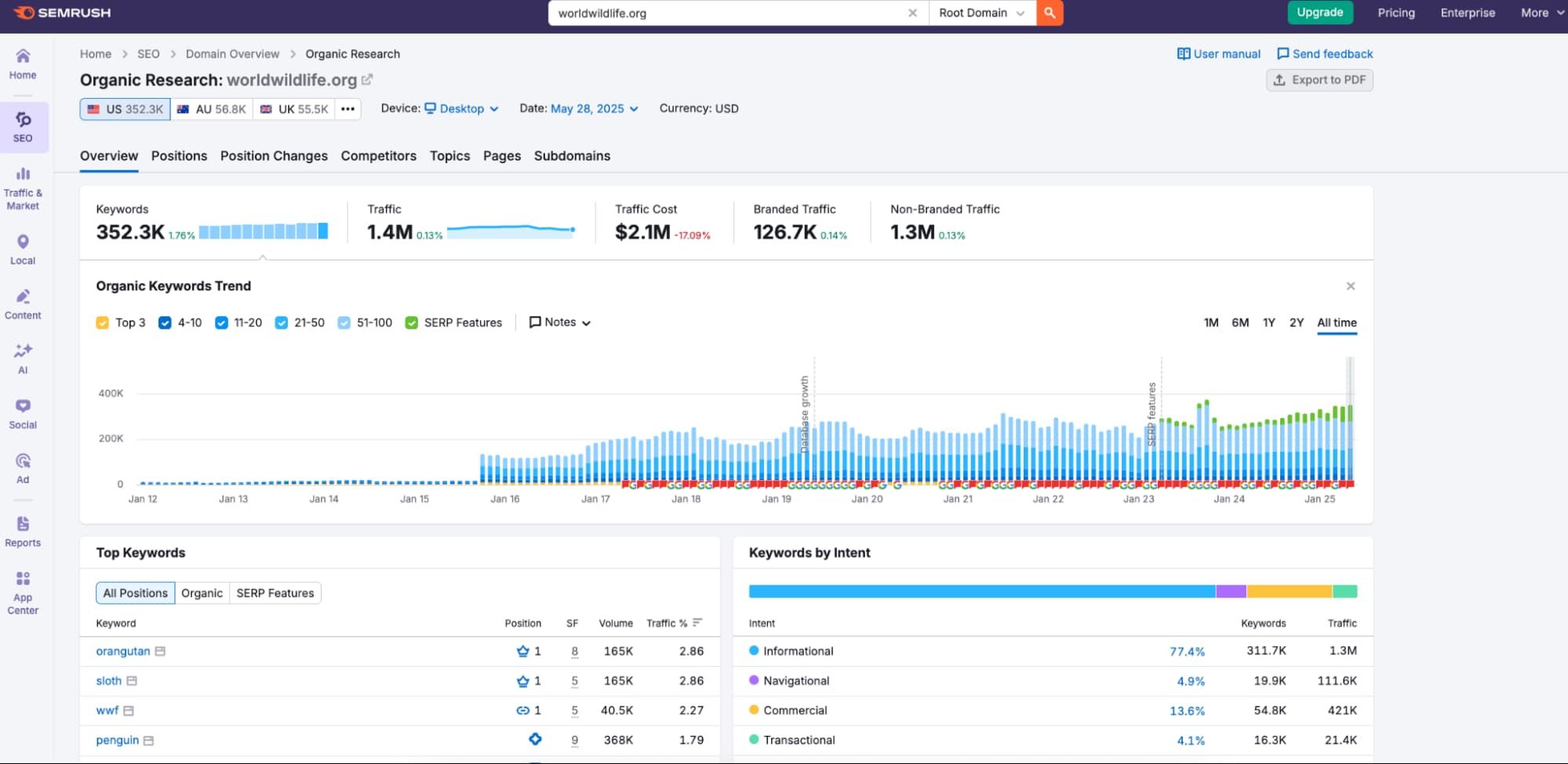
Semrush provides the most expansive API for SEO metrics for teams that require a “one-stop-shop” for SEO, PPC, content marketing, and market research. Its API ecosystem is designed to support high-level strategic decisions by providing a unified data stream for all digital marketing channels.
Features of Semrush API for
- Standard Analytics API: Broad access to domain, organic, keyword, and backlink research reports.
- Trends API: Unique clickstream-based data providing deep insights into website traffic and industry-level benchmarks.
- AI Visibility Toolkit: Benchmarking brand presence in AI-generated search results across platforms like ChatGPT and Gemini.
- Listing Management API: Programmatic tools for managing local business information and Google Maps rankings at scale.
- MCP Server Integration: Securely connect Semrush metrics to AI agents for automated data analysis and strategy generation.
- Historical Data Access: Monthly ranking and backlink data going back as far as 2012 for trend analysis.
Semrush API for is best for
- Multi-channel marketing agencies that need a top SEO API to manage SEO, PPC, and social media data in one place.
- Local SEO specialists who require SEO API automation for managing hundreds of location listings programmatically.
- Large in-house teams that need to correlate search rankings with broad web traffic trends via the Trends API.
Pros & cons of Semrush API for
Pros:
- Most comprehensive all-in-one feature suite.
- Excellent US-based keyword database.
- Mature Looker Studio and BI integrations.
Cons:
- Prohibitive costs for API access (Business plan required).
- Complex credit system can lead to budget overruns.
- Platform can feel overwhelming for new users.
Pricing overview of Semrush API for
- Business Plan: $499.95/month is the minimum tier for standard API access.
- API Unit Costs: 40 units per summary request; 50 units per line of historical data.
- Trends Basic API: Available for $289.00/month as a standalone or add-on.
- Annual Discounts: 17% savings available when paying for the full year upfront.
Use Cases of Semrush API for
- Omnichannel ROI Modeling: Merging organic rankings with PPC cost data to determine the most profitable keywords across channels.
- Generative AI Presence Audits: Using the AI Visibility Toolkit to identify high-performing organic pages that are missing from AI Overviews.
- Enterprise Local Management: Automatically synchronizing business hours and contact info across 200 directories for a national franchise.
Authoritas SEO Metrics API
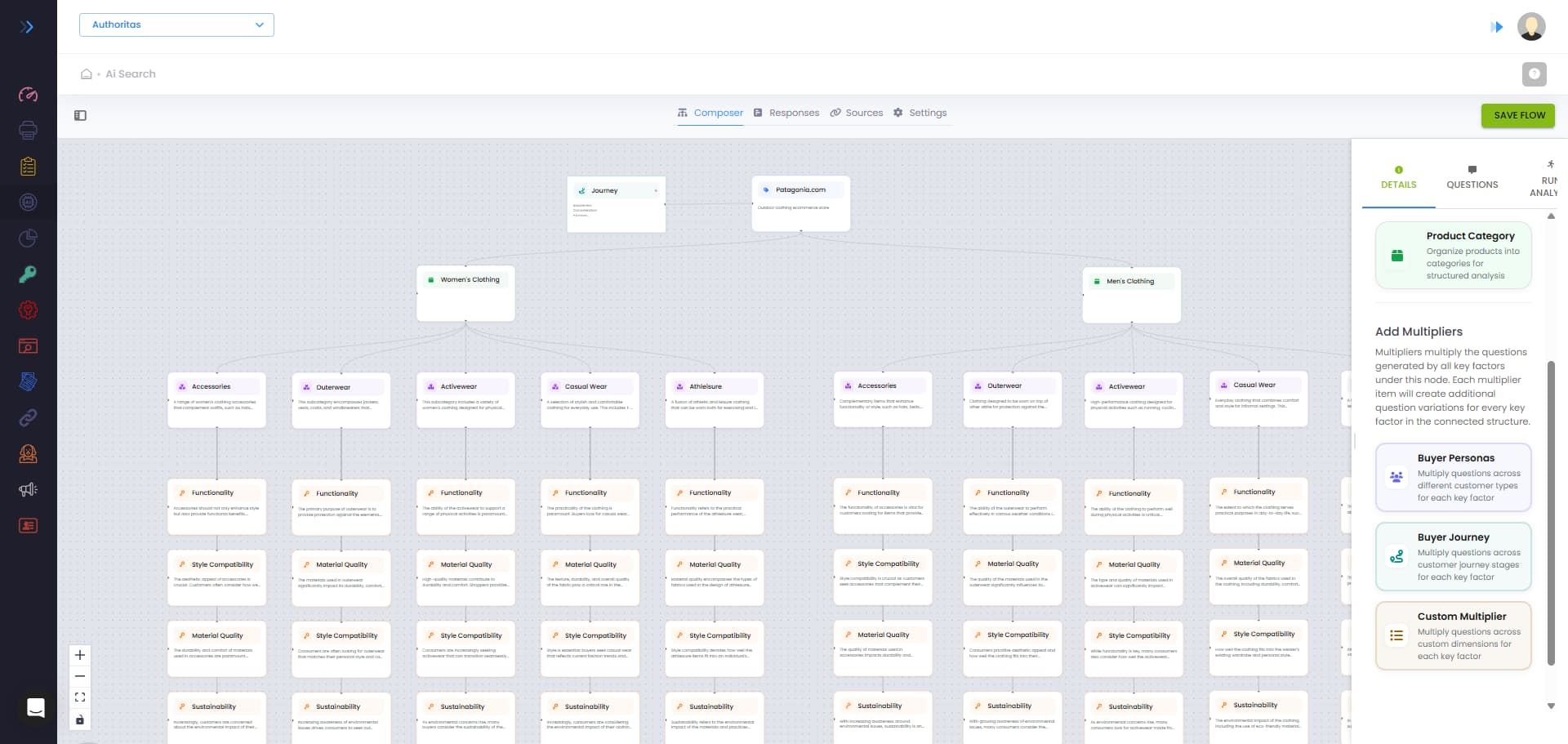
Authoritas offers a premium SEO metrics API designed for data-driven professionals who manage large eCommerce platforms and multinational brands. It prides itself on delivering high-fidelity data through real browser emulation and providing unique insights into the emerging world of generative search.
Features of Authoritas
- AIO Snapshot API: The only solution that programmatically “clicks” to expand Google AI Overviews to capture all internal citations.
- Real Browser Emulation: Uses headless browsers to “type” queries and paginate like humans, ensuring 100% data accuracy.
- Hyperlocal Accuracy: Rank tracking capabilities down to decimal latitude/longitude and ZIP code levels.
- User Intent Scoring: Proprietary algorithm that returns blended intent scores for every keyword (Informational, Transactional, etc.).
- Page Structure API: Deep technical and content analysis of the top 10 ranking pages for any keyword.
- BigQuery & Looker Studio: Native connectors for advanced data warehousing and enterprise-grade reporting.
Authoritas is best for
- eCommerce enterprises that need a SEO analysis API to map user intent to specific category or product page types.
- Global brands managing hundreds of localized sites that require extreme geographic precision in their rank tracking.
- SEO researchers who need programmatic access to the full SERP HTML for deep pattern analysis.
Pros & cons of Authoritas
Pros:
- Most accurate rank data available.
- Unique AI Overview expansion technology.
- Excellent support for custom BigQuery setups.
Cons:
- Expensive for small businesses.
- Keyword database is highly focused on commercial terms rather than informational long-tail.
Pricing overview of Authoritas
- 100K Queries Plan ($399): $0.00399 per query, CPM $3.990.
- 250K Queries Plan ($949): $0.00379 per query, CPM $3.791.
- 500K Queries Plan ($1,809): $0.00360 per query, CPM $3.601.
- 1M Queries Plan ($3,429): $0.00342 per query, CPM $3.421.
- Custom Enterprise Plan (1M+ queries): custom pricing for large-scale API usage.
- Free Key: Offers 1,000 free API credits to test the accuracy of the platform.
Use Cases of Authoritas
- AI Overview Optimization: Identifying which competitors are being cited in SGE results and using the Page Structure API to find their content gaps.
- Global Intent Mapping: Auditing 5,000 keywords across 20 countries to determine how local intent varies for a single product category.
- Hyperlocal Rank Auditing: Verifying local “Near Me” visibility across a network of 1,000 dealership locations.
Majestic Top SEO API
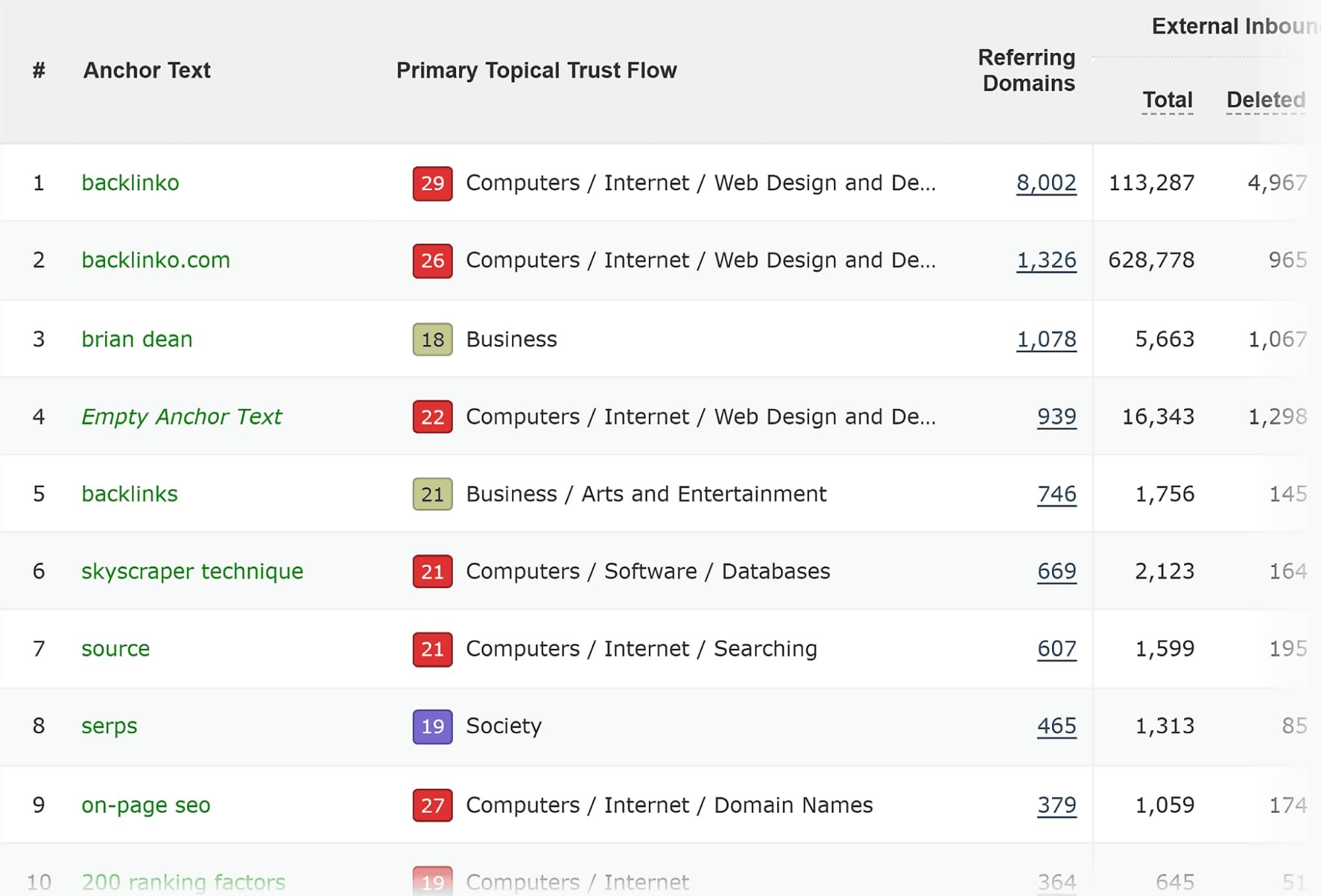
For digital experts who focus exclusively on link intelligence, Majestic remains a top SEO API due to its unmatched historical index and proprietary Trust Flow metrics. It is the foundation for deep backlink analysis, providing an independent map of the web’s interconnections dating back over 19 years.
Features of Majestic Top
- Dual Index Architecture: Fresh Index for daily link monitoring and a Historic Index spanning 19+ years.
- Proprietary Flow Metrics: Trust Flow and Citation Flow scores to assess the quality and influence of any URL.
- Topical Trust Flow: Granular authority scores across 800+ categories to ensure niche relevance.
- Link Graph: Visual and API-accessible representations of how websites are linked in second and third-order relationships.
- Author Explorer: Identifying influential journalists and content authors based on their backlink profiles.
- Clique Hunter: Finding websites that link to your competitors but not yet to your own domain.
- OpenApps Integration: Connecting Majestic data to third-party dashboards and in-house tools.
Majestic Top is best for
- SEO professionals specializing in backlink audits and identifying high-authority outreach targets.
- Domain brokers and investors who require a SEO analytics API to verify the clean history of an expired domain.
- Agencies that want to build custom link-equity tools using a reliable, independent data layer.
Pros & cons of Majestic Top
Pros:
- Deepest historical backlink database in existence.
- Unique Topical Trust Flow metrics.
- Reliable and stable API architecture.
Cons:
- No on-page, keyword, or content tools.
- The user interface feels dated compared to modern all-in-one suites.
Pricing overview of Majestic Top
- API Plan: $399.99/month for 100 million analysis units.
- Pro Plan: $99.99/month for mid-level analysis (no API access).
- Annual Commitment: API plan cost drops to $333.33/month when billed yearly.
- Unit Scaling: Large enterprise plans up to 1 billion units for $1,599.99/month.
Use Cases of Majestic Top
- Niche Authority Auditing: Filtering a list of 10,000 potential partners by Topical Trust Flow to find those with high authority in “Personal Finance”.
- Historical Link Recovery: Identifying lost backlinks that previously provided high authority to a domain and reaching out to restore them.
- Competitor Backlink Modeling: Mapping the link graph of a rival to understand their private blog network or strategic partnership structures.
Conclusion
The selection of a best SEO data API in 2026 is a strategic decision that depends entirely on an organization’s specific technical requirements and the volume of data they intend to process. So:
- For agencies that require a balance of platform-integrated automation and native AI search tracking, SE Ranking stands out as the most versatile and forward-thinking provider, particularly with its official MCP support.
- Developers building massive, custom rank trackers or data science models will find the low-cost, high-scale architecture of DataForSEO to be the most economically efficient path.
- In the enterprise market, Bright Data remains the undisputed leader for high-compliance scraping and infrastructure scalability.
- Authoritas has carved a critical niche for eCommerce and global brands through its advanced AI Overview expansion technology.
- For link builders and technical auditors, Ahrefs and Majestic continue to provide the deepest proprietary indices, though they require a significantly higher financial commitment.
As the search landscape continues to be reshaped by generative AI, the ability to programmatically access high-fidelity, structured search data will be the primary differentiator between successful digital experts and those left behind by the shift to AI-driven discovery.
FAQ
What is the most critical metric for a top SEO API in 2026?
The most critical metric is currently the AIO (AI Overview) Citation Frequency. As traditional search results are pushed “below the fold,” being cited within the AI response layer is the new baseline for organic visibility. Digital experts now look for the best SEO data API providers that can park and parse generative answers specifically. By the way, SE Ranking helps with this task.
How do SEO data API providers handle search engine anti-bot measures?
Most premium SEO data API providers use a combination of residential proxy rotation, browser fingerprinting emulation, and automated CAPTCHA solvers. Infrastructure-heavy providers like Bright Data and SerpAPI manage millions of unique IPs to ensure that scraping requests look like authentic human traffic. They maintain success rates above 95% even on highly protected domains.
Can I integrate these APIs directly with AI agents like Claude or ChatGPT?
Yes, several providers have recently integrated the Model Context Protocol (MCP). For example, SE Ranking offers native MCP support, which allows AI agents to securely pull SEO metrics and traffic data into their reasoning loop without the need for the developer to write custom API wrappers. This is a major breakthrough for SEO API automation in 2026.
