

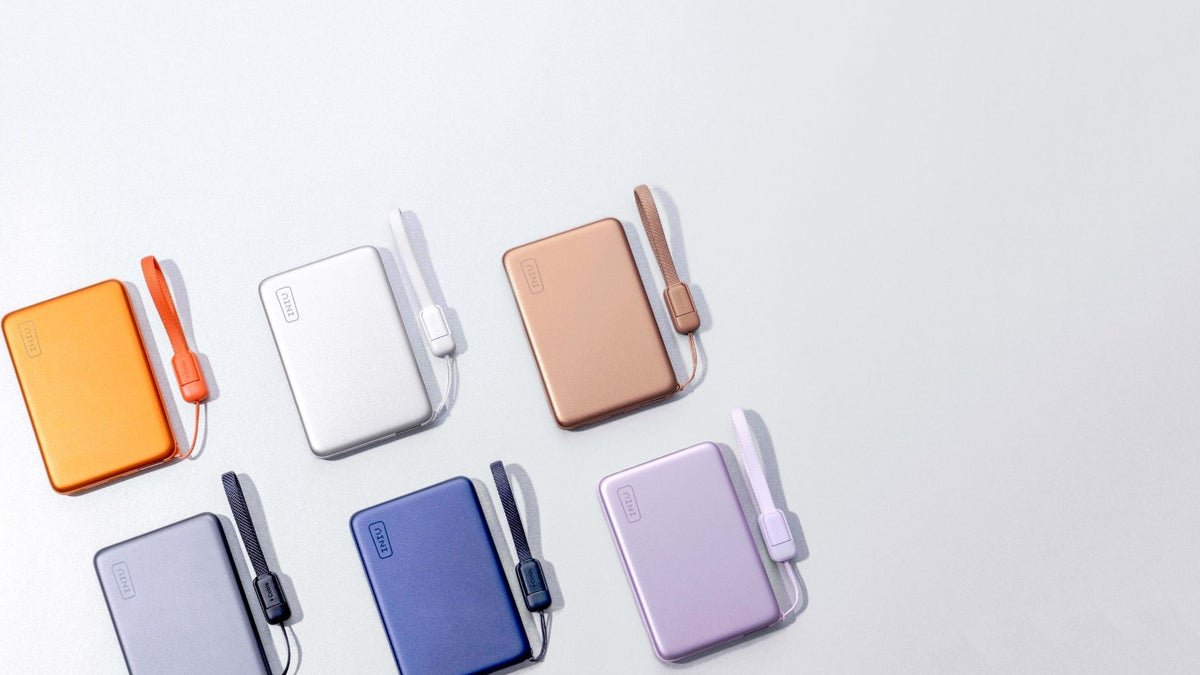
Now, we will take a look at the Iniu SnapGo Air. As the name suggests, it’s a slim magnetic power bank. But, knowing the new generation of Iniu batteries, it’s fair to assume that only scratches the surface. So, let’s dive deeper:
Iniu SnapGo Air: cutting-edge tech in a MagSafe powerbank
The SnapGo Air comes with a 10,000 mAh capacity, yet it’s just 0.5 inches (127 mm) thin and weighs 6.9 oz (196 g).
It supports the Qi2.2 standard, meaning it can charge both the new iPhones and modernized Android phones with 25 W wirelessly. Of course, there’s a 13N magnetic ring inside, so it will safely stick to MagSafe or Qi2 devices.


With a 10,000 mAh capacity, you can wirelessly charge an iPhone Air from 0% to full two times, or an iPhone 17 once to full and once to about 80%.
That’s because wireless charging does burn through more energy, which dissipates into heat. If you have some time to set up, you can use the included braided cable to top up your device more effectively, and faster.
The Iniu SnapGo Air delivers up to 45 W over the USB port, meaning it can even charge up a MacBook Air.
The bank itself takes about 1.8 hours to recharge its 10,000 mAh capacity from 0% to 100%.
Shop Iniu SnapGo Air
Efficient design

Slim, tapered, pretty | Image by Iniu
The SnapGo Air has a pretty-looking anodized aluminum shell that tapers towards the corners. It also comes in a number of fun colors, so you can accessorize with your power bank!
The lanyard you see in the photos is actually a braided USB C cable, which you can click out whenever you need some faster charging action.
There are two USB C power outputs on the bottom of the battery, so you can share, and a small but bright display that gives you the status of the powerbank.
Safety protocols
At the heart of the SnapGo Air, Iniu’s TempGuard 3.0 chip monitors temperature 9,000 times per second to ensure that the battery stays under 104°F (40°C) while charging.
There’s also an 18-layer protection in place, which guards against battery overcharge, short circuits, overcurrent, overheating, undervoltage protection, and low-temperature discharge prevention.
