

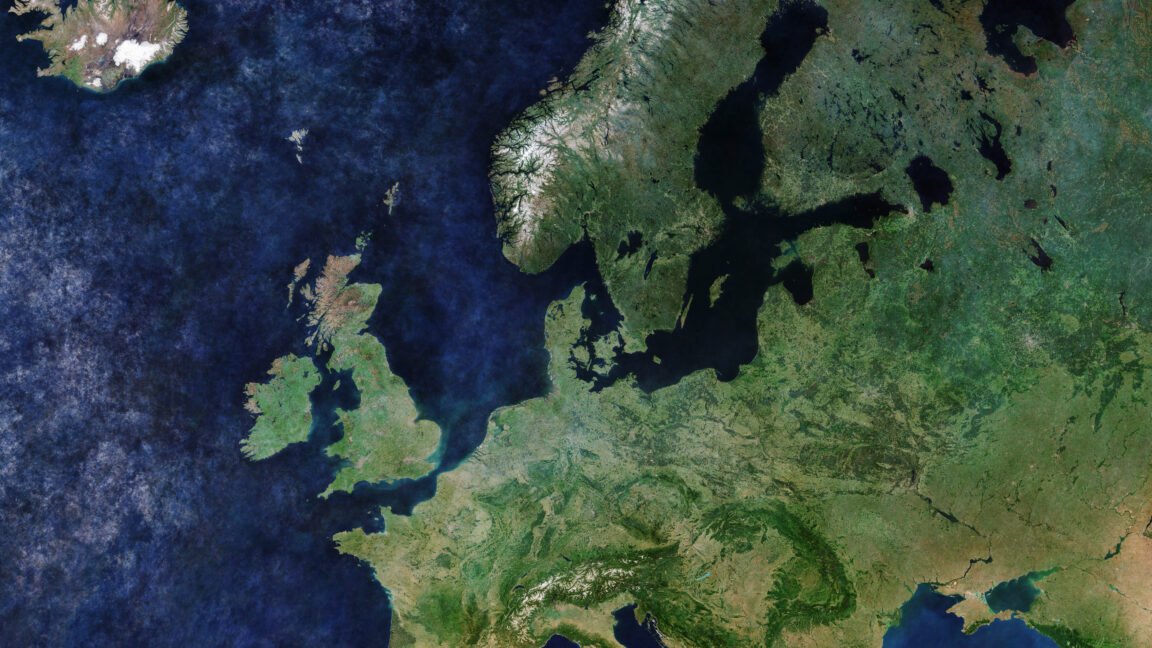
In September 2025, the researchers sought help from the broader community at the Institute of Navigation conference in Baltimore, Maryland, according to Veritasium. Months later, Humphreys received a breakthrough tip about the raw interference signal data having been captured by stations in Amsterdam, Netherlands, and Trondheim, Norway, during an interference event on February 11, 2026.
By examining the difference in timing when that signal arrived at the two different stations, Humphreys and Clements calculated a “quasi-hyperboloid surface”—the term they used in the paper—stretching tens of thousands of kilometers into space where the interference satellite must have been located. As explained by Veritasium, the margin of error represented by the thickness of that surface was only five meters.
A comparison of suspect satellite orbits with the quasi-hyperboloid surface showed that only one satellite’s orbit aligned perfectly—the Russian satellite Kosmos 2546. That discovery, in turn, pointed them to six satellites in the Russian Edinaya Kosmicheskaya Sistema (EKS) constellation, including Kosmos 2546, which are designed to provide early warnings when they detect ballistic missile launches.
Such satellites sit in highly elliptical Molniya orbits extending far above the high latitudes of the Earth that provide long-duration coverage of the northern hemisphere. The analysis by Humphreys, Clements, and Krizise showed that there was at least one such Russian satellite well above the horizon for every single reference ground station during all the GPS interference events.
The uncomfortable why
There is still the open question of why the Russian satellites appear to be periodically engaging in short bursts of targeted GPS interference over Europe—especially because the jamming signal is slightly offset from the usual GPS frequency band.
In the Veritasium video, Humphreys speculated that the Russians may have been testing the satellites’ GPS interference capabilities only briefly on a neighboring frequency adjacent to the typical GPS band. “And then in the eventual future when there is a hot conflict, they go ahead and tune their transmitter down to the GPS band, but it’s much more damaging now that it lies right on that band,” he said.
