

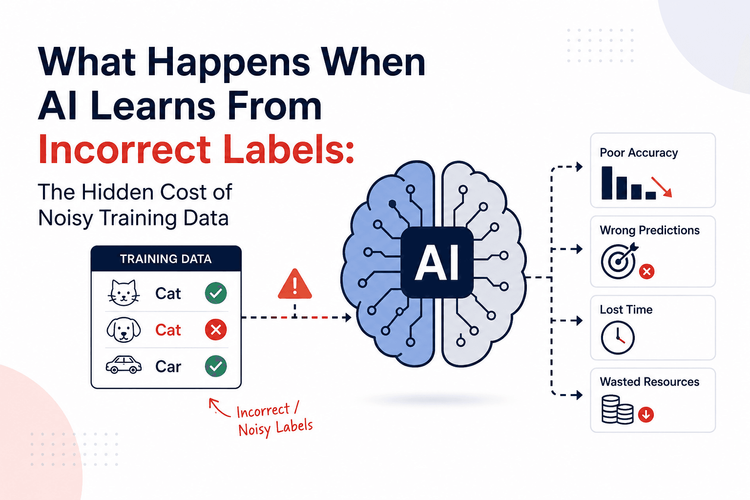
Key Takeaways
- Incorrect labels, also called label noise, cause AI models to learn the wrong patterns, memorize errors, and silently fail in production while still appearing accurate on contaminated test sets.\
- A 2021 MIT study found an average 3.4% label error rate across 10 of the most-cited ML benchmark datasets, including roughly 6% in ImageNet’s validation set and 10.1% in QuickDraw.\
- Structured label errors (consistent, rule-based mistakes) degrade model performance up to 5× more than random label errors, because they create a false “signal” the model learns.\
- Larger, higher-capacity models are more harmed by noisy labels than smaller ones, on a corrected ImageNet, ResNet-18 outperforms ResNet-50 once mislabel prevalence rises by just 6 percentage points.\
- The fix is data-centric, not model-centric: confident learning, cross-validation-based error detection, robust loss functions, and human-in-the-loop relabeling consistently outperform “just train a bigger model.”
TL;DR
When an AI model trains on incorrect labels, it doesn’t just lose a small amount of accuracy, it learns a distorted version of reality. The model memorizes wrong associations, evaluates itself against the same broken ground truth, and ships into production with confident but systematically biased predictions. The damage scales with model capacity (bigger models memorize harder), with error structure (consistent errors hurt more than random ones), and with downstream context (a 3% label error rate in a medical imaging dataset is not the same risk profile as 3% in a meme classifier). This article walks through what’s actually happening inside the model, what the research says about the size of the effect, and how teams detect and recover from label noise without retraining from scratch.
What “Incorrect Labels” Actually Mean
In supervised learning, a label is the ground-truth answer attached to a training example, “this image is a cat,” “this email is spam,” “this transaction is fraudulent.” An incorrect label is any case where that ground-truth tag does not match the true class of the example. In the literature, this is called label noise.
Label noise is not a fringe problem. It enters datasets through several routes:
- Human annotator error — fatigue, distraction, click slips, or genuine ambiguity in the example.\
- Annotator disagreement — two qualified labelers reach different conclusions on the same edge case.\
- Crowdsourcing gaps — non-expert labelers handling specialist content (medical scans, legal clauses, financial documents).\
- Automated extraction errors — OCR misreads, broken regex rules, or weak heuristics in semi-supervised pipelines.\
- Schema drift — the labeling guidelines change mid-project and earlier examples no longer match.\
- Ambiguous ground truth — the example legitimately fits two classes (an image with multiple objects, a sentence with mixed sentiment).
If you’ve ever annotated data yourself or worked through a hands-on dataset project like a primer on machine learning with Python, you’ve felt how quickly judgment calls accumulate. Now imagine that effect across 50,000 samples and 30 annotators.
The Three Types of Label Noise (and Why It Matters Which One You Have)
Not all label errors hurt a model equally. Researchers typically classify label noise into three buckets:
| Type | What it is | Example | Damage profile |
| —————————————– | ———————————————————————————————— | —————————————————————————————— | ———————————————————————————- |
| Random (class-independent) noise | Labels flipped uniformly at random across classes | An annotator occasionally mis-clicks on a labeling tool | Lowest. Tends to average out; well-regularized models can tolerate moderate rates. |
| Class-dependent noise | One specific class is consistently mislabeled, often as another specific class | “Lion” is frequently labeled as “tiger”; positive reviews are labeled as :due to sarcasm | Moderate to high. Creates a directional bias toward the wrong class. |
| Instance-dependent (structured) noise | Errors correlate with specific features of the input (region, lighting, vocabulary, demographic) | Coarse polygon annotations in satellite imagery; a domain term consistently misread by OCR | Severe. Creates a learnable “false signal” the model latches onto. |
A widely cited 2017 remote-sensing study compared random mislabeling with geospatial mislabeling (a structured form caused by coarse polygon boundaries that included undamaged sidewalk pixels as “rubble”). The structured errors degraded classification performance roughly five times more than random errors at the same overall noise rate. The takeaway is uncomfortable: the rate of label errors tells you less than the pattern of label errors.
What Actually Happens Inside the Model
Once incorrect labels enter the training loop, four things go wrong, usually simultaneously.
1. The Model Memorizes the Noise
Modern deep networks have enough capacity to fit almost any labeling, including random noise. During training, the loss function pushes the model to match the labels it’s given. If 8% of those labels are wrong, the model dutifully learns the wrong answer for 8% of the input space. This is memorization, not generalization, and it shows up later as confident but incorrect predictions on real-world data.
2. Decision Boundaries Get Pulled Out of Place
Imagine a clean separation between two classes. Drop a handful of incorrectly labeled points across the boundary, and gradient descent slightly bends the decision surface to accommodate them. With class-dependent or instance-dependent noise, the bend is consistent; the boundary doesn’t just get fuzzier, it drifts in a specific direction. Predictions near that region become systematically biased.
3. Evaluation Becomes Unreliable
Here’s the part that bites teams hardest in production. If your test set also contains label errors, and the MIT/CSAIL research shows this is the norm, not the exception, then your reported accuracy isn’t measuring what you think it’s measuring. A model that secretly learned to ignore certain edge cases may score higher on the noisy test set than a model that learned the true distribution. You ship the worst model and don’t find out until customers complain.
4. Larger Models Are Penalized More
This is counterintuitive. The MIT study found that when ImageNet labels were corrected, ResNet-18 outperformed ResNet-50 once the prevalence of originally mislabeled examples increased by just 6 percentage points. The same effect appeared on CIFAR-10: VGG-11 beat VGG-19 after a 5-point swing. Bigger models have more capacity to memorize noise, so they overfit to label errors more aggressively. The widespread industry assumption that “more parameters always help” breaks down badly in noisy-label regimes.
A Picture of the Damage: Label Noise vs. Model Accuracy
The relationship between label noise rate and model accuracy is roughly linear in the moderate range and accelerates as noise grows. The exact numbers vary by task and architecture, but published benchmarks consistently show patterns like this:
Test Accuracy (%) on CIFAR-10-style classification\
100 ┤■■■■■■■■■■■■■■■■■■■■■■■■■■■■■■ (0% noise: ~95%)\
95 ┤■■■■■■■■■■■■■■■■■■■■■■■■■■■■ (5% noise: ~92%)\
90 ┤■■■■■■■■■■■■■■■■■■■■■■■■■ (10% noise: ~88%)\
85 ┤■■■■■■■■■■■■■■■■■■■■■■ (20% noise: ~82%)\
75 ┤■■■■■■■■■■■■■■■■■■ (30% noise: ~74%)\
60 ┤■■■■■■■■■■■■■ (40% noise: ~62%)\
40 ┤■■■■■■■■ (70% noise: ~40%)\
└────────────────────────────────\
0% 10% 20% 30% 40% 70% Label noise rate\
The headline number, “we lost X percentage points of accuracy,” is the least important part. The damaging part is what isn’t visible: the model now has systematic blind spots correlated with whichever subgroups, regions, or input patterns the labelers got wrong.
The Real-World Evidence: ImageNet, MNIST, and the Benchmarks Everyone Trusted
In 2021, a team from MIT’s Computer Science and Artificial Intelligence Lab (CSAIL) audited the test sets of 10 of the most-cited ML benchmarks using a technique called confident learning. Their findings reshaped what the field believed about its own ground truth.
| Dataset | Domain | Estimated test-set label error rate |
| ————– | ——————– | ———————————– |
| MNIST | Handwritten digits | ~0.15% (15 errors in 10k) |
| ImageNet | Image classification | ~5.8% – 6.0% |
| CIFAR-10 | Image classification | ~5.85% |
| CIFAR-100 | Image classification | ~5.85% |
| QuickDraw | Hand drawings | ~10.12% |
| Amazon Reviews | Text sentiment | ~4% (~390,000 errors) |
| 20news | Text classification | ~1.1% |
| IMDb | Movie reviews | ~2.9% |
| AudioSet | Audio events | ~1.4% |
Across all 10 datasets, the average error rate was approximately 3.4%. These are the datasets that the entire field has used to declare one architecture better than another for the last decade. The same study showed that benchmark rankings can flip once labels are corrected, meaning some “state-of-the-art” results were partly artifacts of which models happened to over-fit to the same errors as the test set.
If the gold-standard public datasets carry this much noise, the realistic floor for a custom enterprise dataset built under deadline pressure is meaningfully higher.
The Cascade Effect: How One Bad Label Spreads Through a Modern AI Stack
In a single classification model, label noise is bad. In a modern AI stack, it’s worse because the errors propagate.
- Bad labels train a base model that learns the wrong associations.\
- The base model is used to auto-label more data (semi-supervised, weak supervision, or active learning loops). The errors multiply.\
- That auto-labeled data trains a larger model or fine-tunes a foundation model, baking the original mistakes into the new weights.\
- The fine-tuned model becomes the retriever, ranker, or generator in a RAG pipeline or agent system, where its biased outputs become someone else’s input.\
- Outputs from step 4 are logged and used for the next training cycle, completing the feedback loop.
This is why teams investing in production AI are increasingly treating labeling as a research problem in its own right. Modern approaches to data labeling now combine automated extraction, semantic linking, and consistency checks rather than relying on raw human annotation. See, for example, this overview of automated document labeling using semantic knowledge graphs, which illustrates how the labeling layer is shifting from manual tagging toward structured, traceable pipelines.
The cascade also explains why LLM-era datasets are especially vulnerable. When you generate training pairs from PDFs or web content using another LLM, a pattern covered in detail in SitePoint’s guide on building a JSON training dataset from PDF documents without manual annotation, every error in the generator silently becomes a “labeled” example in the downstream dataset unless you put real validation between the two steps.
How Teams Detect Label Noise in Practice
You can’t fix what you can’t see. The good news is that detection tooling has matured significantly. The main techniques, ranked roughly by sophistication:
| Method | How it works | When to use it |
| ————————————— | —————————————————————————————————- | ———————————————————————- |
| Manual spot-checking | Sample N examples per class, re-review | Always — as a baseline sanity check on every new dataset |
| Inter-annotator agreement | Compute Cohen’s kappa or Fleiss’ kappa across labelers | When you have multi-annotator data; flags ambiguous classes |
| Cross-validation disagreement | Train k folds, flag examples the model consistently disagrees with | When you have enough data to train a reasonable model |
| Confident learning (e.g., cleanlab) | Estimate the joint distribution of noisy vs. true labels using out-of-sample predicted probabilities | When you want a principled, reproducible detection pipeline |
| Loss-based filtering | Track per-example loss during training; persistently high-loss examples are candidate errors | When you need a lightweight, in-training signal |
| Embedding-based outlier detection | Cluster examples in embedding space; outliers within a class are candidate errors | When you have good pre-trained embeddings (which is now most projects) |
Confident learning, formalized in the cleanlab package, has become a near-default in serious data audits. The technique works by training a model with cross-validation, comparing each example’s given label to its self-predicted probability distribution, and ranking examples by likelihood of being mislabeled. On the original ImageNet dataset, it surfaced more than 100,000 candidate label issues, roughly 6% of the validation set, that human reviewers later confirmed.
How Teams Recover From Label Noise
Once you’ve found the errors, you have four realistic options. Most teams use a combination.
1. Relabel the Problem Examples
The most direct fix. Identify the suspect examples, route them to your most experienced annotators (or a domain expert), and replace the labels. Active label cleaning prioritizes examples by estimated label correctness × labeling difficulty, so you spend the expensive review time where it actually moves the needle.
2. Remove the Worst Examples
If relabeling is too expensive, dropping the highest-confidence label errors is often better than keeping them. Counter-intuitively, training on a smaller clean dataset usually beats training on a larger noisy one, provided the removed examples were actually wrong, not just hard.
3. Use Robust Loss Functions
Standard cross-entropy is highly sensitive to noisy labels because it punishes the model heavily for getting outliers wrong. Robust alternatives, such as symmetric cross-entropy, generalized cross-entropy, bootstrapping loss, or label smoothing, reduce the penalty for examples the model strongly disagrees with, on the assumption that those are the ones most likely to be mislabeled.
4. Train Smaller or Regularize Harder
Given the finding that smaller models often outperform larger ones on noisy data, sometimes the right answer is simply: don’t scale up until you’ve cleaned the labels. Stronger regularization (dropout, weight decay, early stopping, mixup) also reduces memorization of noise.
A simple practical rule of thumb: clean before you scale. Doubling your dataset size cannot undo a 5% structured-error rate. Cutting that error rate in half almost always outperforms doubling the data.
Why This Matters More in 2026 Than It Did in 2020
Three shifts have made label quality a first-order concern, not a nice-to-have.
- Models got bigger. As shown by the MIT findings, model capacity amplifies label noise. The same dataset that produced an acceptable ResNet-18 will produce a worse ResNet-200.\
- Pipelines got longer. LLM-generated training data, synthetic labels, and multi-stage fine-tuning create cascades that compound small errors into large ones.\
- The stakes got higher. A mislabeled meme is a curiosity. A mislabeled chest X-ray, mortgage application, or autonomous-driving scene is a different kind of problem. Domains where labels carry real-world consequences, such as medical, financial, legal, and safety-critical, cannot tolerate the 3–10% noise floors that public benchmarks tolerate.
The same principles also apply to specialized models like the PHP sentiment-analysis classifier walkthrough on SitePoint, a binary sentiment task with a noisy training set will quietly inherit the labelers’ blind spots (sarcasm, mixed sentiment, sector-specific slang) and reproduce them at scale in production.
Frequently Asked Questions
What is label noise in machine learning?
Label noise is any case where the ground-truth tag attached to a training example does not match the example’s true class. It can be random (uniform mistakes), class-dependent (one class systematically confused with another), or instance-dependent (errors correlated with specific input features). Instance-dependent noise causes the most damage.
Can AI models learn correctly despite some incorrect labels?
Yes, up to a point. With small amounts of random noise (under ~5%) and strong regularization, well-designed models recover most of their accuracy. The danger zone is structured noise; even small amounts of consistent, pattern-based label errors create a false signal that the model learns as if it were real.
How much label noise is too much?
There’s no universal threshold, but useful rules of thumb: under 1% is usually safe; 1–5% is common in real datasets and manageable with robust training; 5–10% requires active mitigation; above 10%, you should treat the dataset as broken and prioritize cleaning over modeling.
Does training on a bigger model fix label noise problems?
No, it usually makes them worse. Higher-capacity models memorize noisy labels more aggressively. Research shows that on noisy benchmarks, smaller models often outperform larger ones once mislabel rates rise even modestly.
What’s the difference between label noise and data drift?
Label noise is incorrectness in your training labels; the answers were wrong when you taught the model. Data drift is a change in the input distribution after deployment, and the real world has shifted away from what you trained on. They require different fixes: label noise is solved by data cleaning; drift is solved by monitoring and retraining.
How do tools like CleanLab actually find label errors?
Cleanlab uses confident learning. It trains a model with cross-validation to get out-of-sample probability predictions for every training example, then compares each example’s assigned label to its predicted class distribution. Examples where the model strongly disagrees with the label, especially with high confidence in a different class, are flagged as candidate errors for human review.
Is synthetic or LLM-generated training data a way to avoid labeling errors?
Partially. LLM-generated labels can dramatically reduce cost and time, but they inherit the generator model’s blind spots. The current best practice is to use LLM generation for the first pass and human review (or confident-learning audits) for the second, not to skip validation entirely.
Conclusion
Incorrect labels are not a minor annoyance to be averaged out by enough training data. They are a structural problem that distorts what a model learns, biases how it evaluates itself, and propagates through every downstream system that consumes its output. The research is unusually consistent on this point across a decade of studies: the rate of label errors in mainstream datasets is higher than the field assumed, the damage scales with model capacity rather than against it, and the most reliable path to better models is not more parameters but cleaner labels.
For practical teams, the implication is straightforward. Before the next training run, audit a sample of your labels. Before scaling up your model, scale up your label quality process. And before trusting a benchmark, public or internal, ask what its own error rate is. The model is only as honest as the labels you give it.
