

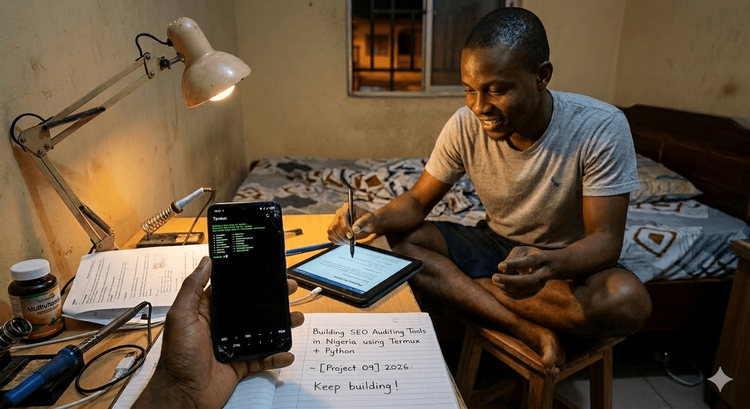
If you’re unfamiliar, Termux is a terminal emulator that turns a mobile device into a Linux environment. It’s where I’ve spent the last few years mastering Python, building web scrapers, and **deploying SEO auditing **tools—all on a screen small enough to fit in my pocket.
Most developers imagine their journey starting with a high-end MacBook, a dual-monitor setup, and a stable fiber-optic connection. For me, the reality was a bit different. My “office” is a single room in Nigeria, and my “workstation” is an Android smartphone running Termux.
Why I Chose the “Hard Way”
Building on a phone isn’t about preference; it’s about persistence. When power outages are frequent and data costs are high, you learn to be efficient. You don’t waste time on heavy IDEs. You learn the command line. You learn how to write code that must work because you don’t have the luxury of endless debugging sessions.
The Project: NeuraCore & Beyond
Recently, I pushed a project called auto-agent to my GitHub. It’s a tool designed to automate complex diagnostic tasks. Writing a repository like that in a mobile terminal requires a different kind of focus. Every line of Python I write is a step toward proving that your hardware doesn’t define your potential—your logic does.
A Message to My Fellow Builders
To the developers in Lagos, Nairobi, or anywhere else working with limited resources: Keep building. We live in an era where the barriers to entry are falling. You don’t need a $2,000 laptop to understand how a neural network functions or how to audit a website’s SEO. You just need a terminal, a bit of curiosity, and the willingness to work through the late-night power cuts.
My journeyis far from over, but with every git push, I’m reminding myself (and hopefully you) that the code doesn’t care if it was typed on a mechanical keyboard or a cracked touchscreen. It only cares that it works.
